August 3, 2026
Why Don’t Solar Eclipses Occur Every Month? 2026 Guide
Solar eclipses don't happen every month because the Moon's orbit is tilted about 5 degrees relative to Earth's orbit around the Sun, so most new moons the Moon's shadow misses Earth entirely. The timing only works during about two eclipse seasons per year when the geometry lines up, which is why the August 2026 eclipse feels so special.
If you're already thinking about 12 August 2026, you're not alone. Across Europe, people are planning around the path through Iceland and northern Spain, checking west-facing horizons, and trying to figure out whether a deep partial view is enough or whether they need to reach totality. The short answer is that the sky is doing something beautifully precise, and the reason it doesn't happen monthly is the same reason the 2026 eclipse will be so memorable.
Table of Contents
- The August 2026 Eclipse and the Question on Everyone's Mind
- Why the Moon's Shadow Usually Misses Earth Completely
- Lunar Nodes and the Two-Window Rule for Eclipses
- Total versus Annular Eclipses and What Distance Really Means
- How Many Eclipses Occur Each Year and Why the Count Varies
- Planning for the 12 August 2026 Eclipse in Europe
The August 2026 Eclipse and the Question on Everyone's Mind
On the evening of 12 August 2026, the Moon's shadow will sweep across Iceland and northern Spain, and for a brief stretch of time the Sun will vanish into daytime darkness. That's why so many people are already studying routes, weather, and horizons for the first total solar eclipse over mainland Europe since 1999.
The scene is easy to understand emotionally and hard to ignore scientifically. A bright summer sky, then a sudden dimming, then the solar corona appearing where the Sun used to be. For Europe, this is one of those rare moments when astronomy stops being abstract and becomes something you can stand under.
The question underneath all the travel planning is simple. If the Moon moves between Earth and the Sun roughly every 29.5 days, why isn't there a solar eclipse every month? The answer lives in the geometry of the Moon's orbit, and once that geometry clicks, the 2026 eclipse starts to make much more sense.
Practical rule: the drama of an eclipse isn't just about the Moon being new, it's about the Moon being new and lined up with the right part of its orbit.
A good place to start is the path of totality itself, because the map already tells the story of precision and scarcity, especially for observers tracking the 2026 track across Europe.
Why the Moon's Shadow Usually Misses Earth Completely
The tilted orbit that changes everything
A solar eclipse needs a new moon, but a new moon alone is not enough. The Moon's orbit is tilted by about 5 degrees relative to the Earth-Sun plane, so in most months the Moon passes a little above or a little below the Sun from our point of view, and its shadow misses Earth. NASA explains this geometry clearly, and it is the key idea that turns a confusing monthly expectation into a predictable pattern of rarity.[^1]
A basketball hoop tilted slightly off level illustrates the point well. If your shot is only a little off, the ball still drops through sometimes, but more often it clips the rim or misses wide. The Moon's path works the same way in the sky, except the miss means the shadow cone never reaches our planet at all.
The Moon's orbit is more like a tilted hula hoop than a flat ring. That tilt is why new moon does not automatically mean eclipse. It tells you the Moon is roughly between Earth and the Sun, but it does not tell you whether the Moon is crossing the same plane that Earth occupies around the Sun. Eclipse geometry needs both pieces to line up.
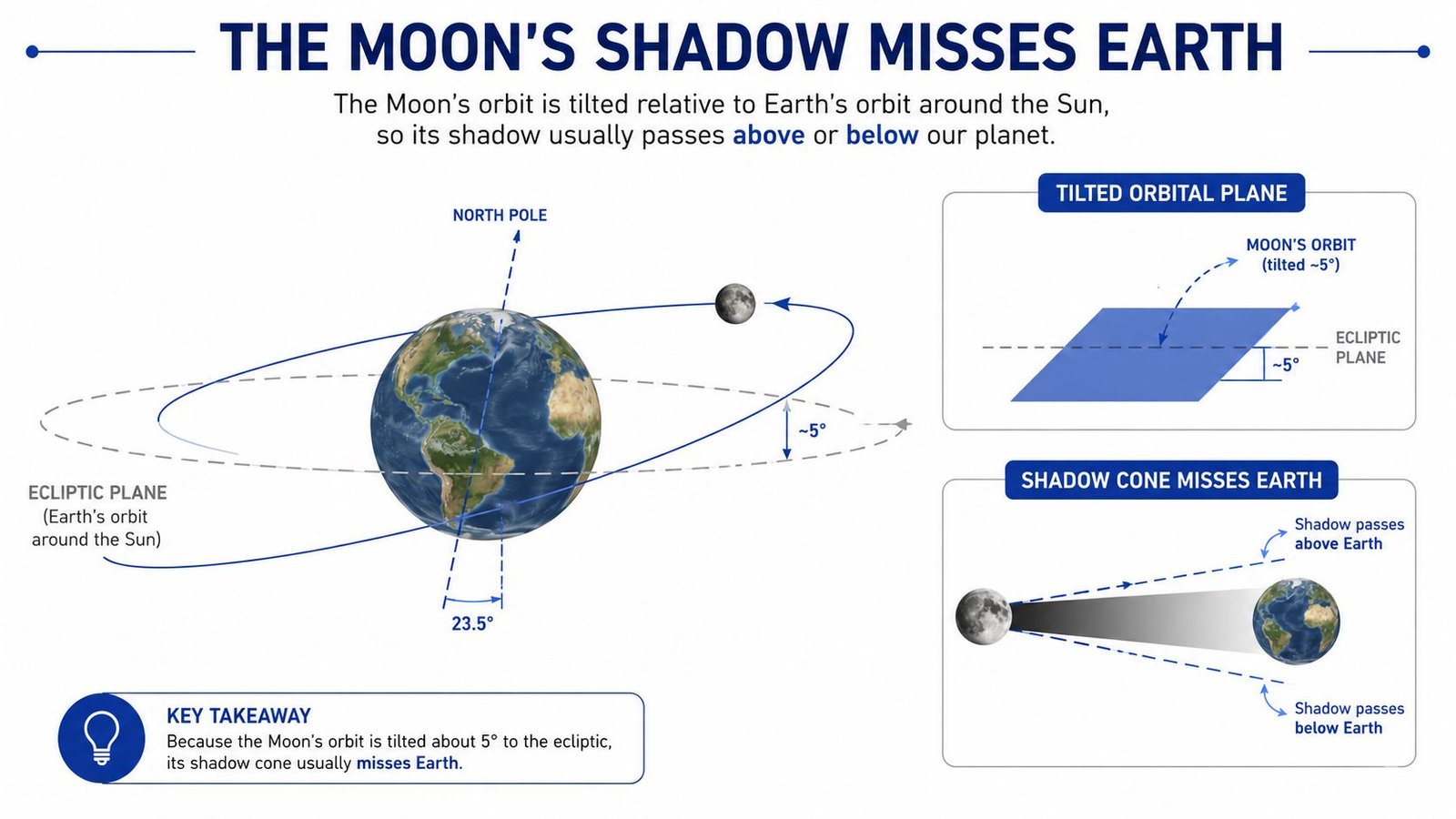
The simplest way to remember it is this, new moon is necessary, but not enough.
NASA's explanation of the monthly miss also connects to the everyday version of the question, why eclipses aren't a monthly event. The phase cycle is easy to picture, but the orbital tilt is harder to visualize, so this is usually the step that clears up the confusion.
Why the tilt matters in real life
Once you internalize the 5-degree tilt, the sky stops feeling random. At most new moons, the Moon's shadow passes harmlessly above or below Earth, so there is nothing to see except an ordinary dark Moon near the Sun. The monthly cycle keeps happening, but the eclipse does not.
That same tilt is why eclipse chasers care so much about geometry and location. A new moon exists for everyone on Earth at once, but eclipse visibility is local. Where you stand, the angle you view from, and whether your horizon is clear all matter because the shadow itself is narrow and precisely aimed.
The plain-language version is reassuring. The Moon does not miss the Sun by accident, it misses most months because its orbit is not laid flat like a dinner plate. That tiny tilt makes all the difference between ordinary new moons and the handful that become eclipses, which is why the geometry behind the August 2026 event matters so much for anyone planning to watch from Iceland or Spain.
For a straightforward overview of the basic solar and lunar setup, the clearest follow-up is this explanation of how eclipses work in the first place.
Lunar Nodes and the Two-Window Rule for Eclipses
Why eclipse seasons come in windows
The tilted orbit is only the first layer. The Moon's path crosses the ecliptic at two points called nodes, and those nodes are where eclipse geometry can happen. If a new moon arrives far from a node, the shadow misses Earth in the needed way, even though the phase itself is correct.
That creates the two-condition rule. The Moon has to be at new moon, and it has to be near one of its nodes. Miss either condition and there is no solar eclipse, which is why eclipses cluster into seasonal windows instead of appearing every month.
NASA explains that this node-crossing geometry produces roughly two eclipse seasons per year, when the Sun lines up with the Moon's orbital nodes and an eclipse becomes possible.[^1] That is the window idea in plain English. The door opens, but only for a limited stretch of time.
The nodal precession of the Moon's orbit makes the line of nodes slowly shift over time, so eclipse seasons drift rather than repeating on a neat monthly schedule.[^2] That slow drift is one reason eclipse calendars never feel as tidy as moon-phase calendars.
Eclipse seasons arrive like scheduled windows. The Moon can pass through its monthly cycle again and again, but the opening only lines up with Earth's shadow path at certain times. When those times arrive, observers get a cluster of eclipse possibilities.
The seasonal pattern readers usually miss
The seasonal timing is why some years feel richer than others for eclipse watchers. During an eclipse season, more than one eclipse can be possible if the lunar phase timing fits the narrow window. Outside that window, the same new moon leaves nothing visible from the solar-eclipse perspective.
Practical takeaway: a solar eclipse requires both the right moon phase and the right geometry.
That point becomes very concrete for the 2026 eclipse. August is not special on its own. The event matters because the alignment falls inside the right eclipse season and along the right track, which is why readers in Europe, especially those planning for Iceland or Spain, care so much about where they stand.
For a concise look at the node-based timing logic, the most relevant background is NASA's eclipse season overview.
Total versus Annular Eclipses and What Distance Really Means
Why distance decides what you see
Even when the Moon is in the right phase and near a node, the eclipse type can still differ. Some eclipses are total, where the Moon completely covers the Sun's disk. Others are annular, where the Moon looks a little smaller and leaves a bright ring of sunlight around the edge.
The reason is the Moon's elliptical orbit. Its distance from Earth changes, so its apparent size in the sky changes too. When the Moon is close enough, it can cover the Sun fully. When it's farther away, it can't quite do the job, even if the alignment is otherwise excellent.
That's the nuance many mainstream explanations leave out. A new moon in an eclipse season doesn't guarantee totality for a given place, because the distance factor can reduce the eclipse to a partial event or prevent totality at that location.[^3] Geometry has to cooperate on more than one level.
| Eclipse type | What you see | Why it happens |
|---|---|---|
| Total | The Sun is fully covered and the corona becomes visible | The Moon appears large enough in the sky |
| Annular | A bright ring remains around the Moon | The Moon appears slightly smaller than the Sun |
That comparison matters because the emotional experience is different. Totality changes the sky, the temperature, and the light. Annularity is striking, but it doesn't replace the full blackout effect that makes eclipse day unforgettable.
Why the 2026 event matters for Europe
The August 2026 eclipse is total in the places that fall inside the correct geometry and distance conditions, which is why Iceland and parts of Spain are drawing so much attention. For travelers, the distinction isn't academic. Being inside totality is the difference between a dramatic sky event and a partially covered Sun.
The practical lesson is to treat location like a scientific variable, not just a travel preference. If you're outside the path, you'll see a partial eclipse. If you're inside it, and the weather cooperates, you get the rare full experience.
Watch the distance, not just the date. Two observers can stand only a short distance apart and still have very different eclipse experiences.
If you want a side-by-side explanation of total and annular appearance, this comparison of solar-eclipse types is the best source to revisit while planning.
How Many Eclipses Occur Each Year and Why the Count Varies
The global count versus your local sky
If you watch the sky for long enough, you learn a simple truth. Solar eclipses are always happening somewhere on Earth, but the yearly count changes because the Moon's orbit, the timing of new moon, and the geometry of eclipse seasons never fall into a perfect monthly rhythm. NASA's geometry explanation notes two eclipse seasons per year, which is why eclipses are common in the planet-wide sense even though they remain rare for any one observer.[^1]
A season can produce one eclipse or more than one, depending on where the new moons land inside that window. The sky does not arrange events around human calendars. It gives you a repeating pattern, then leaves the exact outcome to orbital timing.
That global-versus-local split is where much of the confusion starts. People hear that eclipses happen “somewhere” and assume that should translate into regular visibility from home. In practice, a total eclipse for one city can be the kind of event people wait their whole lives to see, while the Earth as a whole continues producing eclipses at a steady, but not monthly, pace.
| Scale | What matters | What it feels like |
|---|---|---|
| Global | Eclipse seasons and lunar alignment | Eclipses happen regularly somewhere |
| Local | Path of totality and horizon conditions | Totality can feel extremely rare |
The rhythm is predictable even when your own view is not. That is why eclipse maps matter so much. They turn orbital mechanics into a route you can plan for, especially if you are trying to decide whether to travel for the 12 August 2026 event in Europe.
Why repeating geometry still doesn't mean repeated visibility
Astronomers use long-term patterns to predict eclipses far into the future, including the repeating geometry described in the saros cycle explanation, but those patterns do not make any one place lucky every month. The same broad alignment comes back, yet the shadow track shifts, the season timing drifts, and the viewing conditions change from eclipse to eclipse.
That is why the 12 August 2026 eclipse stands out for Europe. It brings a continental audience close to a narrow corridor of totality, which makes the experience feel very different from a routine partial eclipse seen from afar. For travelers, the lesson is clear, the date matters, but the location of the shadow matters more.
A small change in position can decide whether you see a partial Sun or the brief darkness of totality. That is the part of eclipse planning people feel on the ground, not just in the math.
Planning for the 12 August 2026 Eclipse in Europe
The path of totality crosses Iceland and northern Spain, and the Spanish track happens close to sunset, so a low western horizon is essential. In that part of Europe, the sky geometry is not forgiving. Terrain, buildings, haze, and coastline orientation can make the difference between a clean view and a blocked one.
The most important planning mistake is treating a deep partial eclipse like a substitute for totality. Near 98 to 99 percent coverage, the Sun still isn't fully covered, so the visual and atmospheric experience is not the same as being inside the path. That's true even when the eclipse looks dramatic on paper.
Safe viewing remains essential during every partial phase. Use ISO 12312-2 eclipse glasses whenever the Sun is not fully covered, and keep solar filters on cameras and telescopes during partial phases too. Only during totality can specialized exposure settings replace those filters, and only for the short interval when the Sun is completely blocked.
Viewing priorities for Europe
- Choose the path first: If you want totality, pick a site inside the path rather than chasing a better-looking partial view.
- Protect a western horizon: In Spain, sunset timing makes an unobstructed western view especially important.
- Use certified eye protection: ISO 12312-2 glasses are for all partial phases, not just the early ones.
- Prepare for mobility: Weather can change quickly, so a flexible plan helps if clouds move in.
- Book early: Holiday-season demand can tighten lodging options in both Spain and Iceland.
A table makes the decision clearer for city planning, even before you commit to one exact observing point.
| City | Type | Maximum Sun Obscuration | Maximum Eclipse (Local Time) | Totality Duration |
|---|---|---|---|---|
| Reykjavík | Total if inside path | Within path of totality | Local timing varies by exact site | Depends on exact location |
| San Sebastián | Deep partial or total depending on site | High coverage, but location matters | Local timing varies by exact site | Depends on exact location |
| Bilbao | Deep partial or total depending on site | High coverage, but location matters | Local timing varies by exact site | Depends on exact location |
| Madrid | Partial | Not total | Local timing varies by exact site | None |
| Lisbon | Partial | Not total | Local timing varies by exact site | None |
The biggest practical difference is not just comfort, it's outcome. If clouds threaten your first-choice site, flexibility is your best ally, because an eclipse trip succeeds when you can move to a clearer horizon quickly. If you're heading to Spain, coastal or high sites are worth prioritizing because the Sun will be low.
If you're planning travel, the best next step is to map your location against the actual shadow path, compare totality access with horizon quality, and then build your lodging and transport around that. For a city-by-city planning companion, visit Total Solar Eclipse 2026 Live, where the eclipse geometry, timing, and viewing details are organized for European observers who want to make the most of 12 August 2026.