July 26, 2026
Path of Totality 2026: Complete Guide for Europe
On 12 August 2026, the path of totality crosses Iceland and northern Spain, with the longest total phase reaching about two minutes eighteen seconds over the North Atlantic west of Iceland. It's the first big European total solar eclipse since 11 August 1999, so if you've been waiting for a reason to plan a trip, this is the one.
You're probably deciding whether this belongs on your calendar, whether your home city is “close enough,” or whether it's worth crossing a border for a few minutes of darkness. The honest answer is that inside the path is the only place that delivers the full event, and in Spain the low sunset geometry makes site choice matter just as much as the map.
Table of Contents
- Why the 12 August 2026 Eclipse Matters for Europe
- What the Path of Totality Is
- Mapping the 2026 Track Across Iceland and Spain
- Why 99% Partial Is Not the Same as Totality
- Spain's Sunset Geometry and Why Horizon Matters
- Safe Viewing and Photography Protocols
- Weather Strategy and the Case for Day of Mobility
- Putting It All Together for Eclipse Day
Why the 12 August 2026 Eclipse Matters for Europe
If you live in Europe, this is the kind of eclipse you either plan for properly or watch turn into a near miss. Scheduled for 12 August 2026, the total solar eclipse will place Iceland and northern Spain inside the path of totality, with a small corner of northeast Portugal also touching the track, while the rest of Europe will see only a partial eclipse.
A rare European totality
The last comparable mainland European totality was 11 August 1999, which is why this event carries the feel of a once-in-a-generation continental target. The gap matters because eclipse travel is not casual sightseeing, it is timing, geometry, and weather all stacked together. If you miss the band of shadow, you do not get a weaker version of totality, you get a partial eclipse.
That matters even more for travelers planning around Spain. The eclipse will happen near sunset, so the Sun will sit very low over the western horizon, and that low altitude changes where you should stand. A city name on a booking site does not tell you whether you will have the right horizon or whether you will even be inside the umbral corridor.
Practical rule: treat “Europe sees the eclipse” and “I see totality” as two different statements. Only one of them gets you the corona.
What the map means in practice
NASA's map shows the umbral track crossing Iceland and Spain, with the rest of the continent outside it and limited to partial coverage. A Planetary Society analysis estimated that about 980 million people could see at least part of the event, but only about 15 million, or 0.2% of the world's population, live inside the path of totality (Planetary Society analysis).
That is the core takeaway for planners. If you are comparing destinations, the question is not whether the eclipse is visible from Europe. It is whether you can get into the narrow strip where the Moon fully covers the Sun and the sky turns into something you cannot fake with a deep partial.
What the Path of Totality Is
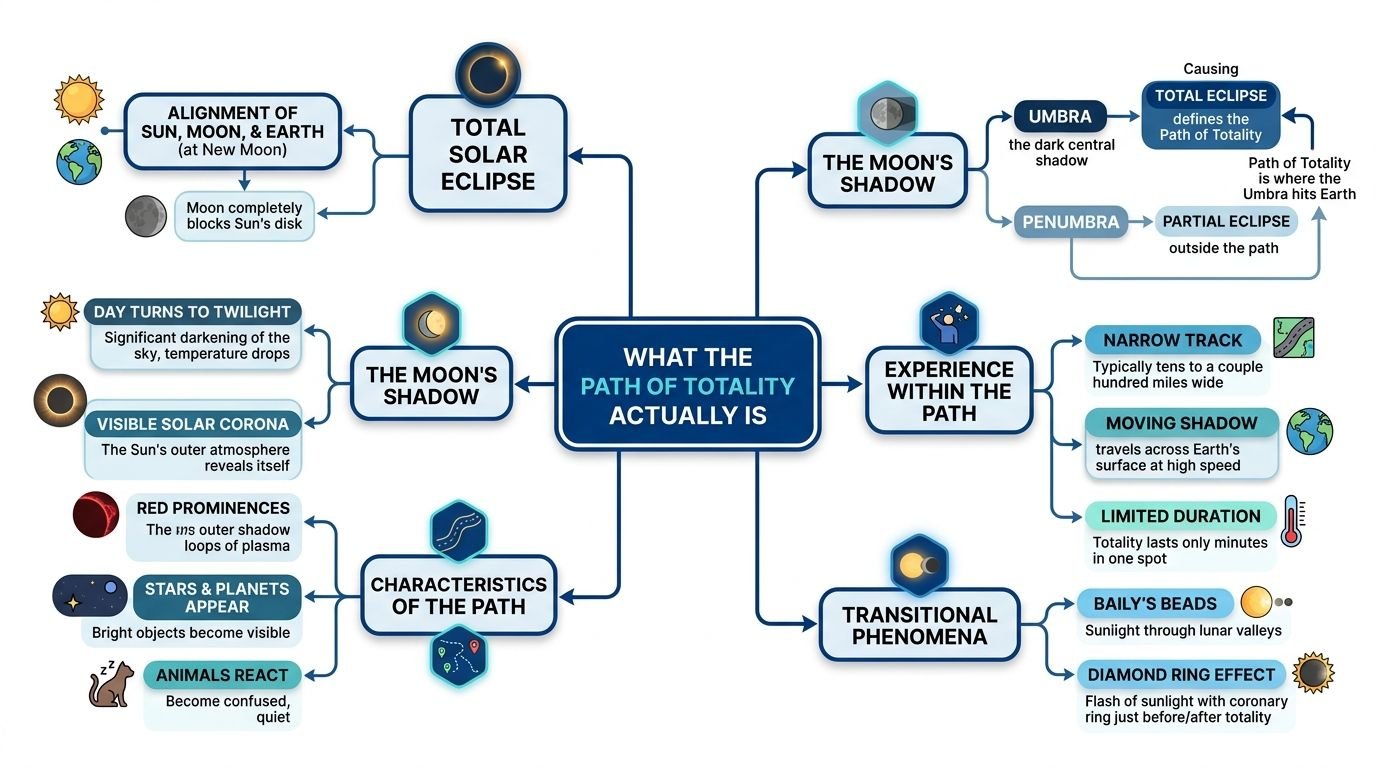
The path of totality is the narrow corridor on Earth where the Moon's umbra reaches the ground and fully blocks the Sun. NASA's solar eclipse material shows that this shadow band moves fast across the surface, which is why totality is a location problem as much as a timing problem (NASA SVS 4515).
Why location precision matters
That geometry is unforgiving. A few kilometers can be the difference between full totality and a partial eclipse, because the transition happens at the edge of the Moon's shadow, not gradually across a city. That is why eclipse chasers care so much about exact coordinates instead of broad regional labels.
The umbra works like a narrow spotlight sweeping across a stage. One place goes dark first, another never does, and the center of that beam is the part that matters.
The centerline is the difference between seeing the corona and seeing a very dramatic partial eclipse.
What observers experience
NASA's eclipse FAQ says totality on the centerline usually lasts about 3.5 to 4 minutes (NASA eclipse FAQ). That sounds short because it is short. You plan a long trip for a brief scientific phase, and that trade-off is part of eclipse chasing.
Within the path, the Moon completely covers the Sun, and the sky takes on a dawn-or-dusk quality that partial phases never reproduce. Outside the path, even a clear sky only gives you a partial eclipse. The difference is not subtle. A deep partial can dim the light, but it does not bring the darkness of totality, the abrupt drop in ambient light, the visible corona, or the reaction you get when daylight turns strange in a matter of seconds. For a practical overview of where totality falls in 2026, use the 2026 totality map and viewing guide.
Mapping the 2026 Track Across Iceland and Spain
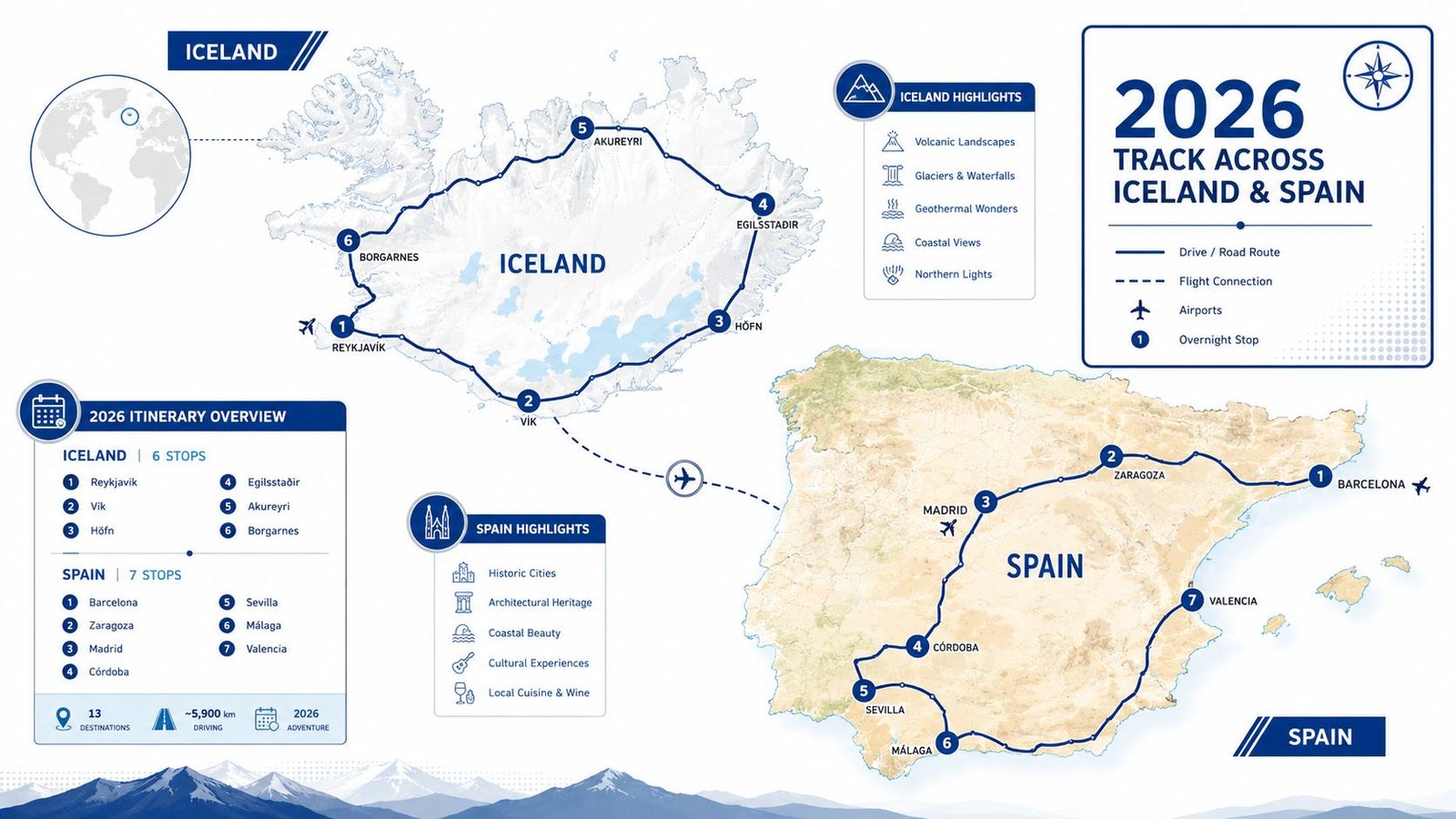
The practical split in 2026 is simple. The path of totality crosses Iceland and Spain, while much of the rest of Europe stays outside the umbra and gets only a partial eclipse. That makes planning very different from a casual “pick a city and watch” approach, because the boundary is sharp and exact location matters. See NASA's 2026 eclipse map for the track layout, then check the interactive location guide for the 2026 eclipse before you commit to a hotel or transit plan.
Where the track is strongest
Over the North Atlantic west of Iceland, totality runs longest, reaching about two minutes eighteen seconds. On land, both Iceland and Spain still offer totality if you are inside the corridor, but the viewing window is shorter. That trade-off matters in real trip planning, because the longest duration is not always the place you can reach, clear, and hold position in.
The map also shows the path brushing a tiny corner of northeast Portugal. That can tempt people into treating western Iberia as broadly covered, but proximity does not count. The only question that matters is whether your exact spot falls inside the umbral boundary.
Cities, names, and false comfort
Travel plans are usually built around city names, and that habit can cause bad assumptions here. Cities such as Madrid and Bilbao may be close to the track, but close still means partial if you are outside the corridor. A near miss on the map does not produce totality, and the sky will not behave like it does inside the path.
The cleanest way to avoid that mistake is to check the spot, not the label. Ask which side of the boundary you will be on at the minute totality begins, then verify the answer against a location-specific map before booking.
Why 99% Partial Is Not the Same as Totality
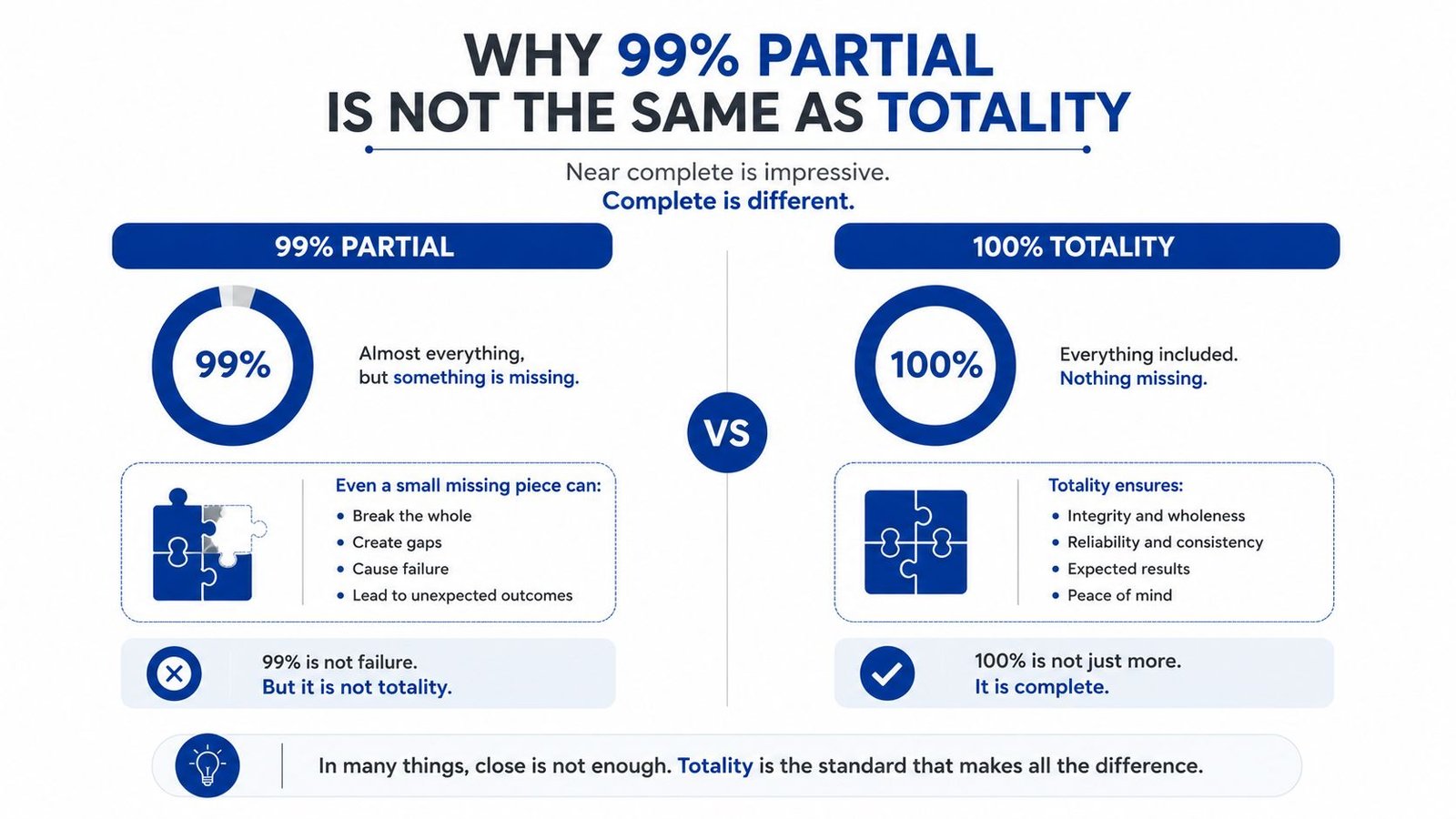
A 99% partial eclipse sounds close until you stand in it. The last sliver of sunlight still matters because the drop in brightness is dramatic, and that is why deep partial and totality feel like different events rather than adjacent versions of the same thing. The comparison in this partial-versus-totality infographic makes the gap easy to see. If you want a practical map-level check before you commit to travel, the umbra and totality guide is the better starting point than a city-name search.
What totality gives you
Inside the path, the Moon completely covers the Sun and the corona becomes visible to the naked eye. That is the visual signature people remember, not the bite out of the disk, but the surrounding solar atmosphere lighting up around a black circle.
The sky itself changes character too. It takes on a dawn-or-dusk quality during totality, and that shift is part of the experience. It does not happen just because the eclipse is almost total.
Why the filter rule changes
Partial phases still require eye protection, but totality is the only window when the Sun is fully covered and safe unaided viewing is possible. That is another reason the distinction matters operationally, not just emotionally.
Simple rule: if you're outside the path, keep the filters on for the whole eclipse. If you're inside the path, the filter comes off only when totality begins and goes back on as soon as it ends.
The message for Europe is blunt. A deep partial can still be worth watching, especially if it is all you can get. But if you are making travel decisions, the percentage is not the primary metric. Totality is binary.
Spain's Sunset Geometry and Why Horizon Matters
Spain turns this eclipse into a very different planning problem from Iceland. During totality, the Sun sits only about 10–12° above the western horizon over northern Spain, which means the quality of your western view can make or break the experience (Exploratorium guide).
What to prioritize on the ground
A low sunset eclipse rewards people who think like surveyors, not tourists. You want an unobstructed westward horizon, some elevation if possible, and a backup location you can reach without a long detour if the first site looks blocked. Terrain, sea haze, and coastal clutter matter more here than they do in a higher-sun eclipse.
That's why inland Spain deserves more attention than casual guides usually give it. A west-facing ridge, a hilltop, or a clear open plain can be more useful than a prettier beach if the beach sits under marine haze or a line of buildings. A good eclipse site is the place where the Sun still exists as a usable object, not just a point on a map.
Why Iceland is easier in one respect
Iceland has a friendlier solar altitude problem because the geometry is less compressed near the horizon. That doesn't make weather irrelevant, it just means you're not fighting the same sunset obstruction risk you get in Spain. In Spain, being inside the path is necessary, but a bad horizon can still erase the practical advantage of totality.
Site-selection checklist
- Clear west: no ridges, trees, or buildings cutting the low Sun.
- Some height: elevation buys margin when the Sun is near the horizon.
- Fallback within reach: a second site can save the day if the first one looks wrong.
- Fast exit or repositioning: don't lock yourself into one road.
A useful planning habit is to treat the map and the terrain as separate problems. The map gets you into the path. The terrain decides whether you see anything meaningful when totality arrives.
Safe Viewing and Photography Protocols
The safest eclipse day is the one where the gear is prepared before the light changes. ISO 12312-2 compliant eclipse glasses belong on your face for every partial phase, and solar filters must stay on cameras, telescopes, and binoculars until totality begins (NASA eclipse safety guidance).
The viewing sequence that works
The rule is simple and critical. Look through certified eclipse glasses during the partial phase, remove filters only during totality, then put them back on before totality ends. That sequence is not optional if the Sun is still visible in any amount.
For photographers, the useful window is the totality itself. A bracketed exposure set lets you capture both the bright corona and the faint red prominences near the lunar limb, but only after the Sun is fully covered. In Spain, the low altitude makes a tripod and a stable setup more important, because lens flare and atmospheric extinction can be stronger near the horizon.
Gear discipline beats last-minute improvisation
Pre-focus your camera. Test your exposure sequence before eclipse day. Keep a cloth or hood handy if flare becomes a problem, and don't assume the same settings will work at every site because the sky brightness can change fast when the Sun is low.
Don't spend the critical minute hunting for caps, menus, or lens threads. The eclipse doesn't wait for gear mistakes.
A site-specific planning page can help with this part too. If you want a city-by-city timing reference while you build your setup, the eclipse safety and timing guide is the kind of reference that keeps the day organized without overcomplicating it.
Weather Strategy and the Case for Day of Mobility
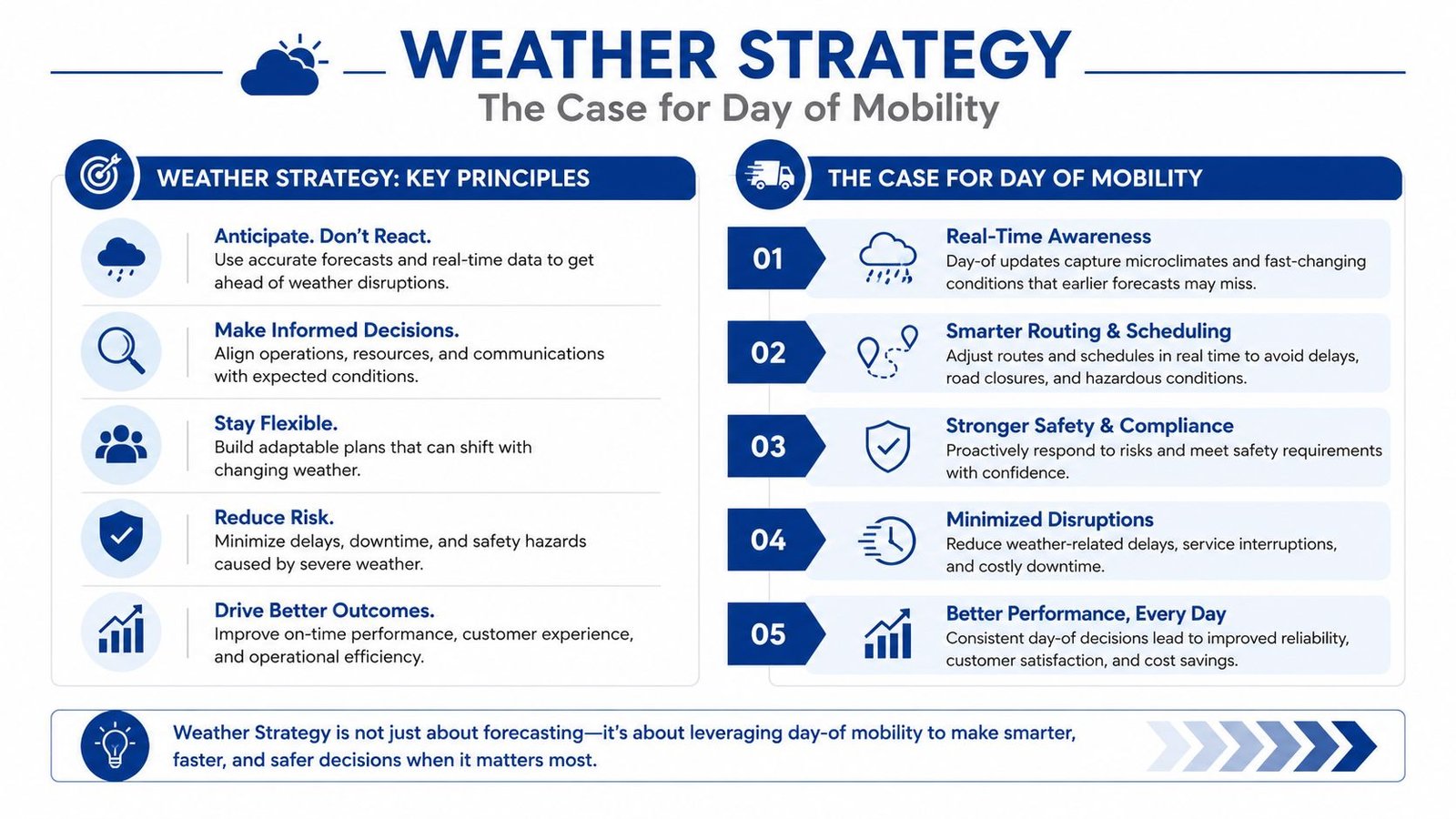
The biggest planning mistake for this eclipse is assuming the centerline is all that matters. It isn't. If the sky is blocked, the exact center of the path gives you nothing, while a site farther away but under clear sky can still deliver totality.
Build options, not a single bet
Weather and microclimate vary sharply across late-afternoon Iceland and northern Spain, especially along Atlantic and Cantabrian exposures. Inland Spain often has better clear-sky odds than the coast, which is why a fixed hotel in the “best-looking” town can be a weaker plan than a movable base with several reachable targets.
That's the contrarian part many travelers miss. The centerline is a geometry problem, but cloud cover turns eclipse day into a weather problem. A person 50 km away with open sky can get a full experience, while a person on the centerline under cloud gets a wasted trip.
What to do on the morning of 12 August
Keep two or three reachable viewing sites inside the path. Check the morning satellite picture. Be ready to drive, and be realistic about traffic and timing if you're chasing a clearer westward window. Mobility gives you a chance to respond to the actual sky instead of the forecast you checked a week earlier.
The same idea applies whether you're in Iceland or Spain, but it matters more in Spain because the low Sun and west-facing horizon give you fewer margin points to work with. If you can move without missing totality, you've given yourself a real advantage.
Putting It All Together for Eclipse Day
A successful eclipse day starts with three decisions made before you leave home. Get inside the path of totality, choose a Spanish site with a clear western horizon, and leave yourself mobile enough to chase clear skies if the forecast shifts. In Spain, totality arrives close to sunset, so the shadow path matters, but the horizon line matters just as much. A perfect map position loses value if the Sun drops behind terrain, haze, or coastal clutter right when the show begins.
The timing in Spain is tight. First contact, deep partial, totality, and the return to partial all happen in a compressed window, which leaves little room for last-minute indecision. That is the practical difference between a well-planned totality day and a long drive to a disappointing partial. At deep partial, the daylight still looks like daylight, just stranger and flatter. Totality is different, with a real drop in brightness that can feel closer to dusk than to afternoon.
My advice is to plan a primary site and at least one backup that you can reach without gambling the whole afternoon. If the sky looks better farther west or inland, move early enough to arrive calmly, not while everyone else is doing the same thing. That kind of flexibility matters more in Spain than in a higher-Sun eclipse, because the low Sun gives you fewer clean angles and less room to recover from a bad site choice.
For city timing, path status, and viewing conditions while you finalize the plan, use Total Solar Eclipse 2026 Live. It helps compare likely options before you commit to hotels, fuel, and a final viewing point.