July 31, 2026
What Is the Saros Cycle? a Guide to Eclipse Cycles
On a summer evening, you check a map, compare a few cities, and wonder whether the same Moon shadow that darkened a faraway place decades ago will ever pass over your own. For the 12 August 2026 total solar eclipse, that question matters to travelers in Iceland, Spain, and across Europe, because the path is narrow, the timing is exact, and the answer depends on more than just counting years.
The cleanest way to understand that pattern is the Saros cycle. It's the quiet rule that groups eclipses into families, so one eclipse doesn't stand alone, it belongs to a longer story that keeps circling back through time.
Table of Contents
- Why Every Eclipse Belongs to a Family
- The Saros Cycle Explained in Plain Language
- Three Lunar Cycles That Make the Saros Tick
- How a Saros Series Evolves Over Centuries
- How Ancient Astronomers Discovered the Pattern
- Why One Saros Does Not Promise the Same Location
- Putting Saros Knowledge to Work on 12 August 2026
Why Every Eclipse Belongs to a Family
On eclipse day, the sky looks dramatic, but the bookkeeping behind it is calm and exact. A solar eclipse is not a one-off surprise, it is one member of a long eclipse family, and the family name is the Saros. That's why astronomers can trace a path from one event to the next instead of treating each eclipse as an isolated mystery.
The core rule is simple enough to hold in your head. The saros cycle lasts 6,585.321347 days, which is about 18 years, 11 days, and 8 hours, and it equals 223 synodic months while coming very close to 242 draconic months and 239 anomalistic months. That near match is the reason the Sun, Earth, and Moon line up in a very similar way again, so a similar eclipse can happen.
For someone watching the 2026 Europe eclipse, that matters more than it first seems. The event belongs to a numbered series, which means it has ancestors and descendants, not just a date on a calendar. If you know the series, you can understand why the eclipse exists, where it came from, and why the next one in the same family won't necessarily meet you in the same city.
Practical rule: think in families, not single dates. An eclipse is one frame in a long reel, and the Saros is the projection speed that keeps the reel moving.
The phrase what is the saros cycle sounds technical, but the idea is ordinary once you strip away the astronomy vocabulary. It's a repeat pattern, built from the Moon's different rhythms, that lets eclipse watchers follow a lineage across centuries.
For a broader primer on eclipse basics, this guide to solar and lunar eclipses is a useful companion.
The Saros Cycle Explained in Plain Language
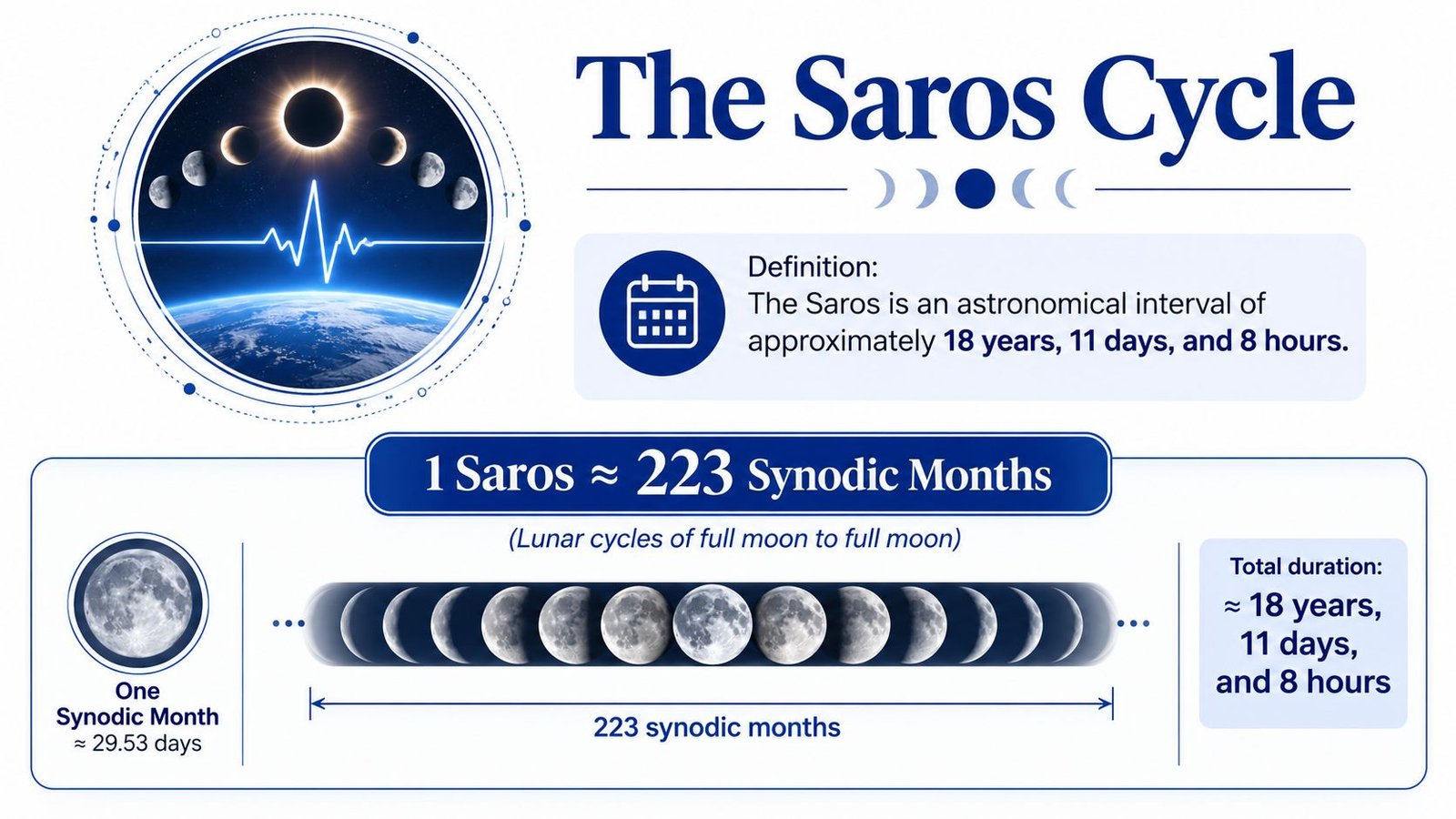
The Saros works because three lunar rhythms almost line up again after a long stretch. The result is a repeat interval, not a repeat date. One Saros is about 18 years, 11 days, and 8 hours, so the Moon, Earth, and Sun return to nearly the same arrangement after a long count of lunar months.
That is why eclipse catalogs organize events into Saros series instead of treating each eclipse as an isolated event. Each return is similar enough to belong to the same family, yet different enough that no eclipse is a perfect copy of the one before it. Once you see that pattern, the next eclipse in the series is easier to place in context.
The comparison is straightforward. The Moon has to come back to the same phase, pass the same node in its orbit, and be at a similar distance from Earth. When those three conditions nearly match again after a Saros, the eclipse geometry also comes back in a recognizable form. The sky does not reset to the same scene, but it does come close enough for the family resemblance to stand out.
That is the point that helps with real travel plans, including a chase for the 12 August 2026 total solar eclipse across Iceland and Spain. A Saros can tell you that a related eclipse is coming, but it cannot promise the same street, harbor, or mountain pass. The Moon keeps the family pattern, while Earth's rotation shifts the viewing zone westward by roughly a third of the globe each time.
The phrase what is the saros cycle matters because it answers a practical question, not just a technical one. It explains why eclipse prediction can be organized by family, why observers track numbered series, and why one event points to another across generations. If you are using eclipse lists or almanacs, that family structure is what makes the entries make sense.
A broader overview of eclipse timing can help if the terms still feel new, and this guide to solar and lunar eclipses gives that foundation. Once the basic terms are clear, the Saros becomes less mysterious. It is the rhythm that lets eclipse watching work as pattern recognition instead of guesswork.
Three Lunar Cycles That Make the Saros Tick
The Saros works because three lunar rhythms almost line up again after a long stretch. They do not stay in perfect step month by month, yet they return close enough together to recreate a similar eclipse pattern.
The phase cycle
The first rhythm is the synodic month, the stretch from new moon to new moon. This is the Moon's phase cycle, the part people notice first without any telescope. A Saros contains 223 synodic months, so the Moon comes back to nearly the same phase when the eclipse family repeats.
The node crossing cycle
The second rhythm is the draconic month, the time it takes the Moon to return to the same node, the place where its orbit crosses the ecliptic. That crossing matters because eclipses only happen when the Moon is near a node. A Saros comes very close to 242 draconic months, so the Moon is again near the same crossing point.
The distance cycle
The third rhythm is the anomalistic month, the cycle tied to the Moon's changing distance from Earth. That distance affects how large the Moon appears in the sky and helps shape how an eclipse looks. A Saros comes very close to 239 anomalistic months, which is why eclipse type and duration can also feel similar from one Saros to the next.
The key idea is near-commensurability, a term that means the cycles almost fit together after the same stretch of time. That near fit is enough to recreate similar eclipse geometry, which is why astronomers can use the Saros as a forecasting tool.
The three rhythms work together like separate clocks that finally strike near the same moment again. One tracks phase, one tracks orbital crossing, and one tracks distance. When those beats come close together, another member of the eclipse family is ready to appear.
For anyone checking a specific lunar event, a separate reference on what time the Moon eclipse happens tonight can help connect the long-term pattern with a single evening, even though the Saros itself describes repeat behavior over many years.
How a Saros Series Evolves Over Centuries
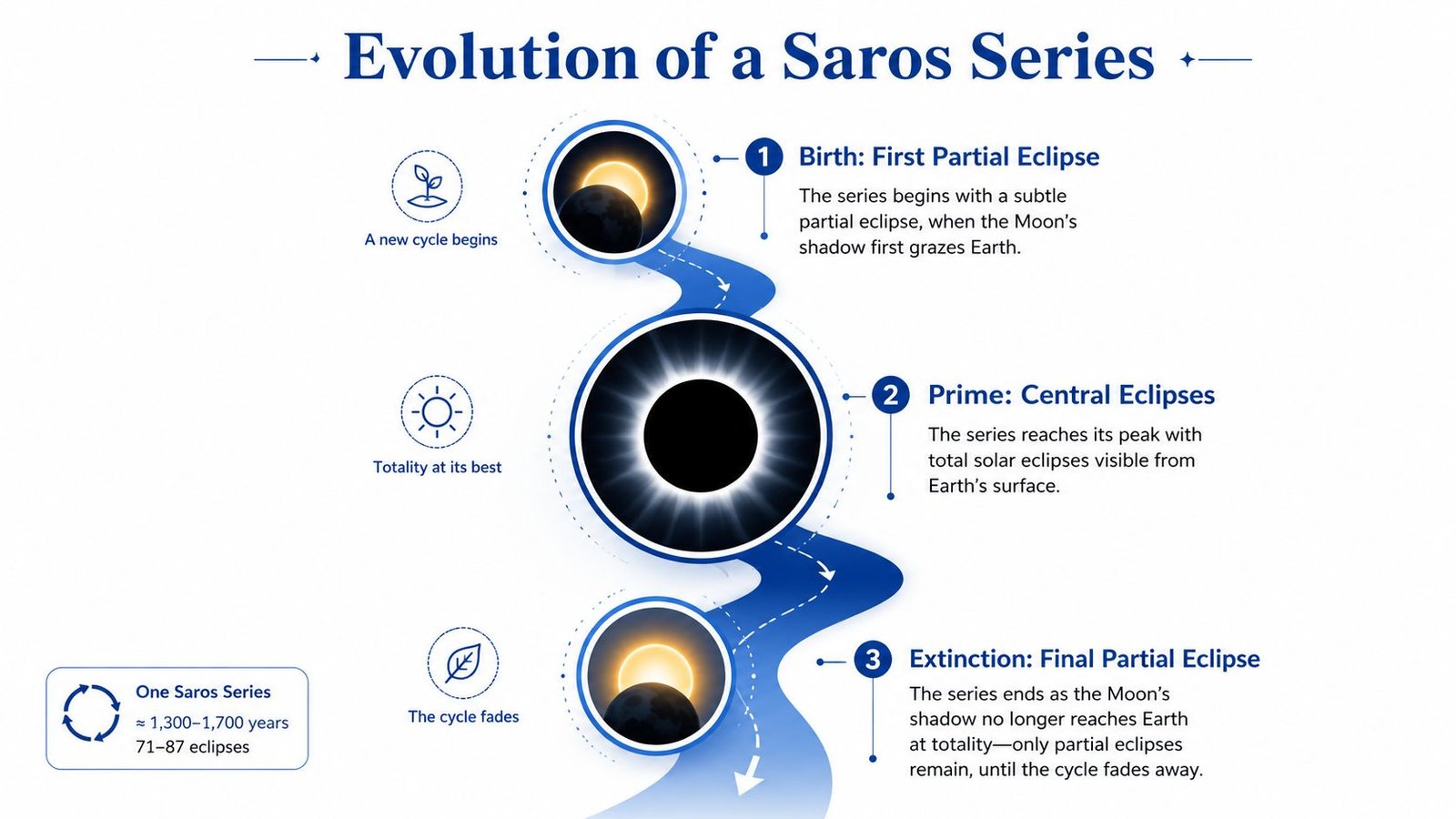
A Saros series has a life cycle of its own. It starts, grows into stronger eclipses, and then fades out again. That's why eclipse families are numbered, they're long-lived but finite, like a lineage that has a beginning, a middle, and an end.
From partial beginnings to central eclipses
The earliest members of a series are usually partial eclipses, and they tend to start near one pole of Earth. As the series ages, the geometry improves and the eclipses deepen. In the middle of the family, the central eclipses arrive, and that's where totality can dominate the series for a while.
Saros 130 as a real example
NASA's catalog for Saros 130 shows how a real family develops over time. The series spans 1,298.17 years and includes 73 solar eclipses, with 43 total and 30 partial eclipses, so 58.9% of the series is total and 41.1% is partial. That balance tells you something important, a Saros series can spend a long stretch producing dramatic total eclipses before it eventually drifts back toward partials.
Why the long span matters
The broad lifespan of a series explains why eclipse catalogs stay organized around families. Britannica describes a Saros series as lasting between 1,226 and 1,550 years and containing 69 to 87 eclipses, which matches the general picture of a long but limited family line. Astronomers don't just care about the next eclipse, they care about where the series has been and where it's heading.
Useful habit: when you hear about a single eclipse, ask which Saros family it belongs to. That family tells you more about its past and future than the date alone ever will.
For the eclipse traveler, that means one event is never just one event. It sits inside a sequence that explains why totality can appear in some eras, then vanish from the series later. If you follow the family, you follow the geometry.
How Ancient Astronomers Discovered the Pattern
The Saros wasn't invented in a modern observatory. It was noticed by people who watched the sky for generations and kept records long enough for a pattern to emerge. Babylonian astronomers recognized the eclipse recurrence pattern over 2,000 years ago, and that discovery became part of the working knowledge passed through later astronomy.
That matters because it changes the way people think about eclipse prediction. The Saros looks like a tidy calculation now, but it began as patient observation. Someone had to notice that eclipses were not random, then record enough of them to see the repeat rhythm hidden inside the dates.
From tablets to tables
Babylonian records made the pattern visible, then later astronomers refined the logic and turned it into a practical forecasting tool. The reliability of the geometry is why the Saros stayed useful. Eclipse tables didn't appear because someone wanted a clever number, they appeared because watchful people proved the sky had a repeatable structure.
That same logic still sits behind modern eclipse catalogs. The family names, the numbered series, and the long-range tables all come from the same ancient habit, careful watching. The tools changed, but the pattern stayed strong enough to survive the centuries.
A useful way to think about this is to imagine a chain of observers handing the same question forward. When will the shadow return, and how will it differ next time? The Saros is the answer they kept refining.
The story also explains why eclipse prediction feels so trustworthy. It isn't built on a single insight from one era. It's built on repeated human attention, spread across civilizations, and tested by the sky itself.
Why One Saros Does Not Promise the Same Location
A lot of readers hear “18 years” and jump straight to a city-level conclusion. If the eclipse comes back on schedule, they assume it should come back to the same place. That's the wrong lesson, because the Saros repeats the geometry, not the exact ground track.
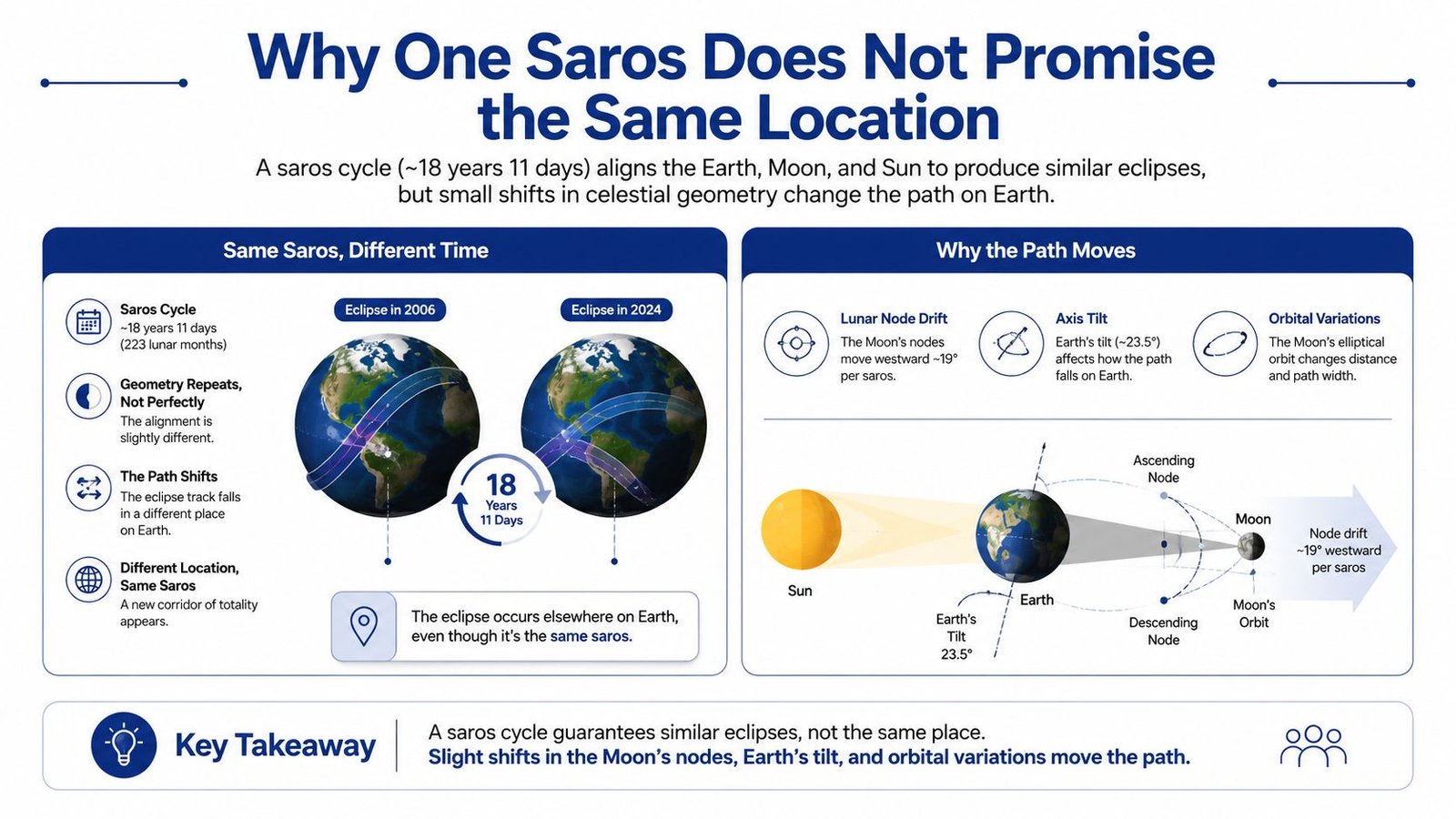
The reason is the 8-hour offset. Because the Saros is about 8 hours longer than an integer number of days, the Earth turns under the shadow, and each successive eclipse in the same Saros series appears roughly 120° west in longitude from the previous one. So the eclipse does not repeat at the same location without additional cycles.
That's the practical point many people miss. The same family comes back, but Earth has rotated too far for the shadow to land on the same region. Your city may miss the next member of the family completely, even if the eclipse itself is a strong match in type and geometry.
The exeligmos and the regional return
A triple Saros, often called an exeligmos, comes into view after roughly 54 years and 34 days. That's the span where an eclipse family can return to a broadly similar geographic region, though the local conditions and exact geometry can still differ. It's closer to a regional echo than a carbon copy.
For travelers, this is the key distinction. The Saros tells you that the family is recurring, but it does not promise your street, your hill, or your hotel balcony. The Earth's rotation makes the shadow walk westward, so the planning question is always local.
Practical rule: don't ask, “Will my city get the same eclipse again?” Ask, “Where is this Saros family going next?”
That shift in thinking keeps eclipse planning realistic. It also explains why eclipse chasers move with the path instead of waiting for a familiar place to be lucky again. The family is stable, but its footprint on Earth keeps changing.
Putting Saros Knowledge to Work on 12 August 2026
The 12 August 2026 eclipse gives the Saros a travel-planning role, not just a textbook one. It's the kind of event where people need to choose between Iceland and Spain, compare local times, and decide whether they want a broad Arctic experience or a low-sun, sunset-view in southern Europe. The Saros explains why the eclipse exists as part of a family, but the path of totality decides where you'll stand.
For that part, a live path tool is the right next step. An interactive path of totality map for 2026 helps you compare cities, check whether you're inside totality, and see how the route crosses Europe. That matters because the 2026 path is a fresh corridor, not a repeat performance in the same place, and the local viewing experience will vary a lot by location.
A practical planning checklist
- Check your city first. The city tables and maps show whether you're in totality or only in a deep partial zone, and that difference is huge when you're choosing where to travel.
- Compare Iceland and Spain. Iceland offers a northern viewing setup, while Spain rewards careful attention to sunset geometry and a low western horizon.
- Match the clock to local time. Eclipse timing changes by time zone, so use local city data rather than assuming your home clock will translate cleanly.
- Bring proper eye protection. Use ISO 12312-2 eyewear for partial phases and switch to safe viewing practices only when totality begins.
- Stay flexible on the day. Weather can change the value of a site quickly, so mobility matters as much as advance planning.
The Saros also helps with expectations. After about three Saros periods, roughly 54 years and 34 days, an eclipse family can return to a broadly similar region, but that doesn't mean the 2026 event will look like a previous one from the same spot. If you're chasing totality, you still need to pick the right place, not just the right year.
The best use of the Saros is simple. It tells you that the eclipse is part of a long family line, and then it hands you back to the map. For the August 2026 eclipse, the map is what turns curiosity into an actual plan.
Visit Total Solar Eclipse 2026 Live for Europe-focused eclipse maps, city-level timing, and practical viewing guidance for the 12 August 2026 total solar eclipse. It's built for exactly this kind of planning, where the Saros explains the family history and the path of totality tells you where to stand.