July 8, 2026
What Is a Solar and Lunar Eclipse? a Guide for 2026
You're probably here because August 12, 2026 has stopped feeling abstract. Maybe you've started looking at maps of northern Spain, wondering whether a beach, a clifftop, or an inland hill would give you the better western horizon. Maybe you've seen people say a deep partial eclipse is “close enough” and you're not convinced. Or maybe you want one solid answer to a basic but important question: what is a solar and lunar eclipse, really?
That question matters more when you're planning travel. An eclipse isn't just a sky event. It's geometry, timing, location, and a bit of humility in the face of celestial precision. If you understand why eclipses happen, the practical choices for Europe in August 2026 start to make sense.
On that evening, many observers will be standing in Spain looking west as the Sun drops lower, wearing eclipse glasses and waiting for a few minutes that will feel far bigger than the clock suggests. If you want to know what you're seeing, why the view changes so sharply inside the path, and how this differs from a lunar eclipse, start here.
Table of Contents
- An Appointment with the Sky
- The Celestial Dance How Eclipses Happen
- A Guide to Solar Eclipses
- Understanding Lunar Eclipses
- Solar vs Lunar Eclipses Key Differences
- The Great European Eclipse of 2026
- Eclipse Viewing Safely and Debunking Myths
An Appointment with the Sky
Late on August 12, 2026, many people across northern Spain will be doing two things at once. They will be looking up in wonder and looking down at maps, forecasts, and timing notes. A total solar eclipse can feel like a gift from the universe, but seeing it well is also a matter of being in the right place at the right minute.
That mix of awe and planning is part of what makes eclipses different from almost any other sky event. You are not just watching astronomy happen. You are meeting a moving shadow that crosses land, sea, and cities on a strict schedule. For readers preparing for Europe's big eclipse in 2026, that means the basic question, what is an eclipse, quickly turns into a practical one. Where should you stand when the alignment arrives?
For many first-time eclipse chasers, the surprise is how much depends on geography. A few kilometers can separate a life-changing view of totality from an ordinary partial eclipse. If you are already thinking about routes, weather, and viewing spots, where to see the 2026 eclipse matters just as much as knowing the date.
At heart, the idea is simple. An eclipse happens when the Sun, Earth, and Moon line up closely enough for one world to cast a shadow on another. It is celestial geometry, but it does not feel abstract when you are standing under it. In a solar eclipse, the Moon passes between Earth and the Sun. In a lunar eclipse, Earth passes between the Sun and the Moon.
Those two arrangements sound similar on paper. In real life, they are very different experiences.
A solar eclipse is narrow, time-sensitive, and demanding. You need eye protection for the partial phases, and location matters enormously. A lunar eclipse is broader and calmer. It unfolds at night, lasts longer, and can be watched safely by anyone on the night side of Earth with a clear view of the Moon.
That contrast is the key to the rest of this guide. Once you understand which body casts the shadow, the practical advice starts to make sense. Why Spain matters in 2026. Why totality draws travelers across countries. Why one eclipse asks for careful preparation, while the other invites you to step outside and look up.
The Celestial Dance How Eclipses Happen
The cleanest way to understand eclipses is to picture three moving bodies sharing one stage: the Sun, Earth, and Moon. The Sun is the light source. Earth and the Moon move through that light, and when they line up just right, one body throws a shadow onto another.
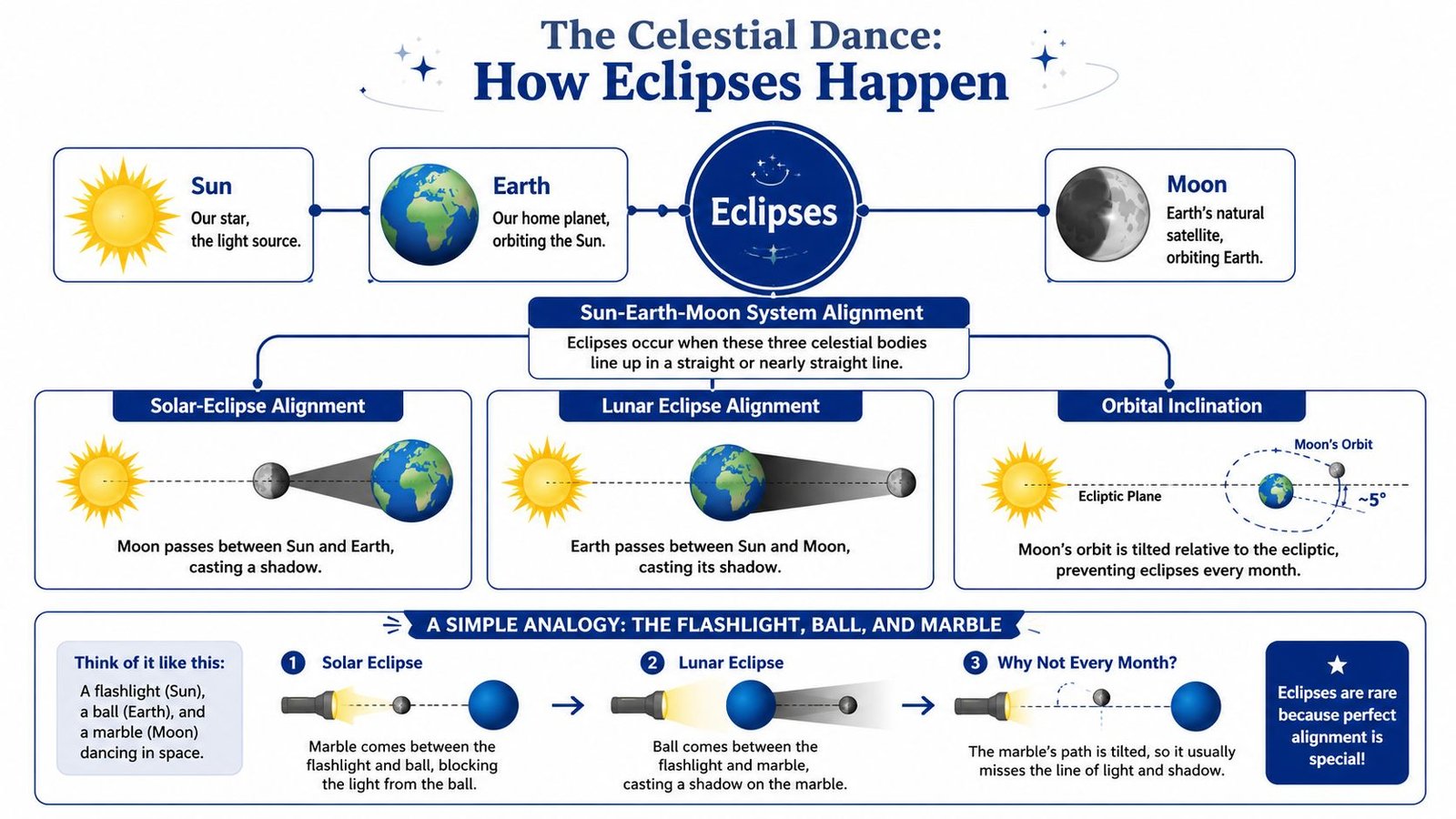
Three bodies, one alignment
A simple park analogy helps. Think of three people walking in a large field at different distances from a bright lamp. If the middle person steps directly into the line between the lamp and the third person, they cast a shadow. That's the basic eclipse idea.
For a solar eclipse, the order is Sun, Moon, Earth. The Moon's shadow falls on Earth. For a lunar eclipse, the order is Sun, Earth, Moon. Earth's shadow falls on the Moon.
Astronomers use two shadow terms that are worth knowing:
- Umbra means the darkest central shadow, where the light source is completely blocked.
- Penumbra means the lighter outer shadow, where only part of the light source is blocked.
A key technical point comes from the European Space Agency. A total solar eclipse occurs when the Moon's umbra, the cone-shaped region of complete shadow, intersects Earth's surface. The eclipse limit is approximately 15–18 degrees for general eclipses and 10–12 degrees for central eclipses, as described in ESA's explanation of solar and lunar eclipses.
That's also where famous transition effects come from. Near the start and end of totality, sunlight can shine through valleys on the Moon's edge, producing Baily's Beads and the diamond ring effect.
Why eclipses don't happen every month
Many people find this question perplexing. The Moon orbits Earth every month, so why isn't there a solar eclipse at every new Moon and a lunar eclipse at every full Moon?
Because the Moon's orbit is tilted relative to Earth's path around the Sun.
Most months, the Moon passes a little above or a little below the exact line needed for an eclipse. The alignment only works when the Moon is near one of the points where its orbit crosses that plane. Those crossing points are called nodes. When the Sun is near a node at the same time the Moon reaches new or full phase, an eclipse becomes possible.
Practical rule: Eclipses need more than the right Moon phase. They need the right phase at the right orbital crossing.
That single idea clears up a lot of confusion. It also helps explain one of the most common educational mistakes people carry into adulthood: mixing up monthly lunar phases with eclipse shadows. The phases of the Moon are about sunlight illuminating different parts of the Moon as it orbits Earth. An eclipse is a much more exact alignment involving an actual shadow crossing.
A Guide to Solar Eclipses
You arrive at your viewing spot in northern Spain in August 2026. The Sun is high, the light still looks ordinary, and it is tempting to think any place with a good view of the sky will do. For a solar eclipse, that assumption is the difference between witnessing a life-list event and seeing only a partial bite taken from the Sun.
A solar eclipse happens when the Moon passes directly between Earth and the Sun. The basic geometry is simple. The experience on the ground is not. Your view depends on where you stand under the Moon's shadow and on how large the Moon appears in the sky that day.
That second point trips people up. The Moon's orbit is slightly stretched, not perfectly circular, so the Moon sometimes looks a little larger and sometimes a little smaller. That small change decides whether it can cover the Sun completely.
Total, partial, and annular
There are three main kinds of solar eclipse, and they are not just different amounts of the same show.
Total solar eclipse. The Moon covers the Sun's bright face completely for observers inside the narrow central track. For those few minutes, called totality, the sky darkens, bright planets may appear, and the Sun's faint outer atmosphere, the corona, comes into view. The Moon's darkest shadow sweeps across Earth quickly, which is why eclipse chasers care so much about precise location and timing.
Partial solar eclipse. The Moon covers only part of the Sun. The Sun can look crescent-shaped or as if a piece has been taken out of it, but the world does not transform in the same way. Daylight often remains surprisingly strong, which is why first-time viewers are often startled by how different partial eclipse light feels from true totality.
Annular solar eclipse. The Moon passes centrally in front of the Sun but appears too small to hide it completely. A bright ring remains around the Moon. This is the "ring of fire" event. It happens because the Moon is farther from Earth and therefore looks slightly smaller in the sky.
A good way to picture the difference is to compare a coin held at arm's length with a lamp across the room. If the coin looks large enough, it blocks the lamp fully. If it looks just a bit too small, a ring of light survives around the edge. Solar eclipses work the same way, only with much grander consequences.
Why totality is its own category
For planning purposes, one idea matters more than almost anything else. A 99 percent partial eclipse is still a partial eclipse.
Until the last sliver of the Sun is covered, the photosphere remains so bright that it overwhelms the corona and keeps the sky much brighter than many people expect. Totality begins only when that bright solar surface disappears completely. That is the moment seasoned observers travel for.
| Eclipse type | What you see | Can you remove eclipse glasses? |
|---|---|---|
| Partial | A bright Sun with a chunk missing or a crescent shape | No |
| Annular | A bright ring around the Moon | No |
| Total, during totality only | The corona around a black solar disk | Yes, but only during totality |
That table carries a practical lesson for anyone thinking ahead to 2026 in Europe. Your first planning question is not how high the eclipse percentage will be. It is whether your chosen location lies inside the path of totality. If it does not, you are planning for a partial eclipse, even if the Sun is almost fully covered.
That is why eclipse maps matter so much. The science answers the "what is happening" question. The travel details answer the "what will I see from where I am" question. For the 2026 European eclipse, those two questions belong together.
Understanding Lunar Eclipses
You can watch a lunar eclipse with a jacket on, a warm drink in hand, and enough time to settle in and notice the changes. That slower pace is part of its charm. While a solar eclipse can feel like a brief, intense performance, a lunar eclipse is more like watching Earth's shadow gradually slide across the Moon.
The geometry is simple once you picture the lineup. The Sun is on one side, Earth moves into the middle, and the full Moon passes through Earth's shadow. In other words, a lunar eclipse is the reverse arrangement of a solar eclipse. Instead of the Moon casting a shadow on us, we watch our own planet's shadow fall across the Moon.
What you actually see
Earth's shadow has two parts, and that is why lunar eclipses come in different forms. The outer part, called the penumbra, is a lighter shadow. The inner part, the umbra, is the dark central shadow.
A penumbral lunar eclipse happens when the Moon passes only through that outer shadow. The effect can be so gentle that an observer who is not expecting it may only notice that one side of the Moon looks slightly muted or dusty.
A partial lunar eclipse begins when part of the Moon enters the umbra. Then the change becomes much easier to spot. A dark, curved bite seems to move across the bright face of the full Moon, and that curve is a clue that Earth is round. We are seeing the edge of our planet's shadow.
A total lunar eclipse occurs when the entire Moon moves into the umbra. Even then, the Moon usually does not disappear. Sunlight still passes through Earth's atmosphere, where shorter blue wavelengths scatter away and redder light is bent into the shadow, washing the Moon in copper, brick, or deep red tones. That is the source of the familiar "blood moon" look, though the exact color depends on the state of Earth's atmosphere at the time.
The National Weather Service describes this gradual dimming and reddish coloring over several hours in its solar and lunar eclipse guide.
Why lunar eclipses are easier to catch
Lunar eclipses ask much less of the observer. If the Moon is above your horizon and skies are clear, you can usually see the event without traveling into a narrow corridor or timing a brief peak with second-by-second precision. Your eyes need no special protection, and binoculars or a small telescope add detail rather than making the event possible.
That broad visibility matters for anyone planning around eclipse season in Europe. A solar eclipse in 2026 will reward careful choices about route, weather, and exact location. A lunar eclipse is usually the opposite experience. The main questions are much more ordinary. Will the Moon be up? Will clouds cooperate? Can you stay outside long enough to watch the shadow progress?
Lunar eclipses also teach the same orbital lesson as solar eclipses. We do not get one at every full Moon because the Moon's orbit is tilted relative to Earth's path around the Sun. Most months, the full Moon passes a little above or below Earth's shadow. Only when the alignment is close enough do we get an eclipse.
That shared geometry is useful to keep in mind if you are planning future eclipse trips. The drama may differ, but the underlying clockwork is the same. Once you understand how Earth, Moon, and Sun line up, the practical questions of where to stand, when to look, and what you can realistically expect become much easier to answer.
Solar vs Lunar Eclipses Key Differences
If you want the shortest workable answer to what is a solar and lunar eclipse, it's this: one is the Moon's shadow on Earth, and the other is Earth's shadow on the Moon. But the viewing experience differs so much that it helps to put them side by side.
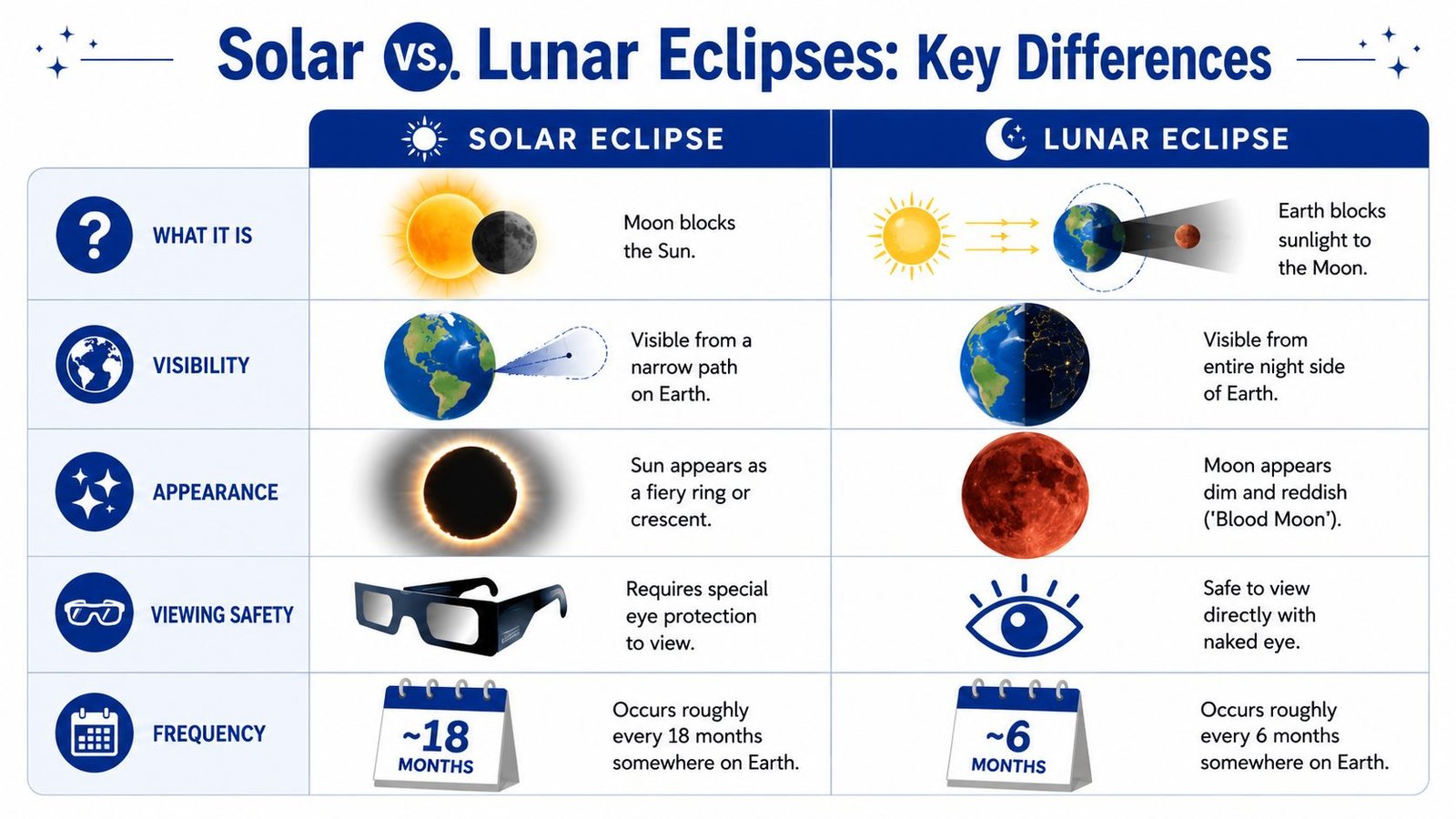
A side by side comparison
| Feature | Solar eclipse | Lunar eclipse |
|---|---|---|
| Alignment | Sun, Moon, Earth | Sun, Earth, Moon |
| Moon phase | New Moon | Full Moon |
| Time of observation | Daytime | Nighttime |
| Visibility area | Narrow path or broad partial region | Entire night side of Earth |
| Eye safety | Special solar viewing protection required except during totality itself | Safe to view with naked eyes |
| Signature look | Crescent Sun, ring, or corona depending on type | Darkened Moon, often reddish in total eclipse |
Some differences matter more than others in practice.
- Location matters far more for solar eclipses. If you miss the path of totality, you miss the defining event.
- Timing pressure is higher for solar eclipses. The most intense phase is brief.
- Lunar eclipses reward patience instead of travel. If skies cooperate, many people can watch the same event from a whole hemisphere.
A detail from eclipse mechanics helps explain the drama of total solar events. The Moon's fully dark shadow is narrow, and totality at one place lasts only minutes because that shadow sweeps rapidly across Earth. By contrast, Earth's shadow on the Moon is large, which gives lunar eclipses their slower, more gradual feel.
Solar eclipses are local experiences. Lunar eclipses are regional experiences.
There's also a sharp safety split. Looking at the Sun during a partial or annular phase without proper solar protection can injure your eyes. Looking at a lunar eclipse is as safe as looking at any full Moon.
That single contrast explains why solar eclipse planning includes eyewear, filters, and exact site selection, while lunar eclipse planning usually comes down to one question: will the sky be clear?
The Great European Eclipse of 2026
You book a train, check the weather, and arrive in the path of totality. Then eclipse afternoon comes, and one practical question decides everything: can you see the low western Sun from where you are standing?
That is why the 2026 eclipse matters in a special way. It is not only a lesson in celestial mechanics. It is also a real-world planning problem for observers across Europe. The same geometry that makes a total solar eclipse so dramatic also determines whether Iceland, northern Spain, or one specific hillside gives you the better view.
Near the start of your planning, it helps to look at the path on a real map instead of treating the eclipse as a broad regional event.
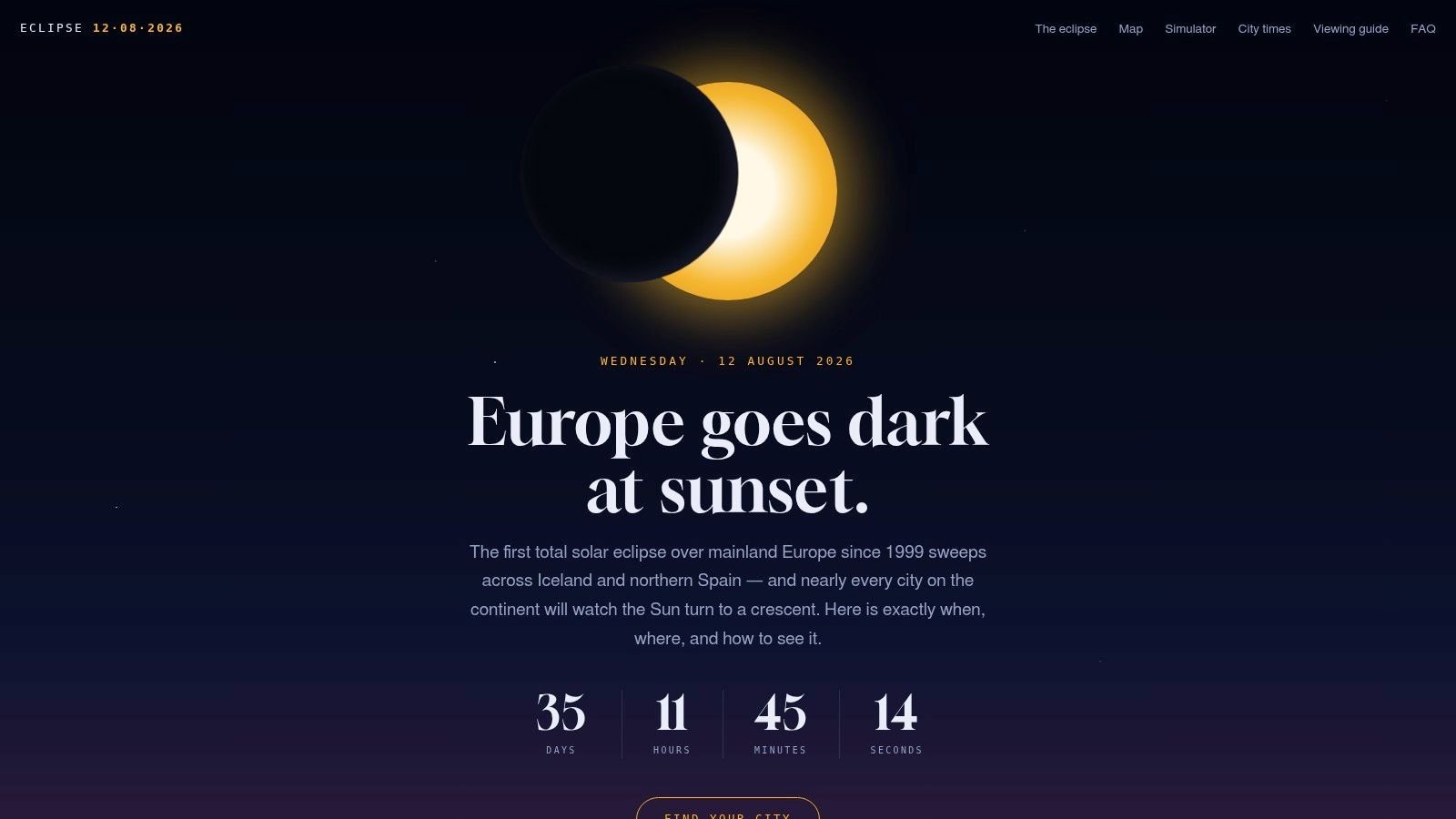
Why Iceland and Spain matter
On August 12, 2026, the Moon's umbral shadow is expected to cross the North Atlantic and reach land in a small set of especially interesting locations. Iceland draws attention because this eclipse is unusually significant there. Spain draws attention for a different reason. It puts totality within reach of large numbers of travelers, while adding a late-day viewing challenge that can make local site choice more important than first-time eclipse chasers expect.
A useful way to picture the difference is to compare the Sun's position to a stage performance. In some eclipses, the show happens high overhead and almost any open field works. In Spain in 2026, the Sun will be much lower, closer to the horizon, so the “front row” can be blocked by ridges, buildings, trees, haze, or even a badly placed rooftop terrace.
Your map matters. Your horizon matters too.
What Spain viewers need to plan for
In northern Spain, totality is expected late in the day, fairly close to sunset. That changes the whole planning mindset. A town inside the path is not automatically a good observing site if the western skyline is cluttered.
A strong Spanish viewing site usually has three traits:
- a clear view toward the western horizon
- enough elevation or openness to avoid nearby obstructions
- enough flexibility that you can relocate if local weather shifts
Coastal locations can be excellent if they face west cleanly. Inland high ground can also work well, especially if it gets you above low haze, but only if the terrain in front of you does not rise into the Sun's line of sight. Urban viewpoints are the trickiest. They can succeed, but you need to scout for cranes, apartment blocks, ridgelines, and all the ordinary obstacles that feel invisible until eclipse day.
For location-specific planning, this specialized guide for Spain is useful because small differences in horizon angle can decide whether you see the full event or lose the Sun behind terrain in the final minutes.
A moving simulation helps as well, because late-afternoon eclipse geometry is easier to understand when you watch the shadow progress across the Earth's surface rather than reading times from a table.
On eclipse day: Ask two questions. Are you inside the path of totality? Can you still see the Sun clearly in the final hour?
Travel planning matters almost as much as astronomy here. Iceland and northern Spain are both attractive in August even without an eclipse, so accommodation and transport are likely to tighten as the date approaches. Flexibility can beat fame. A less celebrated town with an open western view and room to move may serve you better than a popular hotspot where traffic, crowds, or local terrain limit your options.
Eclipse Viewing Safely and Debunking Myths
The most important rule in eclipse observing is also the least negotiable. If any part of the bright Sun is visible, you need proper solar viewing protection. That means certified eclipse glasses that meet ISO 12312-2, or properly designed solar filters on optical equipment.
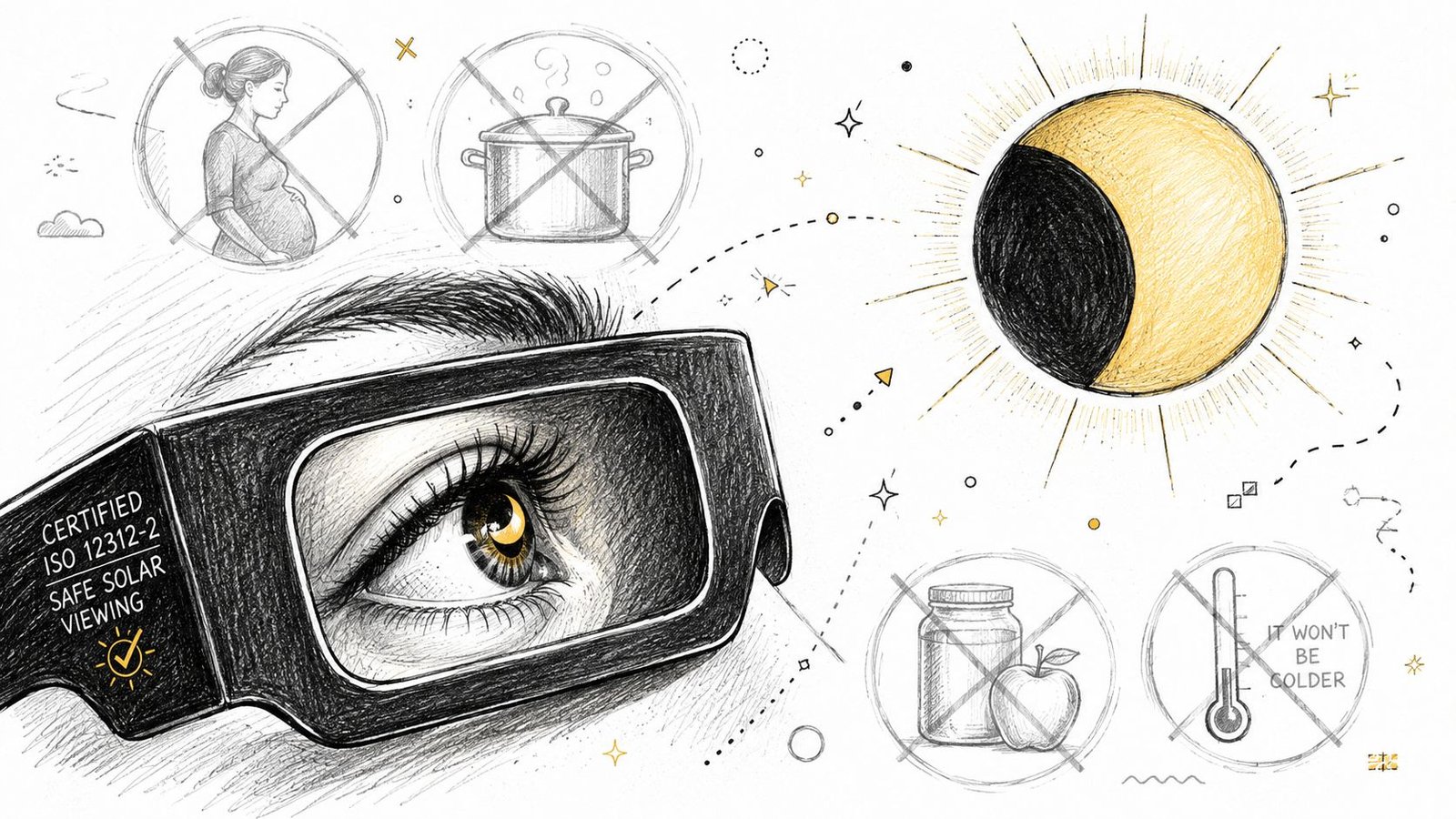
The safety rule that isn't negotiable
During all partial phases of a solar eclipse, the Sun is still bright enough to damage your eyes. Sunglasses won't do the job. Smoked glass won't do the job. A camera, binoculars, or telescope aimed at the Sun without the right front-mounted solar filter is dangerous.
For a concise checklist before eclipse day, this solar eclipse safety guide covers the basics observers should confirm in advance.
A total solar eclipse has one exception, and only one. During totality itself, when the Sun's bright disk is fully covered, it's safe to look with the naked eye. The moment bright sunlight returns, eye protection goes back on.
The myths that cause bad decisions
The most expensive eclipse mistake isn't usually about astronomy. It's about assumptions.
The biggest one is the idea that 99% partial is basically the same as total. It isn't. The critical experiential difference between 99% partial eclipse and true totality remains poorly explained; 99% obscuration still emits intense sunlight, whereas totality plunges the environment into twilight and reveals the Sun's corona, as discussed in this article on common total solar eclipse misconceptions.
That's why being inside the path matters so much for 2026. Near-total is still partial.
Another persistent myth belongs on every educator's cleanup list: the phases of the Moon are not caused by Earth's shadow. That shadow causes lunar eclipses only when the alignment is exact at full Moon. The ordinary monthly phases come from our changing view of the sunlit half of the Moon as it orbits Earth.
A person who confuses lunar phases with eclipses will usually underestimate how exact eclipse alignment has to be.
Get those two ideas right, and almost every other eclipse question becomes easier.
For reliable, Europe-focused planning for August 12, 2026, visit Total Solar Eclipse 2026 Live. It brings together path maps, city timing, viewing guidance, safety information, and practical planning tools for observers in Spain, Iceland, and across Europe.