July 22, 2026
When Is the Next Solar Eclipse in Indiana: Your 2026 Guide
On August 12, 2026, Indiana's next solar eclipse runs from 1:09 p.m. EDT to 1:58 p.m. EDT. In Fort Wayne, the maximum obscuration is only 0.46%, which is a useful way to frame the whole event, this isn't a destination eclipse for Indiana observers.
Indiana will still see the eclipse, but barely. The numbers point to a shallow partial phase that matters more for planning than for spectacle, and that's the core question most readers have when they search when is the next solar eclipse in Indiana. If you want the data, the timing, the city-by-city differences, and the decision point on whether to stay local or travel, the guide below breaks it down from a practical, observer-focused angle, with statewide timing and obscuration details from Timeanddate's Indiana eclipse table and the larger geometry explained by NASA.
Table of Contents
- Introduction
- Overview of Indiana's Next Solar Eclipse
- City By City Visibility and Timings
- How to Use the Indiana Visibility Map
- Understanding Eclipse Type and Obscuration Levels
- Safe Viewing Practices with ISO Eyewear
- Planning Tips for Viewing and Photographing
- Quick Reference Table for Major Indiana Cities
- Glossary and Related Resources
Introduction
Fort Wayne's maximum obscuration for Indiana's next solar eclipse is only 0.46%, which is the kind of number that resets expectations fast. The state's next event arrives on August 12, 2026, and it's a minor partial eclipse that will barely move the needle for most viewers.
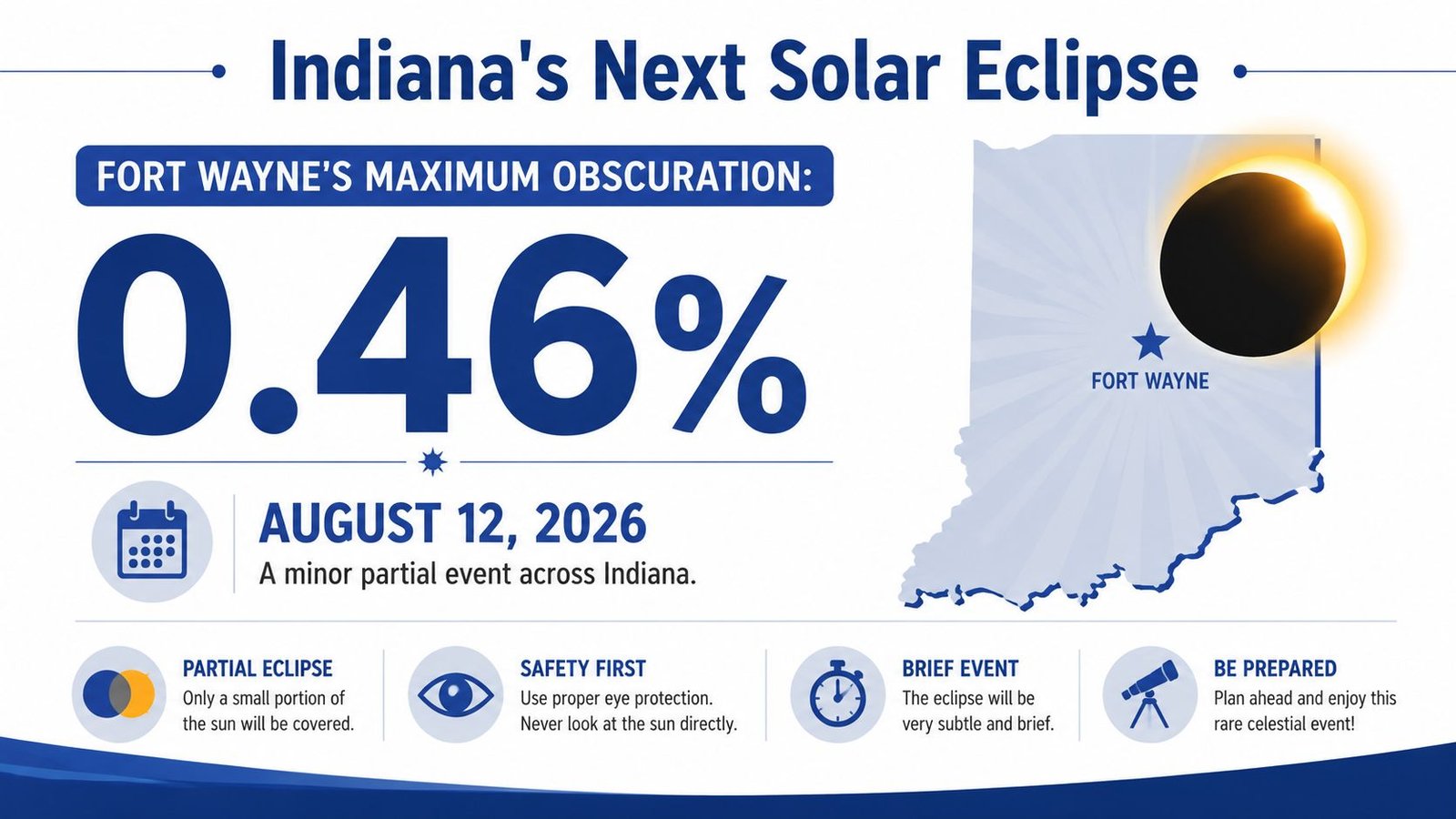
Indiana observers will get a brief partial phase, not totality, and the difference matters. A partial eclipse can be scientifically real yet visually subtle, especially when coverage stays below 1% in most locations, which is why many Hoosiers may not notice anything obvious unless they're comparing images or checking the sky with care. Timeanddate's Indiana eclipse page places the statewide window at 1:09 p.m. EDT to 1:58 p.m. EDT and shows how limited the event is from city to city, while NOAA-style expectations of a dramatic darkening do not apply here.
Practical rule: if a local eclipse is under 1% obscuration, treat it as an observation opportunity, not a spectacle.
This guide follows the numbers in the right order. First comes the statewide context, then city-level timings, then the visibility map, eclipse type basics, safety, and planning advice for observers who are deciding whether to stay put or chase a more meaningful view elsewhere. The key point is simple, Indiana gets a technically visible eclipse, but not a memorable one.
Overview of Indiana's Next Solar Eclipse
NASA's geometry makes the Indiana result easy to understand. The total solar eclipse on August 12, 2026 tracks far to the northeast for U.S. observers, crossing Greenland, Iceland, Spain, and a small corner of Portugal as a total eclipse, while much broader regions only see a partial phase. In other words, Indiana is outside the path of totality, so the state gets the fringe of the event, not the central shadow.
The local timing is short and clean. Indiana's partial eclipse begins at 1:09 p.m. EDT and ends at 1:58 p.m. EDT, and that window applies statewide for the next solar eclipse visible in the state. The duration sounds like a normal lunch-hour event, but the important part is the quality of the event, not the clock time.
What that means for Indiana observers
Indiana doesn't get the dramatic mid-day darkness that travel eclipse chasers build trips around. Instead, it gets a small bite out of the sun that stays shallow enough to be easy to miss unless you know exactly when and where to look. That's why the same August 12, 2026 event is a major eclipse for observers in the path of totality and a near-non-event for most of Indiana.
NASA's summary also reinforces a useful planning distinction. The event is total in the narrow international path, but it is only partial across parts of North America, Europe, Africa, and other broad areas. For Indiana, that means the next eclipse is real, observable, and safely watchable with proper gear, but it is not the kind of eclipse that rewards a full travel budget or a long drive on spectacle alone.
If your goal is to see totality, Indiana isn't the place to do it in 2026. If your goal is to confirm the timing, photograph a subtle solar bite, or teach eclipse basics, the state will still provide a clean example of a deep partial viewed from outside the central track.
City By City Visibility and Timings
The statewide window hides a lot of local nuance, even if the visual differences are tiny. Timeanddate's city data show obscurations ranging from 0.04% in Hammond to 0.46% in Fort Wayne, which tells you the best local strategy isn't “find the biggest eclipse,” it's “understand how little variation there really is.” Across Indiana, the event is shallow enough that the city with the best coverage is still nowhere near a dramatic viewing experience.
Reading the numbers without overthinking them
A city's start time tells you when the partial phase becomes technically active. The end time tells you when the moon fully clears the sun from that location's perspective. The maximum obscuration is the only number that holds significant interest, because it shows how much of the sun gets covered at the peak.
For Indiana in 2026, the practical takeaway is that no city crosses into meaningful partial coverage, let alone totality. That matters because even a change from one town to another won't move the experience from “barely visible” to “obvious.” It just shifts the event from one negligible percentage to another.
How to compare cities
Look at your nearest city first, then compare it with nearby options if you're planning a small drive. If your goal is pure observation, the city with the highest obscuration is still the best local pick. If your goal is photography, timing, or demonstration, the differences are subtle enough that convenience usually beats chasing a few hundredths of a percent.
Observer's note: the closer you are to the northwest side of the state, the better the numbers get, but the event still remains a very shallow partial.
That is the primary decision value in Indiana. The city table matters less as a spectacle guide and more as a confirmation that the whole state sits in the same low-impact category, with tiny local variations but no meaningful leap in visibility.
How to Use the Indiana Visibility Map
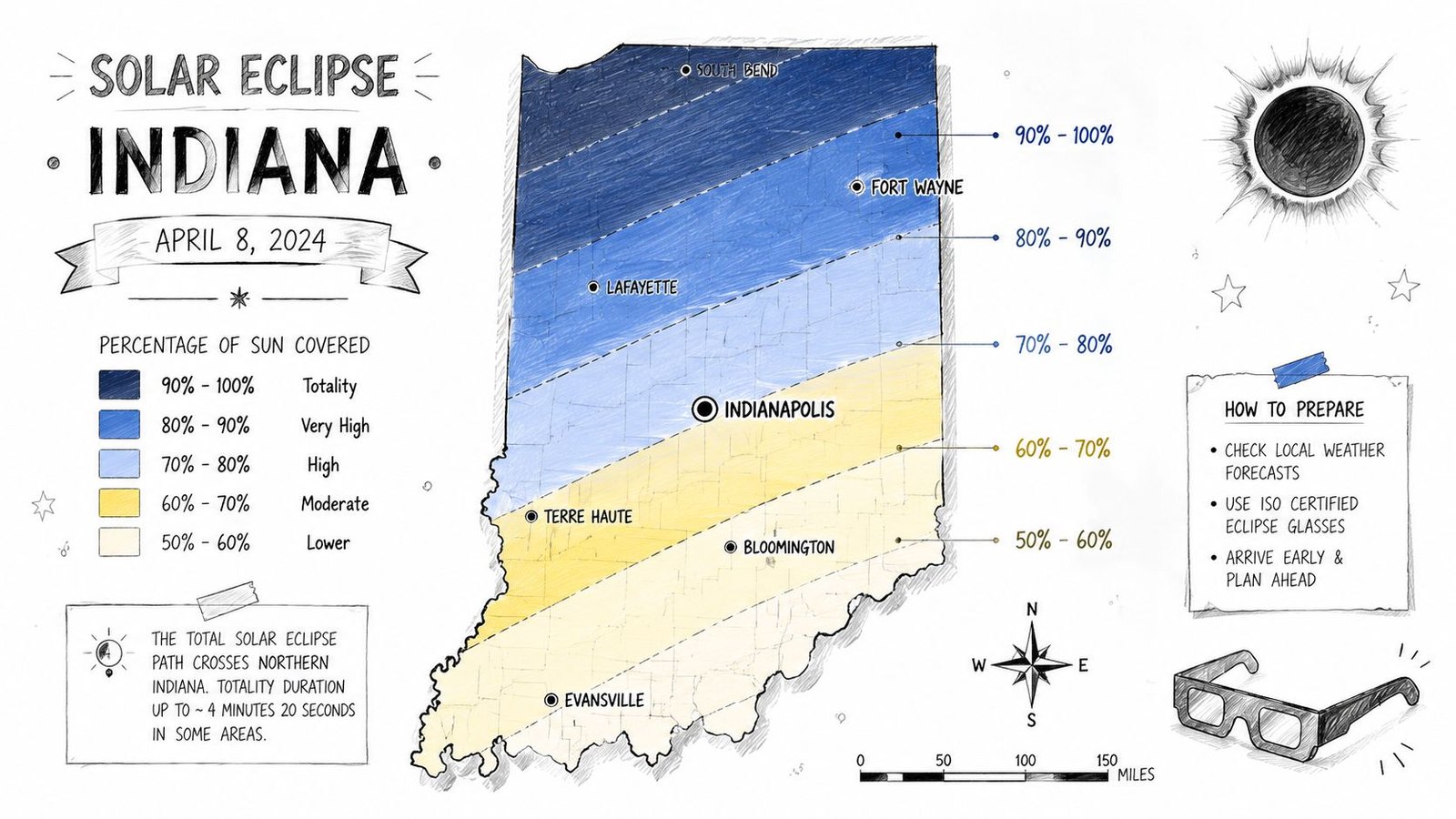
A visibility map is useful because it turns one statewide label into a gradient you can compare. For Indiana's next eclipse, that matters less for finding a dramatic viewing zone and more for confirming how little changes from place to place. The best map use is not to hunt for a major difference, but to verify that the partial eclipse remains weak across the state, with only small gains toward the northwest.
What to look for on the map
Start with your exact location, then check the nearest labeled city or contour band. If your town sits in a lighter-shaded area, the obscuration is lower there. If the map includes contour lines, those lines show where the percentage shifts, which is the cleanest way to judge whether a short drive changes anything in practice.
For this event, the map should read as a decision tool, not a spectacle guide. It shows that Indiana is divided only by fine technical differences, while the lived viewing experience stays extremely subtle almost everywhere. That helps you decide whether a backyard stop is enough, whether a small drive makes sense, or whether the low payoff argues against changing plans at all.
A map built for the August 12, 2026 eclipse should also make one conclusion obvious. Northwest Indiana gets the strongest partial view in the state, but even there the event remains far from the kind of eclipse that justifies travel for its own sake. If you want a quick refresher on eclipse basics before reading the map, this overview of solar and lunar eclipses gives the terminology that makes the shading easier to interpret.
Understanding Eclipse Type and Obscuration Levels
A partial eclipse means the moon covers only part of the sun. A total eclipse means the moon fully covers the solar disk for observers in the narrow path of totality, while an annular eclipse leaves a bright ring because the moon appears smaller than the sun. Indiana's August 12, 2026 event is a partial eclipse, and the obscuration stays so low that it sits far below the threshold typically noticeable in normal daylight.
Time.now's Indiana eclipse summary says a 2.8% obscuration threshold is typically needed for noticeable dimming, which puts Indiana's next eclipse well under that bar. That's the key interpretive fact, because it separates a technical event from a visually useful one. Under that threshold, the sky may not look meaningfully different unless you're tracking the sun directly and carefully.
Why this matters for decision-making
A 99% partial eclipse still isn't totality, and Indiana's 2026 event is nowhere close to that. The moon's shadow path misses the state's centerline, which is why the numbers stay so small and the experience stays so subdued. In practical terms, that means the event is good for measurement, teaching, and safe filtered observation, but weak for travel planning if you want drama.
If you're new to eclipse terminology, a quick reference on solar and lunar eclipse basics can help anchor the definitions, and the overview at what is a solar and lunar eclipse is the most direct place to start.
Bottom line: Indiana's 2026 eclipse is technically visible, but it's not a visually significant sky event for most observers.
That's the decision value. The numbers don't just tell you when to look, they tell you whether the sky will reward the effort.
Safe Viewing Practices with ISO Eyewear
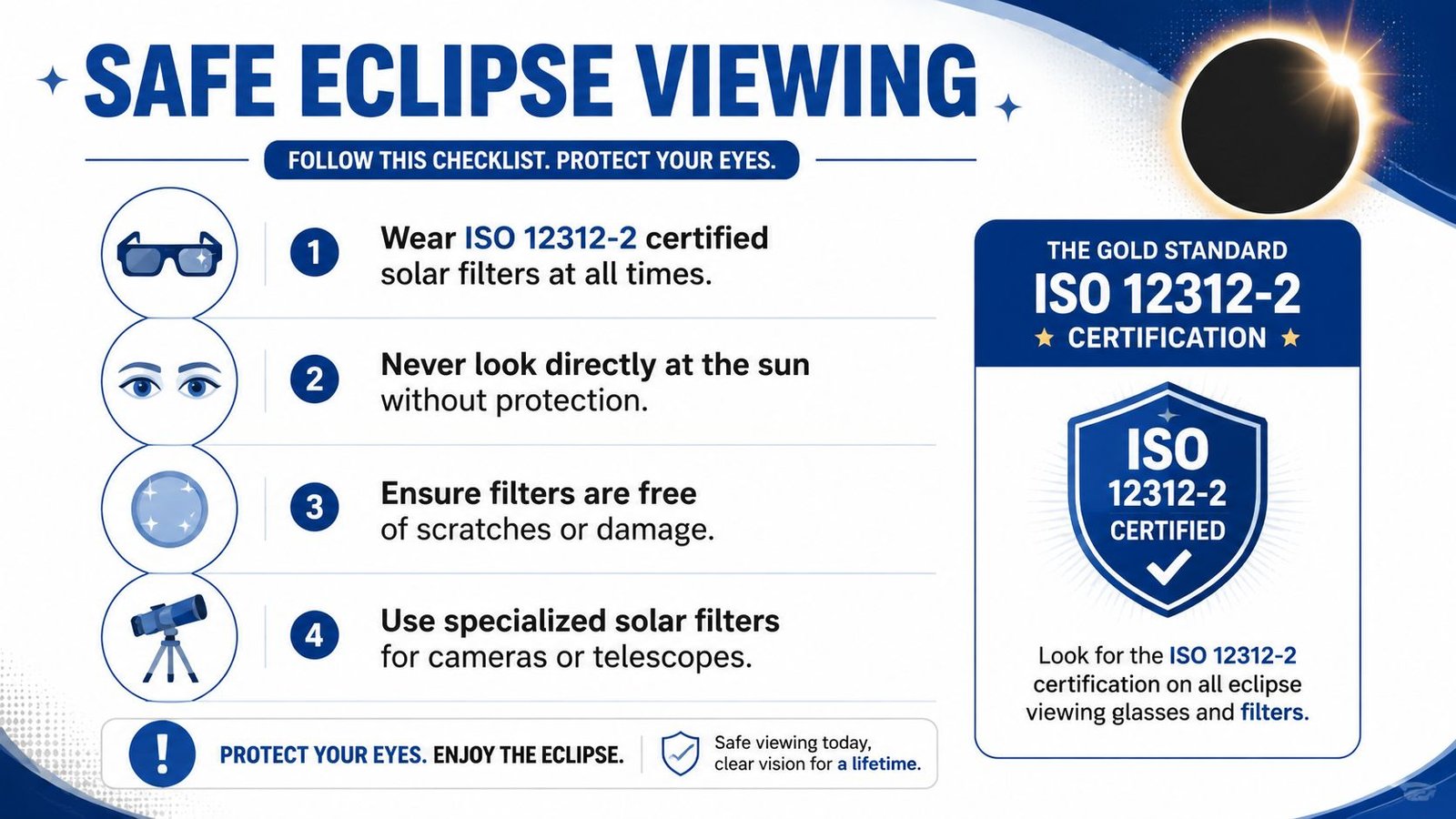
Even a weak partial eclipse needs real solar protection. The sun is still dangerously bright, and any direct view without proper filtration can damage your eyes whether the eclipse is deep or shallow. Use ISO 12312-2 certified solar filters for any unaided viewing during the partial phase, including the entire Indiana event window.
What safe viewing looks like
Wear certified eclipse glasses before you look up, and keep them on whenever the sun is visible. Check the glasses for scratches, tears, or punctures, because damaged filters aren't reliable. If you're using a camera, binoculars, or telescope, those need dedicated solar filters too, since ordinary eyewear doesn't protect optics.
Avoid improvised materials such as smoked glass, exposed film, or sunglasses. They don't block enough solar energy, and they can create a false sense of safety because the sun still looks dimmer to the eye while remaining harmful. The same rule applies to phones and unfiltered lenses, the device may survive, but your eyes shouldn't be part of the experiment.
A short safety video can reinforce the basics, especially for families and first-time viewers.
For a deeper checklist on certified eye protection, see the guide on eclipse safety glasses. The standard doesn't change because the eclipse is small, and that's exactly why consistency matters.
Planning Tips for Viewing and Photographing
If you're staying in Indiana, pick an open site with a clean view of the sky and minimal tree cover. A small eclipse still benefits from a clear western or southern horizon, because any obstruction makes an already subtle event harder to notice. If you're thinking about travel, the numbers suggest a different question than usual, not “where can I see totality,” but “is it worth chasing a slightly better partial?”
Decide based on value, not just mileage
The strongest local upgrade is northwest travel. One Indiana report says viewers would need to go northwest of Angola to reach roughly 1% eclipse coverage, which is still modest but better than the rest of the state's tiny obscurations. That tells you something important, the event improves only incrementally as you move toward the northwest edge.
Parking and crowd issues should be light compared with a major eclipse, but don't assume the day is frictionless. A few people will still set up in parks, school lots, and open fields, especially if they want to compare filtered views or capture the sun at maximum obscuration. Since the event is brief and partial, mobility matters more than fixed seating.
For photography, use a solar filter on the lens during every partial phase. Bracket exposure carefully, because the sun remains bright even when the coverage is tiny. If you're stacking frames or building a comparison sequence, the workflow guide at astronomy photo stacking software is useful for organizing eclipse imagery after the fact.
Photographer's rule: don't leave the filter off just because the eclipse is weak. The camera sensor and your eyes both need protection.
If your goal is a memorable eclipse trip, Indiana's 2026 event probably isn't the one to build it around. If your goal is a controlled local observation with minimal travel, it's enough to justify a careful setup and a quick look at maximum coverage.
Quick Reference Table for Major Indiana Cities
| City | Start Time (EDT) | End Time (EDT) | Max Obscuration (%) |
|---|---|---|---|
| Indianapolis | 1:09 p.m. | 1:58 p.m. | 0.22% |
| Fort Wayne | 1:09 p.m. | 1:58 p.m. | 0.46% |
| Evansville | 1:09 p.m. | 1:58 p.m. | 0.12% |
| South Bend | 1:09 p.m. | 1:58 p.m. | 0.08% |
| Hammond | 1:09 p.m. | 1:58 p.m. | 0.04% |
The city table makes the decision point plain. Indiana shares the same short observation window across these major cities, but the maximum obscuration stays very low even at the higher end of the state. Fort Wayne offers the strongest city-level view in this group, while Hammond is the weakest, and the gap between them is still small in practical terms. For eclipse chasers, that means the local event is best treated as a brief partial check-in, not a trip anchor.
If you only need a fast planning snapshot, this table gives it. It shows where the slight differences sit without overstating what Indiana delivers, and it helps separate a modest local observation from a more meaningful eclipse experience elsewhere.
Glossary and Related Resources
Umbra is the darkest central shadow, the zone that creates totality for observers on the centerline. Penumbra is the lighter outer shadow, the region where a partial eclipse is visible. Obscuration is the percentage of the sun covered by the moon from a given location, and it is the clearest shorthand for comparing how much of the eclipse a city can see.
For readers who want to verify the local view, the Indiana eclipse details are available on Timeanddate's Indiana page, and NASA explains the broader August 12, 2026 event on NASA's future eclipses page. The first source is the better fit for timing and location-specific visibility, while the NASA page gives the larger geometry that explains why Indiana sees only a partial event. Used together, they make the decision clearer, watch locally for a brief partial eclipse, or travel for a more meaningful eclipse experience.
A shallow eclipse is a timing exercise, not a spectacle. That frame keeps the map, the city table, and the safety guidance in proportion, so readers can judge Indiana's next eclipse by its practical value rather than by the label alone.
A CTA for Total Solar Eclipse 2026 Live.