July 19, 2026
Eclipse Safety Glasses: Your 2026 Europe Viewing Guide
You're probably doing one of two things right now. You're either comparing eclipse trips to northern Spain and Iceland, or you've already booked one and realized the smallest item in your bag may be the most important one you carry on eclipse day.
That item is a pair of eclipse safety glasses.
For the August 12, 2026 total solar eclipse, the drama in Europe comes with a twist. In Spain, the eclipse will happen low in the evening sky, close to sunset. In Iceland, the setting is different, but the safety rule is the same. If any part of the Sun's bright face is visible, your eyes need proper protection. First-time viewers often focus on weather, timing, and photography. Experienced eclipse chasers worry about those too, but they also know that counterfeit or misused glasses can ruin the day in seconds.
Table of Contents
- Your Front-Row Seat to the 2026 European Eclipse
- The Science Behind ISO 12312-2 Certified Glasses
- How to Spot Fakes and Test Your Glasses
- Using Glasses Correctly for the 2026 Sunset Eclipse
- Care Storage and Safe Photography Alternatives
- Your Final Eclipse Safety Checklist for 2026
Your Front-Row Seat to the 2026 European Eclipse
A traveler stands on a headland in Galicia. Another waits along the coast in Iceland with a clear western view and a nervous eye on the clouds. Both have spent months planning where to stand, when to arrive, and how to get that rare combination of open horizon and luck.
Then the light starts to change.
The eclipse on August 12, 2026 is worth that effort. At its maximum, totality will last exactly 2 minutes and 18.21 seconds, and that maximum point occurs 45 km off the western coast of Iceland, as described in Space.com's guide to the 2026 total solar eclipse. That's a short interval, but anyone who has seen totality knows it doesn't feel short. It feels concentrated. The sky darkens, the temperature seems to shift, and the crowd usually falls silent.
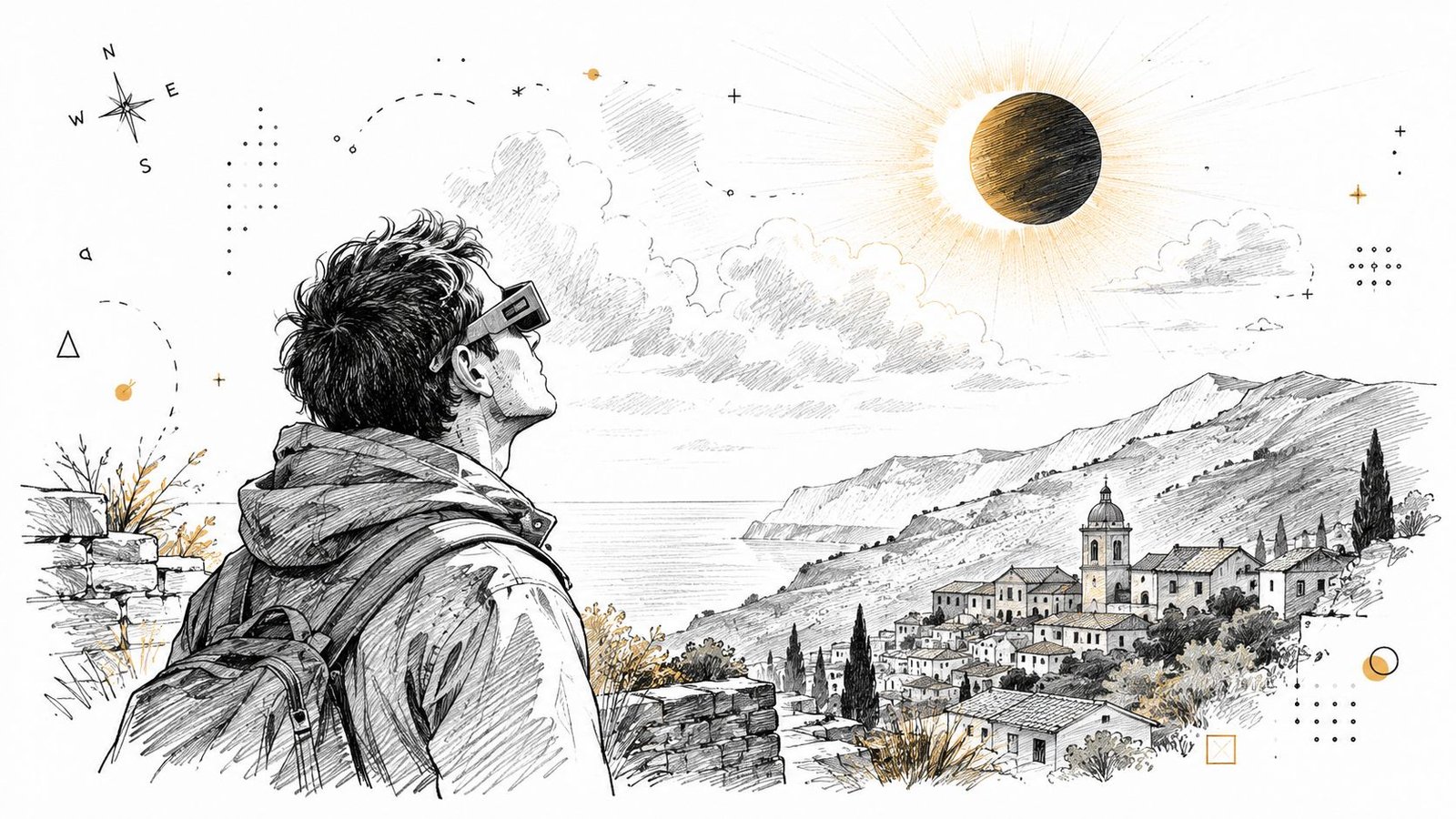
The danger is that the most beautiful eclipses are also the ones that tempt people into bad decisions. A low Sun can look softer. A dimming sky can feel safer. Those are visual cues, not safety cues.
Practical rule: Treat eclipse safety glasses as essential gear, not a souvenir. They matter more than your camera and more than your perfect viewing spot.
If you're viewing from Europe in 2026, especially in Spain near sunset, you need more than generic advice. You need to know what safe glasses are, how to verify them, and how to use them when the evening light starts fooling your instincts.
The Science Behind ISO 12312-2 Certified Glasses
A proper pair of eclipse safety glasses is a solar filter in wearable form. Its job is very specific. It reduces the Sun from a blinding energy source to a small, controlled image your eyes can view briefly and safely during the partial phases.
That narrow job description matters for the 2026 European eclipse because many viewers will be watching a low evening Sun. Near sunset, the light can feel gentler and the sky can look dimmer. Your eyes may trust that scene. They should not. A low Sun is still the Sun.
What the standard actually means
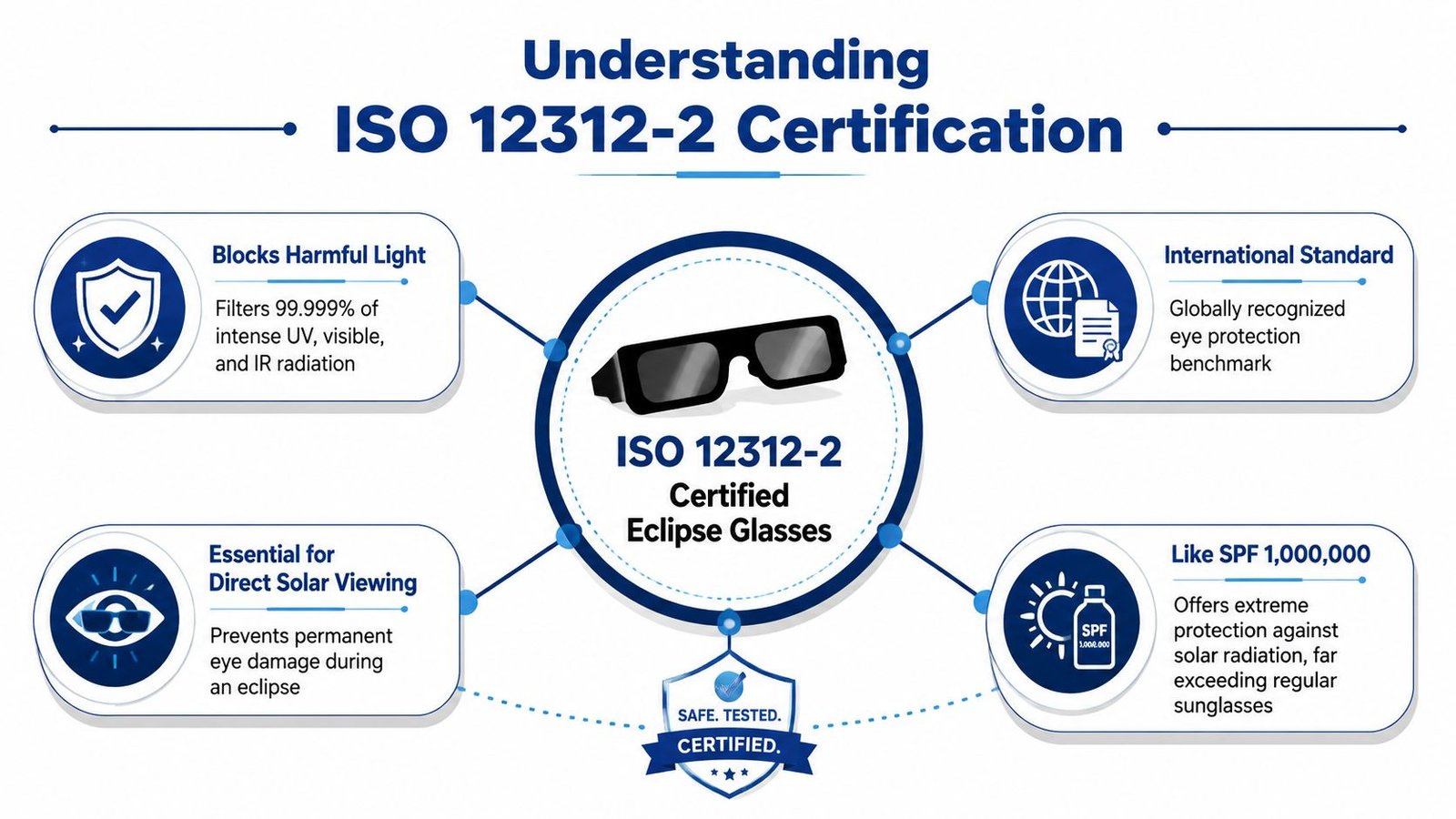
The label to look for is ISO 12312-2:2015. According to the International Organization for Standardization guidance on eclipse viewers, eclipse viewers that meet this standard allow only a tiny fraction of visible light through and are designed to protect against harmful solar radiation during direct viewing. The same guidance also says ordinary sunglasses, camera filters, and welding shades below 12 are unsafe for looking straight at the Sun.
The easiest way to understand this is to separate comfort from safety. Dark sunglasses may make sunlight feel comfortable. Eclipse glasses are made to make direct solar viewing safe within the limits of the product and the instructions. That is a much stricter requirement.
A useful comparison is a window blind versus a furnace shield. Both reduce what reaches you, but only one is designed for intense heat and light. Eclipse glasses belong in the second category.
If you want a quick refresher before choosing gear, this explainer on solar and lunar eclipses gives the basic mechanics.
Why eclipse glasses are so dark
Good eclipse glasses are dark enough that you should not be able to see ordinary indoor objects through them. That often surprises first-time viewers. People put them on in a room, see almost nothing, and assume something is wrong. In fact, that is close to what you want.
Point them only at the Sun, or at a very bright reflection of the Sun, and the filter should reveal a clear bright disk. Everything else should stay extremely dim or invisible. That is the whole point. The filter is not trying to preserve a normal daytime view. It is trying to cut overwhelming light down to a level your eyes can handle.
This becomes especially important in western Europe, where many travelers may be viewing late in the day over water, haze, or a bright horizon. Those conditions can make the scene feel softer while still exposing your retina to concentrated sunlight.
What to look for on the glasses
The printing on the glasses is part of the safety system because it gives you traceability. If a product has no clear identity, you have no easy way to tell who made it, which standard it claims to meet, or whether it belongs in the European PPE system.
A compliant pair sold in Europe should show the reference ISO 12312-2:2015 on the packaging and usually on the viewer itself. In Europe, Regulation (EU) 2016/425 also adds practical traceability expectations, including a visible CE mark and the manufacturer's address.
Use this quick screening table before you buy or before you pack:
| Marking or detail | Why it matters |
|---|---|
| ISO 12312-2:2015 | Identifies the relevant international safety standard |
| CE mark | Shows the product is presented for compliance within the European PPE framework |
| Manufacturer's address | Gives traceability if something is wrong |
| Lot or batch information | Helps identify a specific production run |
Regular sunglasses fail here for the same reason a bike helmet fails as a climbing helmet. Each is protective gear, but each is built for a different hazard.
How to Spot Fakes and Test Your Glasses
You arrive on a Spanish headland on eclipse evening, the Sun is dropping toward the Atlantic, and someone nearby offers you a spare pair of glasses still in the wrapper. In that moment, the wrapper means very little. For a low-sun eclipse like Europe will get in 2026, you want to know two things before you trust any pair: where it came from, and whether the filters behave like real solar viewers.
The safest way to check is to treat eclipse glasses the way you would treat a life jacket on a ferry crossing. The label matters because it tells you who made it and which standard it claims to meet. The material matters because a convincing fake can still let through far too much light.
Start with the paper trail
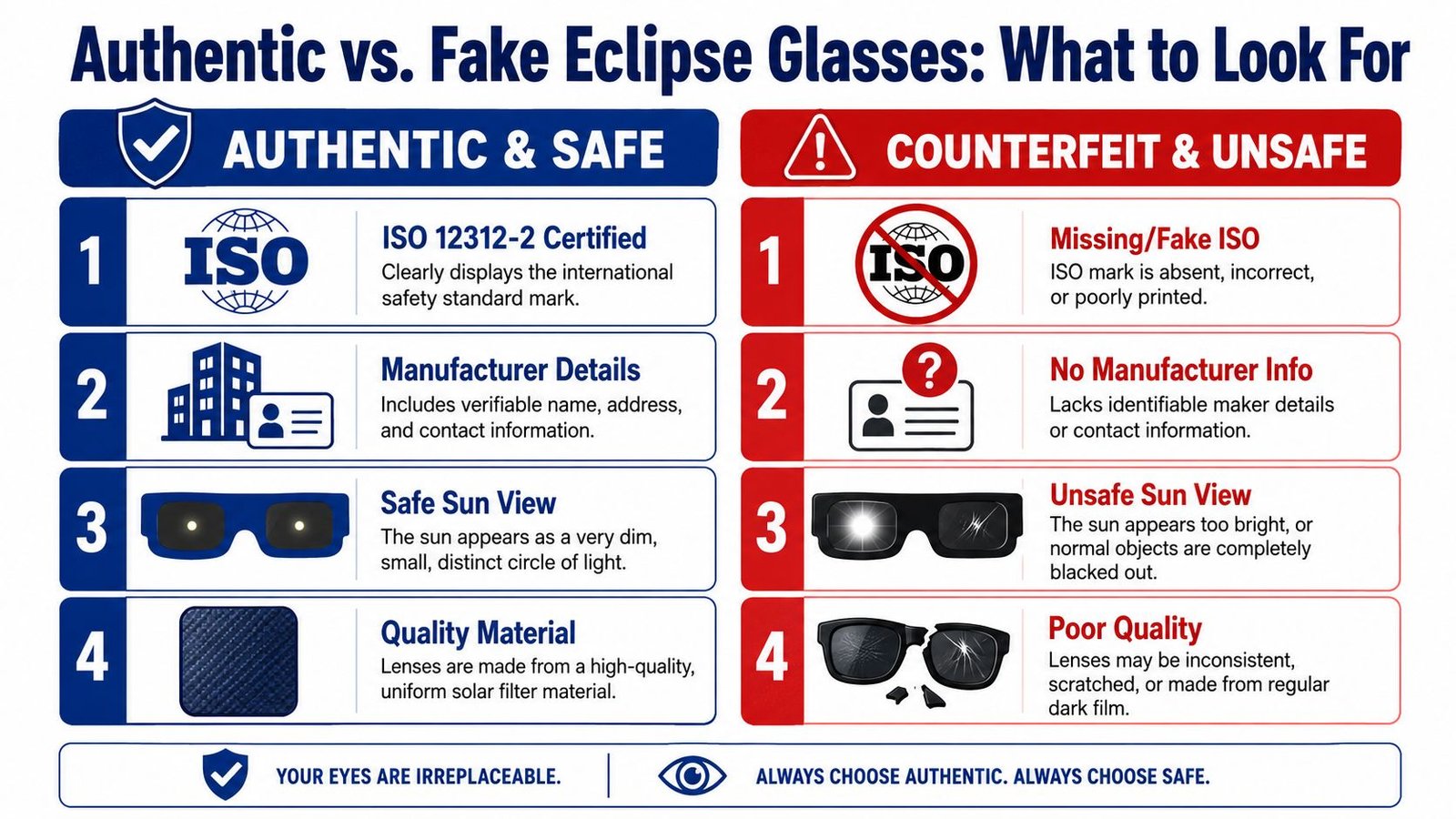
Counterfeit glasses often copy the look of legitimate eclipse viewers. They print familiar words, add official-looking symbols, and arrive in neat packaging. That is why your first check should be traceability, not appearance.
A safety review summarized in the University of Hawaiʻi paper on eclipse eyewear safety found that some viewers sold as compliant still failed basic transmission checks, while products from verified sellers performed more reliably. The lesson is practical. During eclipse season, buying from a known source matters as much as reading the print on the frame.
Check for these signs before you trust a pair:
- Printed standard reference: Look for ISO 12312-2:2015 written clearly and completely.
- European traceability details: For products sold in Europe, a CE mark and a real manufacturer address should be present.
- Clean construction: The filter material should be even, with no waviness, peeling, gaps, or loose edges.
- Seller reputation: Astronomy clubs, science museums, observatories, and established specialist retailers are safer bets than anonymous marketplace listings.
For the 2026 eclipse, this matters even more than usual. Many travelers will be buying glasses shortly before departure, sometimes from temporary vendors near viewing hotspots. A sunset eclipse creates a holiday atmosphere, and holiday atmosphere is exactly when people lower their guard.
Use the indoor light test
Paperwork tells you whether a product is worth considering. The indoor test tells you whether the filters behave like eclipse glasses.
Guidance discussed in the same study, drawing on post-2017 eclipse safety checks, points to a simple rule used by NASA and the American Astronomical Society: when you wear proper eclipse glasses indoors, ordinary room lighting should vanish. That surprises first-time viewers, but it makes sense. These filters are built for the Sun, not for everyday seeing.
Watch this short demonstration before you test your own pair:
Try the test this way:
- Put the glasses on indoors. Choose a normally lit room, not a dark hallway.
- Look toward lamps or ceiling lights. Regular indoor lights should disappear or be barely perceptible.
- Check what else you can see. If you can comfortably make out furniture, walls, faces, or objects across the room, the filters are not doing the job.
- Set aside any doubtful pair. Good eclipse glasses do not give you a dim version of normal vision. They block almost everything.
A useful mental check is this: real eclipse glasses should feel closer to looking through a welder's filter than through dark sunglasses. If you can wear them and casually walk around your hotel room, do not pack them for eclipse day.
A quick buyer's checklist
Run through this when your glasses arrive, not at the coast with minutes to spare:
- Check the print: Confirm the markings are readable, complete, and not smeared or partly missing.
- Inspect the filters: Reject any pair with scratches, pinholes, creases, peeling layers, or uneven color.
- Run the indoor test: Test each pair before you travel.
- Bring a backup pair: Travel, bags, sand, and last-minute handling can damage glasses that were fine at home.
If a pair fails either check, the label check or the indoor test, treat it as unsafe. With the 2026 eclipse occurring low over the horizon, many people will be tempted to trust what feels dim enough. Your eyes do not judge safety by comfort. The filter either blocks the light properly, or it does not.
Using Glasses Correctly for the 2026 Sunset Eclipse
You arrive at a coastal viewpoint in Spain. The light is warm, the Sun is low, and the whole scene feels closer to sunset sightseeing than to a serious eye-safety moment. That is exactly why this eclipse needs extra discipline. A low orange Sun can look gentle while still being bright enough to injure your eyes.
For many travelers planning to watch from Spain, the eclipse is expected to happen with the Sun low in the western sky near sunset, as described in the Wikipedia summary for the 2026 solar eclipse. That creates two practical problems at once. You need a clear horizon, and you cannot use the darkening surroundings as a safety signal. The sky may look dusky before the Sun is safe to view without protection.
Why sunset changes your judgment
Near sunset, your brain starts reading the whole scene as dimmer and calmer. Hills darken. Shadows stretch. The glare drops. That can make people feel they are looking at a weakened Sun, when in fact they are still looking at concentrated sunlight.
Clouds can add to the confusion. Thin haze, sea mist, or a bank of cloud near the horizon may make the Sun look filtered. It is not a substitute for eclipse glasses. If you can still see a bright solar crescent, your glasses stay on.
NPR's eclipse safety reporting highlighted a problem many first-time viewers run into. People know the rule in theory, but unusual lighting conditions make them second-guess it. The 2026 event in Europe adds that pressure because the partial phases blend into evening light.
The routine to practice before eclipse day
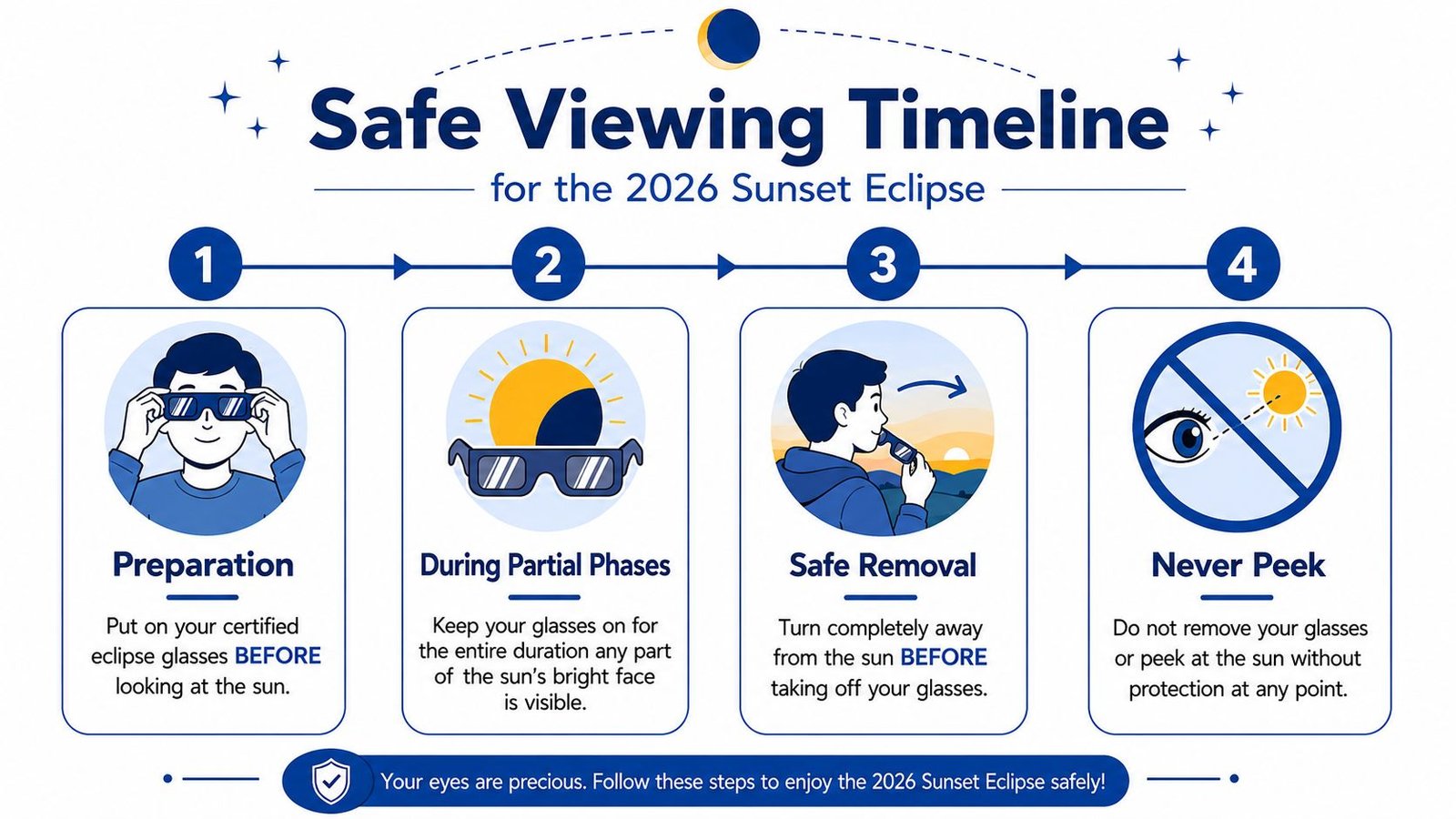
Use the same sequence every time you look up. Repetition helps when excitement rises.
- Put the glasses on before looking up. Not while looking, and not halfway through the motion.
- Keep them on during every partial phase. If any part of the Sun's bright surface is visible, your eyes need the filter.
- Turn away before taking them off. This removes the temptation to peek.
- Put them back on before looking up again. Treat each glance as a fresh start.
A good way to rehearse the timing is to watch a solar eclipse time-lapse sequence before you travel. It helps you picture the switch points, especially the moment when the Sun changes from a thin bright crescent to full coverage and then back again.
What first-time viewers often get wrong
The common mistake is using your surroundings as the cue. Do not do that. The safe cue is only the Sun itself.
If you are in the path of totality, you may remove your glasses only during the brief interval when the Moon completely covers the Sun's bright face. The instant even a tiny bright bead or crescent reappears, the glasses go back on before you look again. If you are outside totality, the glasses stay on for the entire eclipse.
This works like crossing a road by watching the traffic light, not the brightness of the street around you. The surroundings can change for many reasons. The signal you trust is the one tied to the hazard.
Groups need a plan too. Families and tour groups often make more mistakes because people copy the person next to them. Pick one person to track the stage of the eclipse and call out the transitions clearly, especially if children or first-time viewers are with you.
Care Storage and Safe Photography Alternatives
At a 2026 sunset eclipse viewing site in Europe, glasses often get damaged before the Sun is anywhere near the horizon. They get stuffed into a daypack, bent under a water bottle, or smeared with sunscreen on a windy beach or roadside stop. That matters because the filter only protects your eyes if its surface is intact from edge to edge.
Treat eclipse glasses more like a camera filter than a pair of sunglasses. Sunglasses can have a small scratch and still feel usable. Eclipse viewers are different. You are relying on them to cut the Sun's light to a safe level, so any puncture, peeling layer, deep crease, or loose seam is a reason to replace them.
Inspect and store them like delicate filters
Check them before you travel, not when the crowd is already looking up.
A quick routine is enough:
- Hold them under indoor light: The filter should look even, with no bright spots, pinholes, or patchy areas.
- Look closely at seams and tabs: Cardboard frames often weaken where the material folds or where the lenses are fixed in place.
- Store them flat: A folder, book, or rigid envelope helps prevent bends during travel.
- Keep them dry and separate: Keys, snacks, sand, and sunscreen are all common ways to scratch or contaminate the surface.
As noted earlier, safe eclipse viewers must meet ISO 12312-2. In practice, that means they are built to reduce the Sun's visible light to a tiny fraction and block harmful ultraviolet radiation. If the material is damaged, you are no longer looking through the filter as designed.
If you want to rehearse how the Sun's appearance changes during the event, this solar eclipse time-lapse sequence helps you picture the visual stages before eclipse day.
Why glasses are not camera filters
This is one of the most common mistakes first-time eclipse travelers make. Eclipse glasses protect eyes. They do not protect cameras, binoculars, telescopes, or long lenses.
The reason is simple. Optical equipment collects sunlight and concentrates it, the way a magnifying glass can concentrate light onto a small point. Eclipse glasses were never made to sit behind that focused beam. A telephoto lens or telescope can heat and intensify sunlight enough to damage the filter, the equipment, or your eyesight if you try to look through it.
For direct photos of the partial phases, use a solar filter mounted on the front of the lens or optical tube. Front-mounted matters because it stops most of the Sun's energy before that light enters the instrument. If you do not have the right filter, choose a safer alternative: photograph the scenery, the changing light, people reacting, crescent shadows under trees, or a simple pinhole projection.
Many eclipse chasers end the day with better memories from a calm, well-timed view than from rushed photos taken while juggling gear at sunset. That is especially true in Europe, where the low Sun, glare, and busy horizons can make people forget basic handling and safety.
Your Final Eclipse Safety Checklist for 2026
By eclipse day, you want your decisions finished. Don't leave anything important to the mood of the moment.
Run this checklist before you leave your hotel, campsite, or rental car:
- Certified glasses packed: Confirm the print, condition, and fit.
- Test already done: Don't postpone the indoor check until the crowd gathers.
- Viewing site chosen: In Spain, make sure your western horizon is low and unobstructed.
- Group plan set: If you're watching with others, agree on who tracks totality and who reminds everyone when protection goes back on.
- Camera expectations realistic: If you don't have a dedicated front-mounted solar filter, don't point optics at the Sun.
- No shortcuts near sunset: The dimmer surroundings in Spain doesn't make the partial phases safe.
The biggest mistake is thinking “almost total” is close enough. It isn't. The only time you may look without eclipse safety glasses is the brief interval when the Sun's bright face is completely covered. Before that, glasses on. After that, glasses back on immediately.
For a broader overview of planning and protective viewing practices, keep this eclipse safety reference handy before you travel.
If you're preparing to view the eclipse in Europe, Total Solar Eclipse 2026 Live is a practical place to check timing, path details, safety guidance, and location-specific planning for Spain, Iceland, and cities across the continent.