July 28, 2026
What Time Will the Moon Eclipse Tonight: 2026 Viewing Guide
6:04 a.m. to 7:02 a.m. EST is the totality window, and the point of greatest eclipse is 6:33 a.m. EST. The full event lasts 5 hours and 39 minutes, but “tonight” depends on your time zone, so the answer is the local start, peak, and end of totality where you are.
You're probably doing the same thing everybody does before an eclipse. You look up the headline time, glance at the clock, and wonder whether you need to stay up, wake up early, or forget it because the Moon won't even be up yet. That instinct is right, but the single clock-time answer is wrong.
Table of Contents
- Reading the Question Before You Read the Sky
- The Five Phases of a Lunar Eclipse Explained
- Why One Eclipse Spans Many Local Times
- How to Read a City-by-City Eclipse Timing Table
- Totality Versus Deep Partial and Why the Difference Matters
- Finding Tonight's Eclipse Time for Your Location
- Planning Around Weather and Horizon Conditions
- A Short Pre-Eclipse Checklist for Tonight
- Using a City Simulator to Fine-Tune Your Night
- Eclipse Timing Questions You Might Still Have
Reading the Question Before You Read the Sky
The right question is local, not global
People type what time will the moon eclipse tonight because they want one number they can circle on the clock. That's not how lunar eclipses work. The Moon moves through Earth's shadow on a fixed celestial schedule, but your location decides whether you see the whole thing, only part of it, or nothing at all during the most important phase.
The useful answer is a window, not a moment. You want the start of totality, the midpoint of greatest eclipse, and the end of totality in your own time zone, because that's when the Moon fully enters Earth's umbra and shows the strongest visual effect.
Practical rule: if your local time only gives you one number, it's probably the wrong answer for planning.
That's why “tonight” can be slippery. In one place, the eclipse is a late-night event. In another, it's a pre-dawn show, and in some regions the Moon can be below the horizon during totality, which makes the headline time useless. The right move is to think like a skywatcher, not like a headline reader.
What you should look for first
Start with three things, in this order. First, check whether the eclipse is even visible from your location. Second, find the peak or totality window in local time. Third, check moonrise, moonset, and horizon direction so you know whether the best part happens while the Moon is still up.
The rest of this guide gives you a practical way to do exactly that. It keeps the jargon light, shows you how the phases fit together, and helps you decide whether staying awake is worth it. If you're tracking a Europe-centered solar eclipse in August 2026, the same mindset applies, but the location math becomes even more important because the path and timing change sharply across the continent.
The Five Phases of a Lunar Eclipse Explained
The Moon does not jump straight to totality
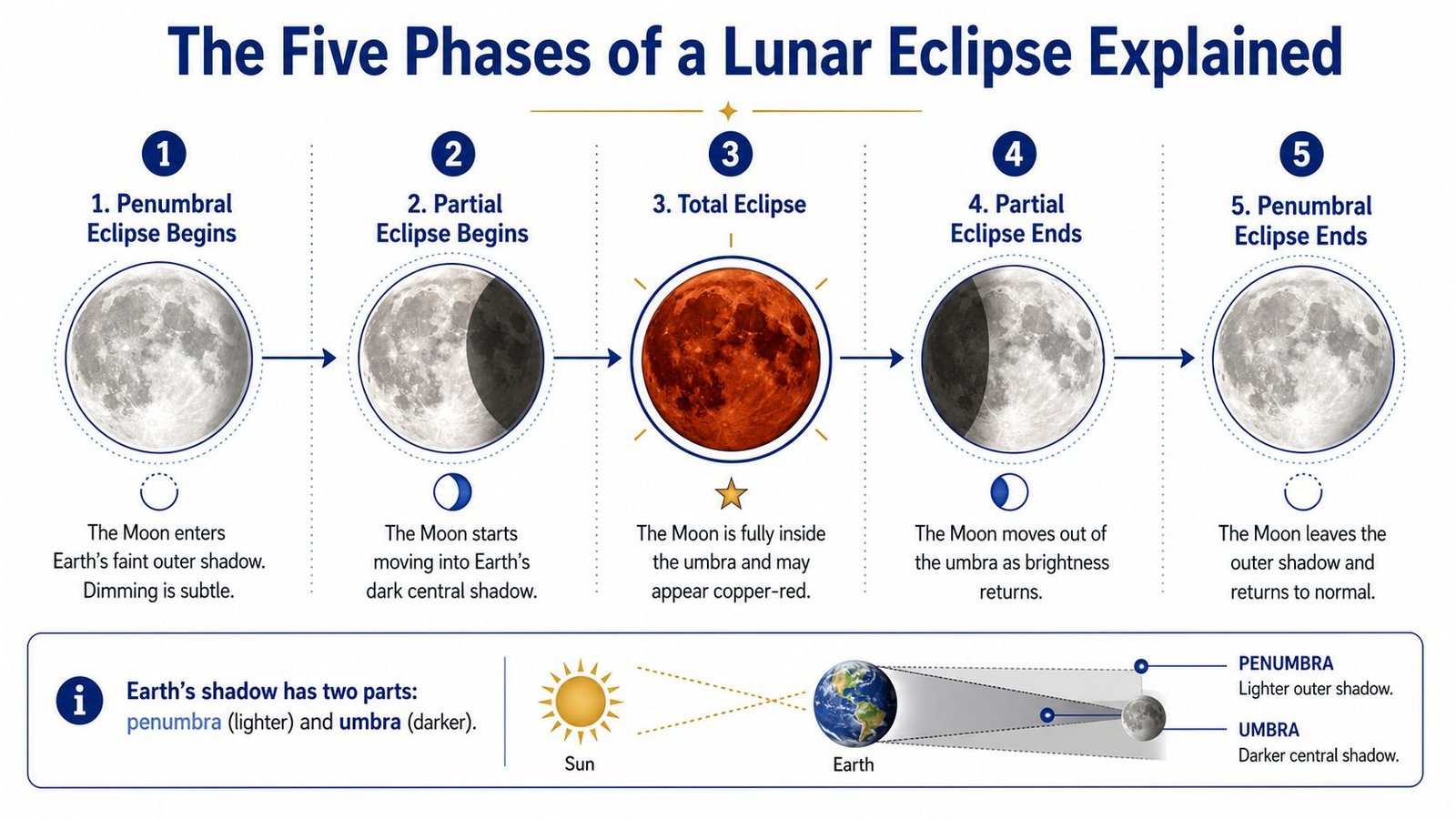
A lunar eclipse unfolds in stages. The first phase is penumbral eclipse, when the Moon enters Earth's outer shadow and darkens only subtly. This part is easy to miss unless you're watching carefully, because the change is gentle rather than dramatic.
Next comes the partial eclipse, when the Moon starts moving into Earth's darker inner shadow, the umbra. This is the phase where a dark curve bites into the Moon's edge and the shadow grows obvious. It's worth watching, but it's still not the main event.
Then you reach totality, the moment the Moon is fully inside Earth's umbra. That's the phase people remember, because the disk can appear deep red, coppery, or rusty as sunlight is refracted and filtered through Earth's atmosphere. The Moon stays visible, which is why lunar eclipses feel eerie instead of empty.
The moments worth setting alarms for
The main timestamp is not the first dimming. It's the start of totality, the middle of totality, and the end of totality. In recent eclipse coverage, totality has been reported as lasting from about 58 minutes to 82 minutes, depending on the geometry of the event, while the full event spans much longer than totality alone. That's why a casual glance at the sky can fool you, but a timed alarm won't.
Watch for the color change, not just the shadow. The real payoff starts when the umbral bite stops looking gray and starts looking red.
After totality, the Moon leaves the umbra and returns through the partial and penumbral phases. The visual drama declines fast, so if your schedule is tight, focus on totality first and everything else second. For a clean primer on eclipse mechanics, this eclipse explainer is the right place to bookmark.
Why One Eclipse Spans Many Local Times
The same eclipse lands on different clocks
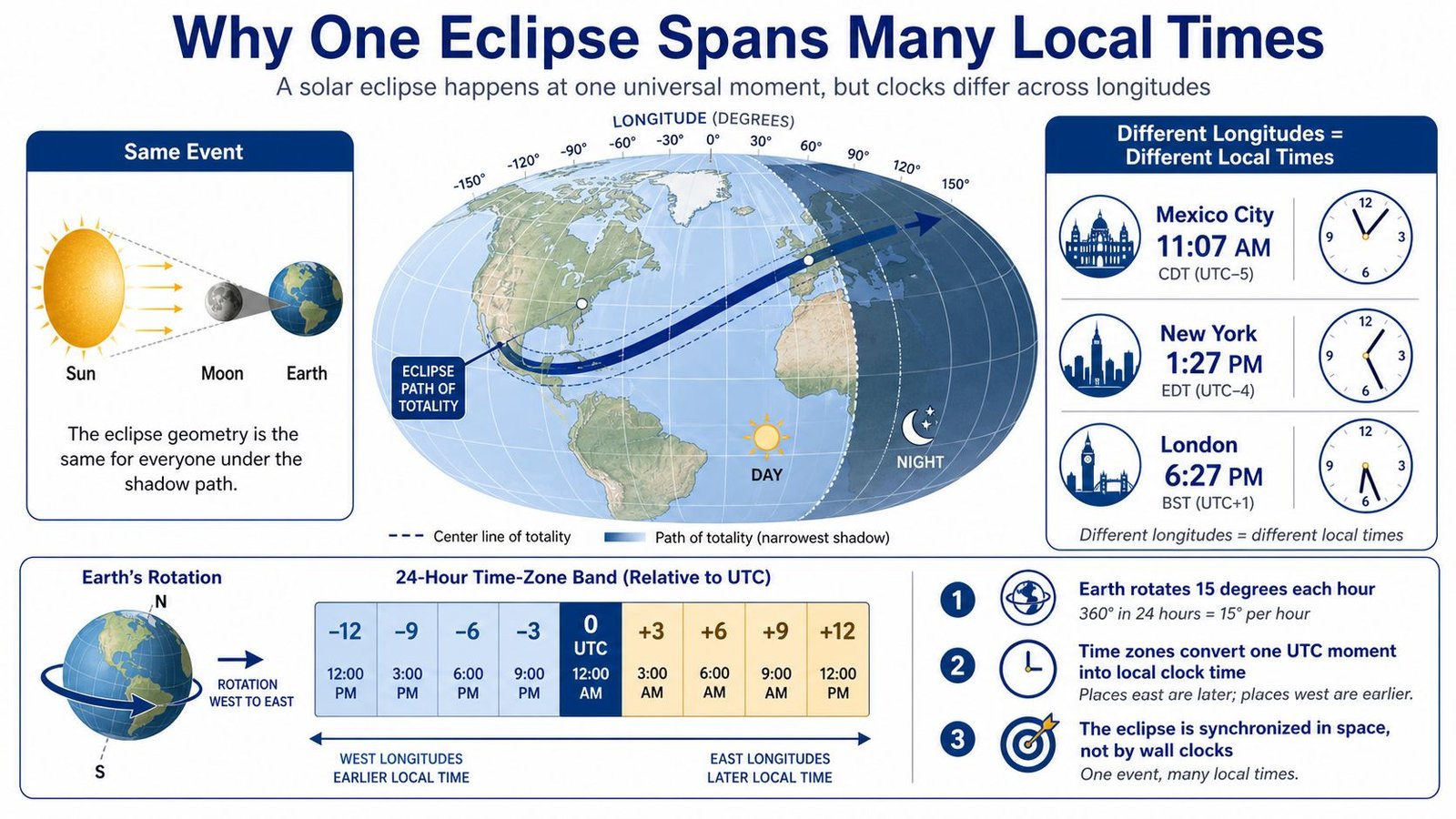
A lunar eclipse is one event, but it shows up on different local clocks at the same time. A headline can be accurate and still do a poor job for a real viewer. One widely reported eclipse had totality running from 6:04 a.m. to 7:02 a.m. EST, with greatest eclipse at 6:33 a.m. EST, and the full event lasted 5 hours and 39 minutes from beginning to end (Space.com).
The same spread shows up in city-by-city coverage. One report listed New York at 3:44 a.m., Los Angeles at 12:44 a.m., Tokyo at 5:44 p.m., and Beijing at 6:00 p.m. for the same eclipse (Space.com). That is why generic “peak time” posts fail people who need to know whether the Moon is up, whether totality is visible, and whether the best part lands before dawn, after midnight, or in the evening.
“Tonight” can mean a different calendar night
This is the detail search results skip. One viewer can be watching before midnight, while someone else is seeing the same eclipse after midnight or close to dawn. The clock date changes, but the sky event does not.
Local time beats calendar wording every time. A region can miss the start, catch totality, or only see the last part, depending on where the Moon sits in the sky and how the time zone lines up with the eclipse. In some places, the Moon is already setting or not yet risen during the best phase, which turns a global event into a partial view from the ground.
For European eclipse planning, the timing spread matters even more. The August 2026 eclipse will involve solar geometry across Europe, not one continent-wide moment, so the same rule still applies. If you do not translate the event into your own local clock, you do not really have a viewing plan.
How to Read a City-by-City Eclipse Timing Table
The table gives you the local-clock answer
A solid city table translates eclipse timing into the clock on your wall. Read the peak time first, then check the local zone and whether the city sits inside the path of totality or only gets a partial view. If the table also lists coverage, use it as context, because the coverage figure does not replace the local viewing time.
Use the city line to answer the question fast. New York, 3:44 a.m. means a middle-of-the-night watch. Los Angeles, 12:44 a.m. means an earlier viewing window. Tokyo, 5:44 p.m. and Beijing, 6:00 p.m. show the same eclipse landing in the evening for other observers.
| Sample City Peak Times From a Recent Total Lunar Eclipse | ||
|---|---|---|
| City | Peak Time | Local Zone |
| New York | 3:44 a.m. | Local time as published |
| Los Angeles | 12:44 a.m. | Local time as published |
| Tokyo | 5:44 p.m. | Local time as published |
| Beijing | 6:00 p.m. | Local time as published |
Check the zone label before you trust the time
European tables often use labels like CEST, BST, WEST, and EEST. That matters because the same eclipse window can shift by an hour or more depending on daylight saving and location. If the table says peak time, use that as your anchor, then check the start and end around it so you know whether totality falls in a workable viewing window.
If the city is inside the path of totality, the peak time is not a bonus detail. It is the moment to protect.
Skimming the time and assuming visibility is the mistake that ruins a plan. Match the city, the zone, and the path status together. If you want a Europe-focused planning base for the 12 August 2026 eclipse, the city-level timing table at the 2026 eclipse cities page gives you a local-frame view instead of a generic headline.
Totality Versus Deep Partial and Why the Difference Matters
Ninety-nine percent is not the same experience
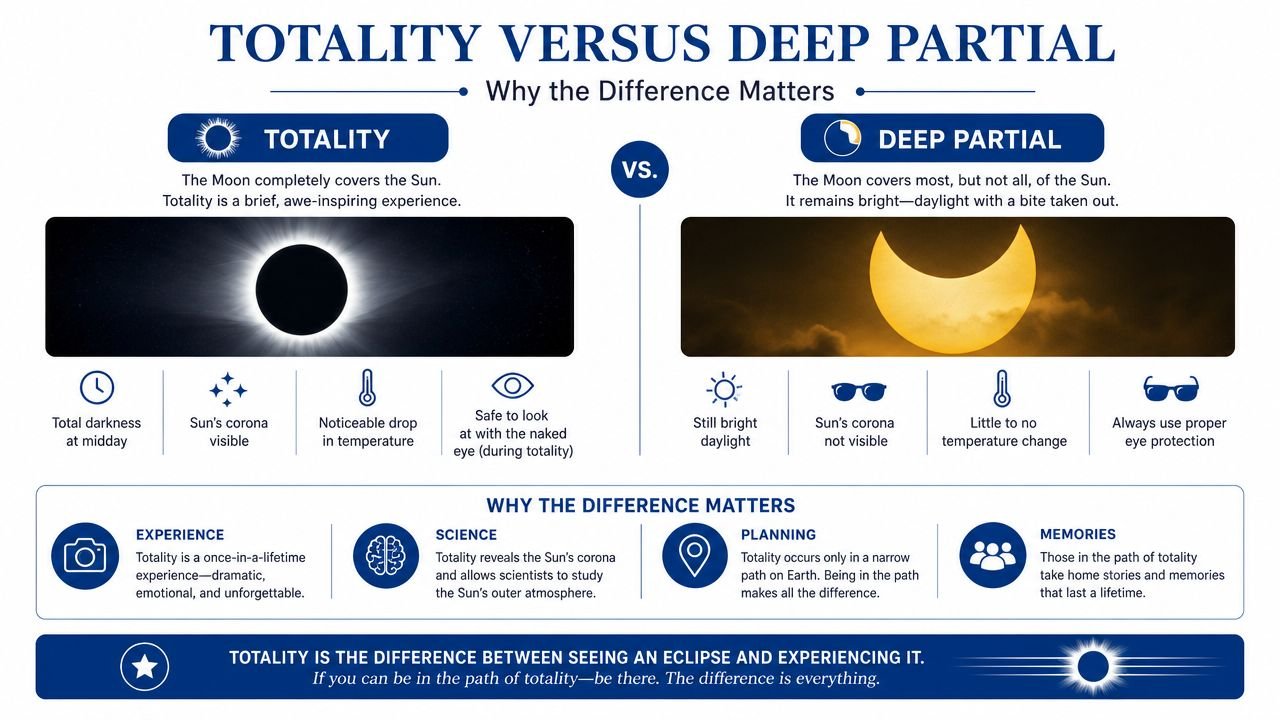
A deep partial eclipse can look impressive in photos and still miss the whole point. The Moon looks dark, the shadow looks dramatic, and your camera may make it seem like the show is complete. It isn't. Totality is the phase where the Moon is fully inside Earth's umbra and the red color becomes the defining feature.
That qualitative gap matters more than the percentage number. People outside the path of totality often see a near-total partial eclipse and think they got almost everything. In reality, they missed the one phase that makes the event feel unmistakable and memorable.
The practical takeaway is blunt. If totality is visible where you are, plan around totality. If it isn't, decide whether a deep partial is enough for your schedule and travel budget, but don't pretend it's the same experience.
Plan around the phase, not the percentage
This is why the right planning anchor is the totality window, not a broad obscuration figure. Reporting has shown totality windows around 58 minutes and 82 minutes in different eclipses, which is a useful reminder that the exact duration changes with the geometry of each event. The number matters, but only after you know whether you'll be in the path.
If you live just outside totality, I'd be careful about overcommitting to a late-night drive for a deep partial alone. If the Moon's altitude is poor or the horizon is blocked, the difference between 99 percent and 100 percent becomes painfully obvious. The decision should be simple, chase totality when you can, and treat deep partial as a consolation prize, not an equal substitute.
Finding Tonight's Eclipse Time for Your Location
Use a local tool, not a generic headline
If you want the answer to what time will the moon eclipse tonight, start with a city lookup or timing table built for your location. A live map, a city simulator, or a city-by-city timing table all do the same job, they turn a global eclipse into a local clock you can use. The point is to get the start, peak, and end in your own time zone, not someone else's.
Enter your city, confirm the time zone, then check whether the event reaches totality or stays partial. If the eclipse falls after midnight where you are, still treat it as part of tonight's viewing plan, because local clock time decides when you step outside, not the calendar heading on the page.
For a direct location lookup, use the city lookup on Total Solar Eclipse 2026 Live. It gives you a specific place instead of a vague national headline, which is the only way to answer the question with any real precision.
Don't settle for a “good enough” partial
A deep partial can still be worth watching, but only if you know exactly what you are getting. The show turns fully unmistakable at totality, where the Moon crosses the strongest visual threshold. If your location misses totality, make that choice on purpose. A big percentage number can make a partial eclipse sound complete when it is not.
The best eclipse plan is the one that tells you exactly what you'll see, and exactly what you won't.
That distinction keeps people from being disappointed on a curb, a hotel balcony, or a parking lot with a blocked view. Check the local time first, then decide whether to stay put, travel, or sleep.
Planning Around Weather and Horizon Conditions
The Moon has to be visible, not just scheduled
Timing is only half the battle. The Moon still has to be above the horizon, and your view has to stay open long enough to see the phase you care about. A perfect clock time means nothing if a tree line, building, or ridge cuts the Moon off.
Pick a site with a low, unobstructed horizon. If the eclipse happens low in the sky, that detail can make or break the view, especially for observers chasing a sunset geometry in Europe. A western horizon matters when the Moon is near the edge of visibility, and even a modest obstruction can erase the best part.
Build a backup, not a wish
Clouds and local haze are the other obvious failure point. Don't lock yourself into one spot if you can avoid it. Use two or three viewing options within driving distance, then choose the clearest one on the day.
If you're planning around a major Europe-centered eclipse, mobility matters even more. Use the kind of live planning page that helps you compare different watch points and camera feeds, such as this live path coverage page, then move toward the clearest horizon you can reach.
Practical rule: the best cloud strategy is to have a second parking spot before you need it.
For a lunar eclipse tonight, the same logic holds. Watch the sky, protect the horizon, and keep one backup location ready if the first one turns useless.
A Short Pre-Eclipse Checklist for Tonight
The five things that matter
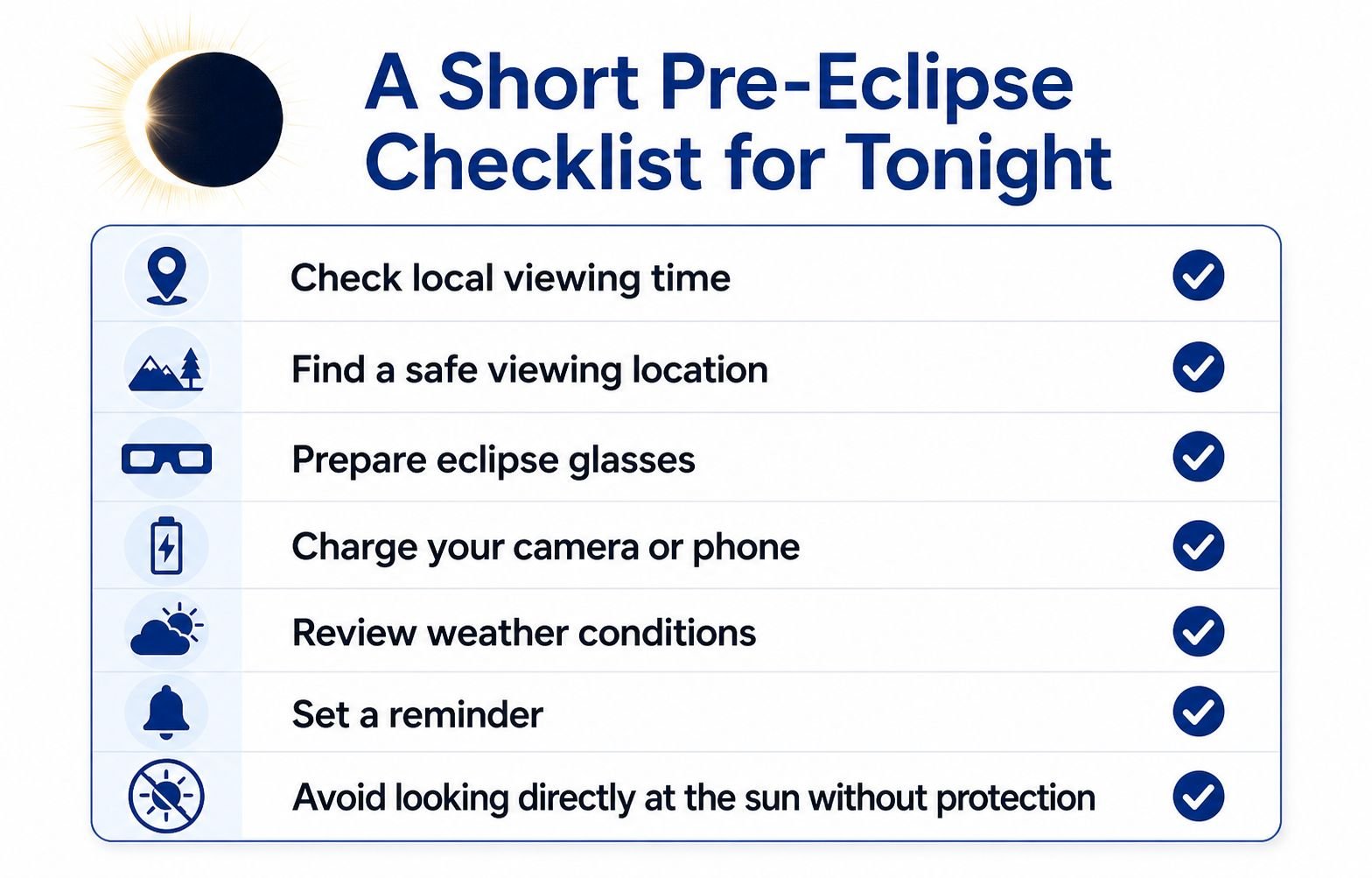
Start with the times. Confirm the local start, peak, and end before you leave the house, because a time printed for another zone is a bad plan in disguise. Then pick a viewing spot with a clear horizon and no visual clutter in the direction the Moon will sit.
Bring the small stuff that saves the night. A red-light source protects your night vision, and warm layers matter more than people expect when you're standing still for a long stretch. Set alarms for the first noticeable phase and for totality so you don't drift off between “it's starting” and “it's happening.”
A simple field routine
- Confirm the local times. Use your own city, not a national headline.
- Arrive early. Give yourself time to settle in before the shadow deepens.
- Face the right horizon. An open view beats a pretty location with a blocked sky.
- Keep lighting minimal. Red light only when you need it.
- Watch totality closely. That is the phase worth staying awake for.
The checklist sounds basic because it is. That's the point. Eclipse viewing falls apart on small mistakes, not grand ones. People miss the show because they showed up late, faced the wrong direction, or forgot that the best part can be over before they realize it started.
Using a City Simulator to Fine-Tune Your Night
Let the animation confirm the clock
A city simulator is the fastest way to strip out guesswork. Enter your location, then watch the Moon's path and eclipse timing for that specific place. That gives you a local result instead of a broad, generalized estimate.
Use it to compare the maximum coverage and the duration of totality for your exact spot. Then check those numbers against a published city table so you are not relying on a single readout. If the simulator and the table disagree, trust the location-specific table first, then use the simulator as the visual check.
Use it as a rehearsal, not just a lookup
Value is repetition. Run the same tool for different cities, compare whether a trip is worth it, and decide when to leave home. For a Europe-focused solar eclipse, a small change in location can shift the horizon, the Moon's altitude, and the quality of the view.
Use the simulator to rehearse the night, then verify the timing table and your local conditions. That combination keeps you from building your plan around a headline time that was never written for your street.
Eclipse Timing Questions You Might Still Have
What if the Moon rises or sets during the eclipse
Then the visible part of the event is shortened. You might catch only the end of totality or only the partial phases, depending on your location and the Moon's altitude. That's why horizon checks matter as much as the clock.
Why does totality look red instead of black
During totality, the Moon stays visible because sunlight is refracted and filtered through Earth's atmosphere, which sends red-toned light into the umbra. That's the visual reason a total lunar eclipse looks dramatic rather than disappeared. The Moon is still there, just transformed.
What if the peak lands on a different calendar night
Treat the event by local clock, not by calendar label. If the peak comes just after midnight where you are, it still counts as your night for planning. The sky doesn't reset itself at midnight because a website does.
Is a deep partial worth staying up for
Sometimes, yes, if it's the only thing visible from your location. But don't confuse impressive with complete. A deep partial is a good consolation, not a replacement for totality.
The 12 August 2026 total solar eclipse is visible in Europe, with the core path crossing Iceland and northern Spain, making it a continent-centred event rather than a regionally isolated one (Timeanddate). That's exactly why local timing and location choice matter so much for European viewers.
If you want a clean Europe-specific planning tool for the August 2026 eclipse, visit Total Solar Eclipse 2026 Live and check the city timing, path details, and viewing guidance before you go outside. It gives you the local-clock view that generic headlines miss, which is exactly what you need when the difference between partial and totality decides the whole night.