July 24, 2026
Umbra Solar Eclipse Explained for the 12 Aug 2026 Event
You're likely planning more than a date on a calendar right now. You're checking whether 12 August 2026 is worth a flight, a hotel booking, or a long drive, and the question underneath all of that is simple, will you be inside the Moon's shadow or just close to it? For a solar eclipse in Europe, that boundary matters more than almost anything else, because the difference between standing in the umbra and standing just outside it is the difference between totality and a partial view that still feels unfinished.
If you're looking at Iceland, northern Spain, or nearby cities and trying to decide what counts as “close enough,” the answer starts with the geometry of the umbra solar eclipse path. The Moon's shadow is narrow, fast, and unforgiving, so the planning job is less about chasing a broad event and more about finding the exact strip of land where the Sun disappears completely.
Table of Contents
- What the Umbra Means for the 12 August 2026 Eclipse
- The Three Shadow Zones and What Each One Looks Like
- Why the Umbra Is So Narrow and So Fast
- The 12 August 2026 Umbral Path Across Iceland and Spain
- Totality Versus 99 Percent Partial The Experience Gap
- Safety, Site Selection, and Photography Inside the Umbra
- Common Umbra Misconceptions and Last-Mile Pitfalls
- Your Umbra Checklist for 12 August 2026
What the Umbra Means for the 12 August 2026 Eclipse
On 12 August 2026, the difference between a memorable eclipse and a life-changing one won't be a big-city name or a glossy forecast. It'll be whether your feet are planted inside the Moon's umbra, the dark core of the shadow where the Sun is fully covered and totality happens. If you're in the penumbra, you'll still see an eclipse, but it remains partial, no matter how dramatic it looks on a map.
That's why eclipse chasers obsess over the word umbra. It isn't a textbook term to memorize and move on from, it's the planning line that decides what you'll see in the sky. A location can sit very near the path and still miss the full effect, which is why nearby cities, coastline choices, and even hillside viewpoints become important.
Practical rule: if your site is outside the umbra, the eclipse can still be impressive, but it won't become total.
For first-time travelers, the challenge is usually not understanding that totality exists. It's understanding that totality is geographically exclusive, and the border between “almost” and “yes” can be small enough to change with a short drive. That's what makes this event in Europe such a planning puzzle, especially for people comparing Icelandic and Spanish options.
A good place to start is a simple framing question. Are you learning what the eclipse is, or are you deciding where to stand for it? If it's the second, the next step is mapping the Moon's shadow zones clearly, then checking whether your target location is in the right one. If you want a quick refresher on eclipse basics before choosing a site, this eclipse primer helps anchor the vocabulary.
The Three Shadow Zones and What Each One Looks Like
A flashlight, a ball, and a wall can teach the whole geometry in a minute. Hold the ball between the light and the wall, and you'll see a dark center shadow with a lighter outer halo. That dark center is the umbra, the lighter edge is the penumbra, and the narrow region beyond the tip of the full shadow is the antumbra.
In an actual solar eclipse, the umbra is the darkest, inner part of a shadow, and it's the region where the Moon completely blocks the Sun. Observers inside it see a total solar eclipse, while people in the penumbra see only a partial eclipse. That distinction is the one that matters when you're reading a map, because a city can look extremely close to totality and still remain in the wrong shadow zone. (Umbra and eclipse geometry)
The plain-language version
The umbra is the place where the Sun is fully hidden. The penumbra is where only part of the Sun is covered. The antumbra is where the Moon is too far away to cover the Sun completely, so the Sun shows as a ring.
If you're standing in the penumbra, you're watching a partial eclipse. If you're standing in the umbra, you're inside the only zone where totality can happen. If you're in the antumbra, you're looking at an annular eclipse, which is a different event altogether and not the one happening over the 12 August 2026 European track.
Inside the umbra, the question isn't “how much of the Sun is covered?” It's “is the Sun completely gone yet?”
That's why a “99 percent partial” observation still belongs to the penumbra, not the umbra. The eye sees a bright daytime scene until the final sliver disappears, and that last sliver is what changes everything. If you want a visual companion for the partial-versus-total distinction, this eclipse diagram is the right next stop.
Why the Umbra Is So Narrow and So Fast
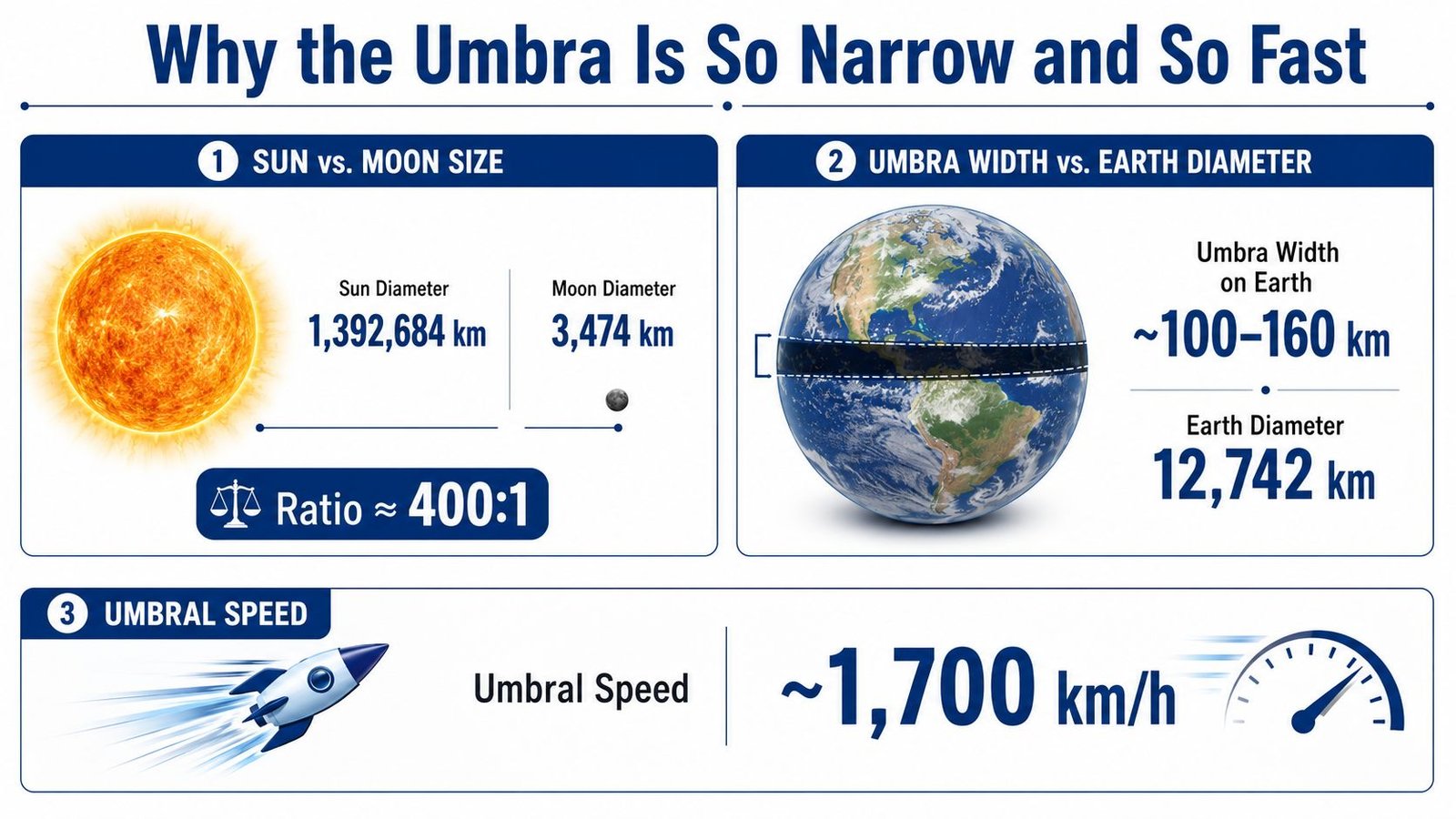
The Moon's shadow isn't a giant blanket spread across Europe. It's more like a moving blade, narrow enough that a short drive can change the outcome completely. NASA's eclipse geometry notes that the Moon's shadow sweeps across Earth in 4 to 5 hours, but the total phase at one location is usually only a few minutes or less, and the umbra at Earth is typically only about 100 to 260 km wide. That is why totality feels rare even when the eclipse itself is widely visible. (NASA eclipse geometry summary)
Why size matters more than distance on a map
The Moon is much smaller than the Sun, so its shadow narrows into a cone before it reaches Earth. That geometry creates a moving strip of totality rather than a continent-wide zone, and it's why planning by country or region is too broad to be useful. A traveler who chooses the wrong side of the line can miss totality entirely, even with excellent weather.
The practical consequence is simple. A move of even tens of kilometers can separate a total eclipse from a deep partial one, so city choice is not a small detail, it's the core decision. That's especially true for Europe, where travelers may compare two nearby destinations and assume they're functionally the same. They aren't.
What the narrow path feels like on eclipse day
The shadow arrives, slides past, and leaves. You don't get hours of totality, you get a brief window, sometimes only a few minutes or less, then the Sun starts to return. NASA's umbral-path documentation also shows how location-specific the experience is, with one example giving 2 minutes 24 seconds of totality at the center line and a solar altitude of 12°, while a nearby point just outside the path had magnitude 0.996 and only 0.2% of the Sun exposed. (NASA umbral-path example)
That's the key planning insight. The map border matters more than the forecast headline, because the umbra is a moving corridor, not a broad cloud of darkness.
The 12 August 2026 Umbral Path Across Iceland and Spain
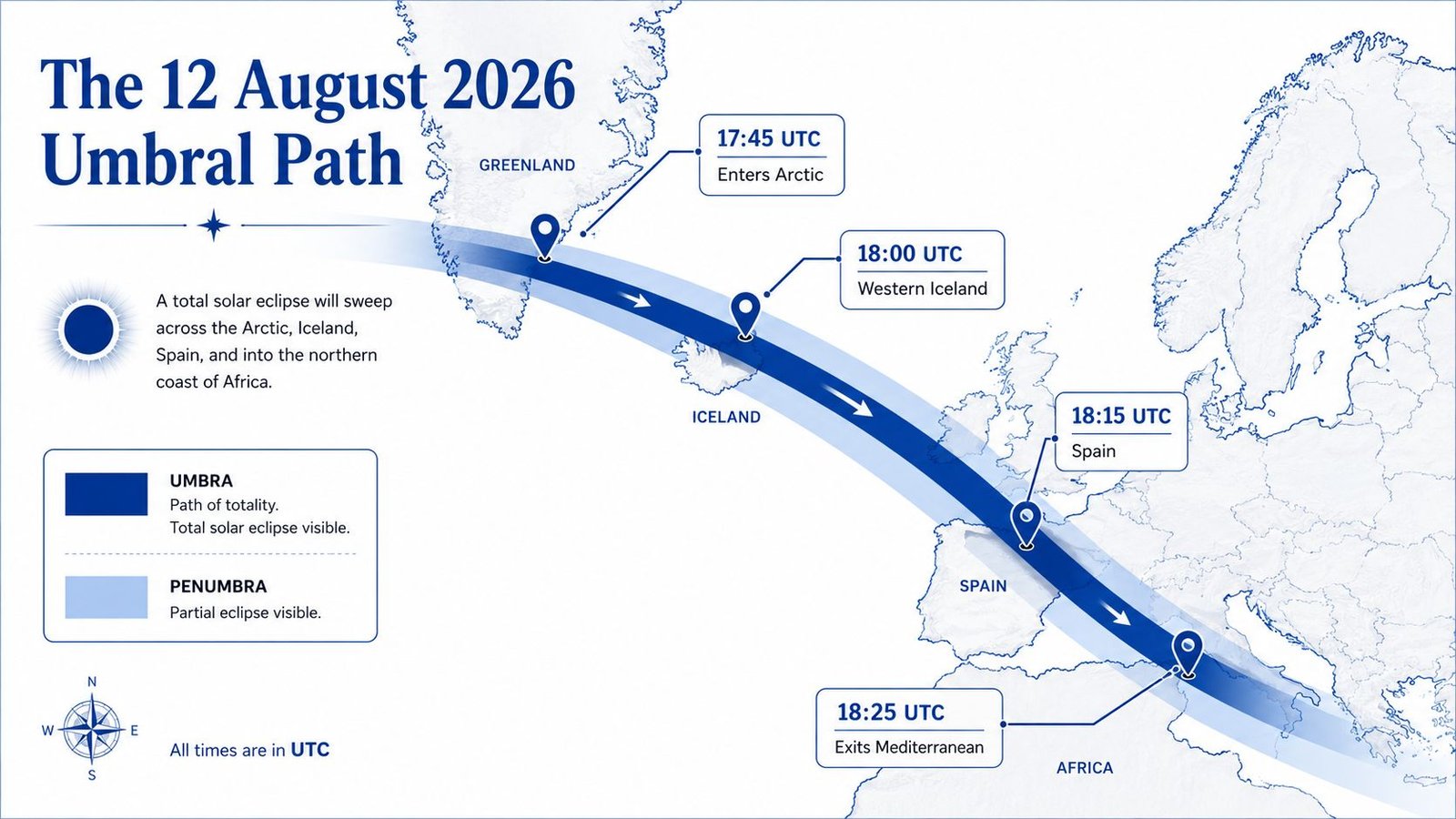
The 12 August 2026 path is the reason this eclipse has become such a travel target across Europe. The umbra moves from the Arctic into Greenland, crosses western Iceland, then continues over the North Atlantic before reaching northern Spain and a small corner of northeast Portugal. The Spanish section is especially important because totality happens near sunset, which makes horizon planning part of the geometry instead of an afterthought.
Iceland first, Spain later
Western Iceland sits in the path, so observers there are planning for a true total eclipse rather than a near miss. That matters because a city just outside the line may still see a deep partial view, but not the darkened sky, corona, and horizon effects that define totality. In the Spanish track, the low Sun means site choice becomes a second filter, not just for being inside the umbra, but for seeing it clearly.
The practical difference between a ridge, a coast, and an inland site can be decisive. A western horizon that stays open can make a low-altitude total eclipse usable. A blocked horizon can reduce the experience even if the location is technically inside the path. That's why elevation, coastline access, and terrain become part of the planning conversation for Spain.
The center line still matters
A location on the center line generally gets the longest totality, while places near the edge get less. In the NASA path example already cited, the center line location reaches 2 minutes 24 seconds of totality at 12° solar altitude, which is a helpful reminder that totality has both a geographic and a timing component. The closer your chosen spot is to the center line, the more forgiving your viewing margin tends to be.
For city-level planning, a tool that compares local coverage and path status can be useful, and Total Solar Eclipse 2026 Live provides city-by-city eclipse detail alongside path context. That kind of location-specific planning matters because “in Spain” is too vague, and “near the coast” is too vague as well. For a near-sunset eclipse, the exact site and the open western sky are part of the same decision.
A low western horizon isn't a bonus for this eclipse, it's part of the requirement.
Totality Versus 99 Percent Partial The Experience Gap
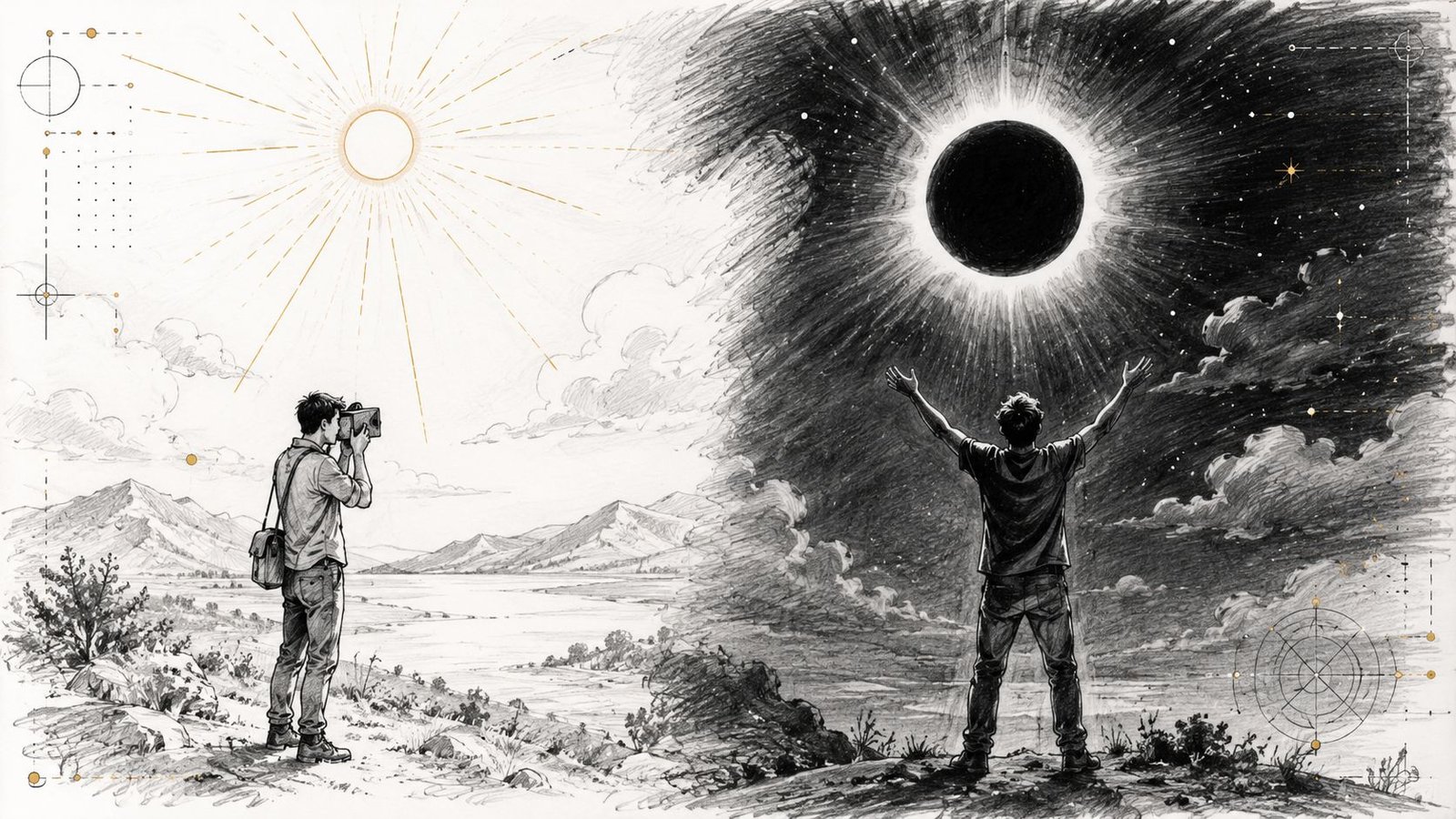
A near-total partial eclipse and a total eclipse can look similar on paper, but they don't feel similar in the field. In the partial zone, a bright slice of the Sun remains, so the day still reads as day. Inside the umbra, the last sliver disappears and the sky changes character fast. That's why the experience gap is so much larger than the percentage gap suggests.
Why the last sliver matters
A tiny uncovered portion of the Sun is still intensely bright. That means the sky doesn't fully darken, the corona stays hidden, and the dramatic cues people associate with eclipse chasing don't appear. Totality is the threshold where the solar disk disappears and the outer atmosphere becomes visible, which is why “almost total” is not the same category of event.
Partial phases can still last a long time around the main event, usually 1 to 2 hours on either side, according to NASA's eclipse guidance. But that long arc doesn't mean the experience is the same throughout. The beginning and end of the partial phases are gradual, while totality is a distinct interval with a different visual and atmospheric feel. (NASA eclipse safety guidance)
The simplest side-by-side comparison
| In the penumbra | In the umbra |
|---|---|
| Partial eclipse only | Total eclipse possible |
| Daylight remains obvious | Sky can shift toward twilight |
| Solar glasses stay on | Glasses come off only during totality |
| The Sun still dominates the scene | The corona becomes the headline |
The contrast is why eclipse travelers keep returning to the location question. A site that is 20 km inside the umbra can be more valuable than a perfect weather forecast farther away, because no amount of clear sky outside the path turns partial into total. Weather matters, but it only matters after you've chosen the right shadow zone.
Safety, Site Selection, and Photography Inside the Umbra
Eye safety doesn't relax just because an eclipse is exciting. During the partial phases, ISO 12312-2 eclipse glasses or other certified solar viewers are required, and camera lenses need proper solar filtration too. NASA's guidance is clear that viewing protection stays on until the total phase begins, then comes back on as soon as totality ends. (NASA eclipse safety guidance)
Choosing the right place on the ground
For the Spanish track, a clear western horizon is the first site-selection test. The Sun sits low near sunset, so a hill, ridge, headland, or open coastal viewpoint can make the difference between seeing totality cleanly and seeing it chopped by terrain or haze. Inland sites can also be attractive when weather patterns favor them, but the key is still line of sight to the low Sun.
A second test is flexibility. If you can move on eclipse day, you can respond to cloud bands or haze rather than accepting them. That mobility matters because the umbra is narrow and the weather can be localized, so the best plan is often the one that lets you shift a short distance without losing your path position.
Camera discipline inside and outside totality
Keep a solar filter on the lens during every partial phase. Remove it only during the brief total phase, then replace it before the Sun reappears. For photographers, that brief window is the time to capture the corona and the surrounding sky, while partial phases are for filtered solar crescents and safe tracking shots.
A time-lapse tool can help organize the event sequence, and the path-and-safety material on Total Solar Eclipse 2026 Live is useful if you want to rehearse the timing before you travel. The point isn't fancy gear, it's knowing which phase you're in and matching the equipment to it.
Practical rule: if the Sun isn't completely covered, the filter stays on.
Common Umbra Misconceptions and Last-Mile Pitfalls
The most common mistake is treating 99 percent partial as if it were a near-win for totality. It isn't. The final fraction of uncovered Sun still keeps the scene in daytime mode, and that last bit is exactly what keeps you outside the full eclipse experience.
Four planning errors that keep showing up
- “Close enough counts.” It doesn't. The umbra is a narrow corridor, so a nearby city can miss totality entirely.
- “Clear weather anywhere is enough.” Clear skies outside the path still give only a partial eclipse.
- “Clouds ruin everything.” Clouds inside the umbra can still leave gaps for the corona and the darkened sky, so location still matters first.
- “Glasses aren't needed during partial phases.” They are. NASA says eclipse or solar-viewing glasses are required except during totality. (NASA eclipse safety guidance)
The last-mile problem is usually about mobility, not theory. If the path is narrow and the forecast is uncertain, the ability to drive roughly 100 km on eclipse day can be the most valuable thing in your plan, because it lets you chase clearer sky without giving up the umbra. That kind of flexibility is often what separates a decent trip from a successful one.
There's also a visual trap. Many people assume a city with almost complete coverage must look like totality, but partial eclipse lighting doesn't behave that way. The sky can stay bright, the corona stays hidden, and the social media photo you thought you'd get never materializes.
Your Umbra Checklist for 12 August 2026
Start with one question, am I inside the umbra on 12 August 2026? If the answer is no, the event can still be interesting, but it won't be totality. If the answer is yes, the rest of the plan becomes about access, horizon, safety, and flexibility.
Five checks before you commit
- Confirm path status. Make sure your chosen place is inside the published path of totality, not just near it.
- Confirm the western horizon. Spain's low-sun geometry makes open sightlines essential.
- Confirm safety gear. Bring ISO 12312-2 eclipse glasses and certified solar filters for every optical device.
- Confirm mobility. Build in room to shift location if clouds or haze move in.
- Confirm your distance from the center line. Closer usually means better totality timing and a longer dark interval.
A few questions come up again and again. Is 99 percent partial worth watching? Yes, but it's still partial. Can totality be photographed without a filter? Only during the brief total phase, not before or after. Is the umbra visible from the ground? You see its effect, not a literal outline in the sky. Could the path shift before August 2026? The path is a known astronomical prediction, but your weather and local horizon will still decide what you personally see.
If you're ready to choose a location, compare Iceland and Spain with a city-level path tool, lock in lodging early, and leave yourself room to move on eclipse day. For a practical planning base, keep Total Solar Eclipse 2026 Live open while you decide where to stand, because the only question that really matters is still the same one, will you be inside the umbra when the Sun goes black?