August 4, 2026
The Orbit of the Moon and the 2026 Total Eclipse
You might be planning a trip, checking hotel options, or just trying to understand why one eclipse map says totality and another says 99% partial. The difference isn't a detail, and it isn't about clouds. On 12 August 2026, the Moon's orbit decides who gets the full show, who gets the near miss, and why the Sun hangs low over the western horizon in places like Iceland and Spain.
Table of Contents
- Why the Orbit of the Moon Decides Who Sees Totality
- The Shape and Size of the Lunar Orbit
- Lunar Nodes and the Gatekeeper for Every Eclipse
- The 18.6-Year Precession That Shifts the Eclipse Calendar
- Perigee Apogee and Why the Moon Sometimes Looks Bigger
- How Orbit Geometry Shapes the 12 August 2026 Path
- Practical Takeaways for Observers and Photographers
- From Orbital Mechanics to the Moment of Totality
Why the Orbit of the Moon Decides Who Sees Totality
On 12 August 2026, the Moon's shadow doesn't fall evenly across Europe. It reaches in from the Arctic, crosses western Iceland, sweeps the North Atlantic, and then hits northern Spain as the Sun is dropping toward the western horizon. Inside the path, observers get totality. Outside it, even nearby cities can be left with a dramatic but different deep partial eclipse.
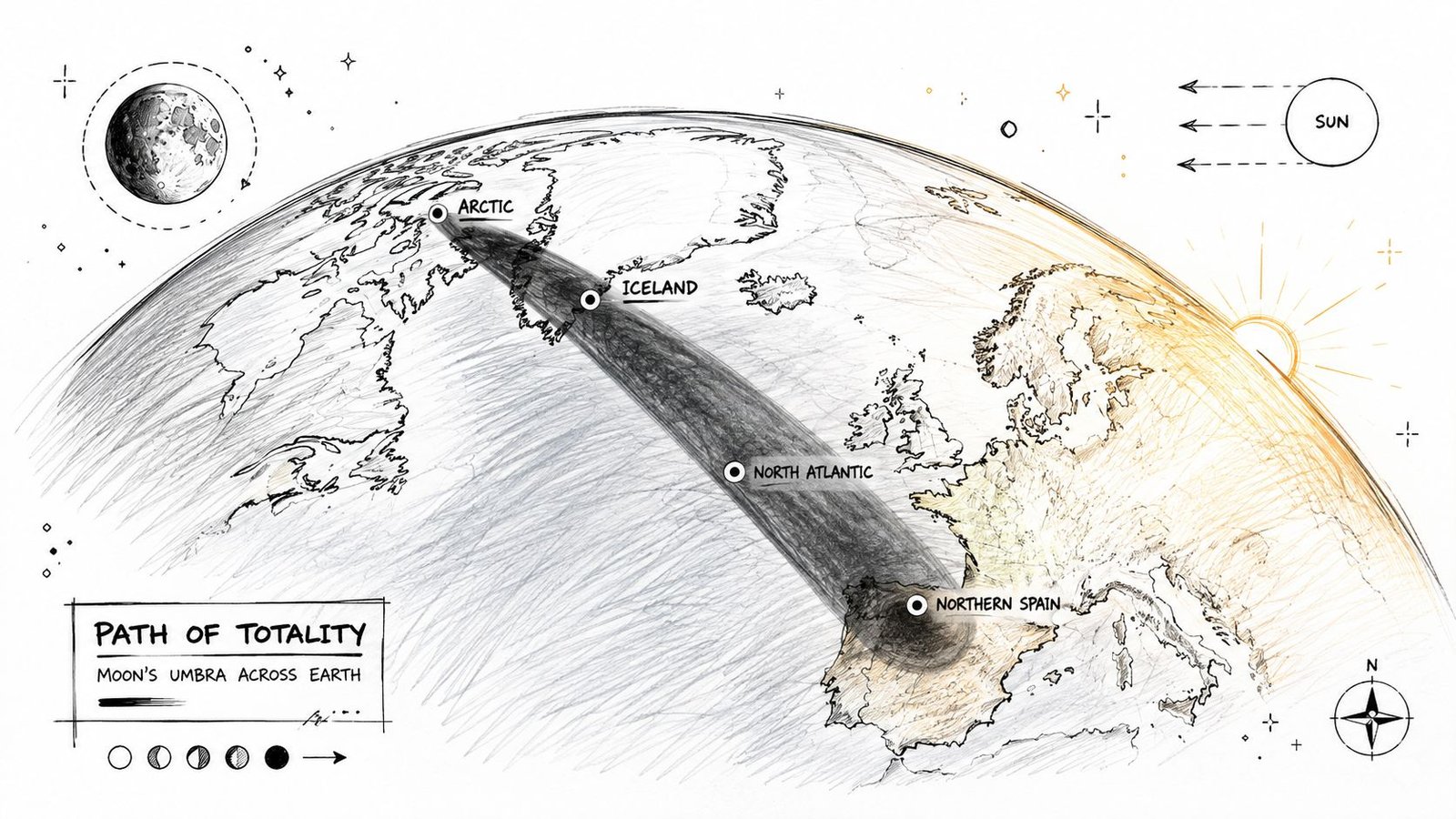
The question most eclipse explainers skip is one of why here, why now, and why only a narrow ribbon sees the full event. The answer sits in orbital geometry, not weather, not borders, and not luck. A location can be clear and still miss totality if it lies just outside the shadow path.
Practical rule: if you want totality, you have to stand where the Moon's umbra actually reaches Earth, not just somewhere near the track.
That's why a planning decision in summer 2026 is really an orbital decision. Where you stand, which horizon you choose, what equipment you carry, and how you frame your photography all trace back to the Moon's position in its orbit at that exact moment. The geometry makes the event possible, and the geometry also limits who gets to see it.
For readers trying to compare possibilities, the key thing to keep in mind is that Madrid and Barcelona can see a deep partial, but that's still not the same as standing in the narrow path itself. The difference between “almost” and “inside” is the whole story. A useful explainer on why solar eclipses don't happen every month is available in this eclipse guide, and it points straight toward the orbital reason the shadow path is so selective.
The Shape and Size of the Lunar Orbit
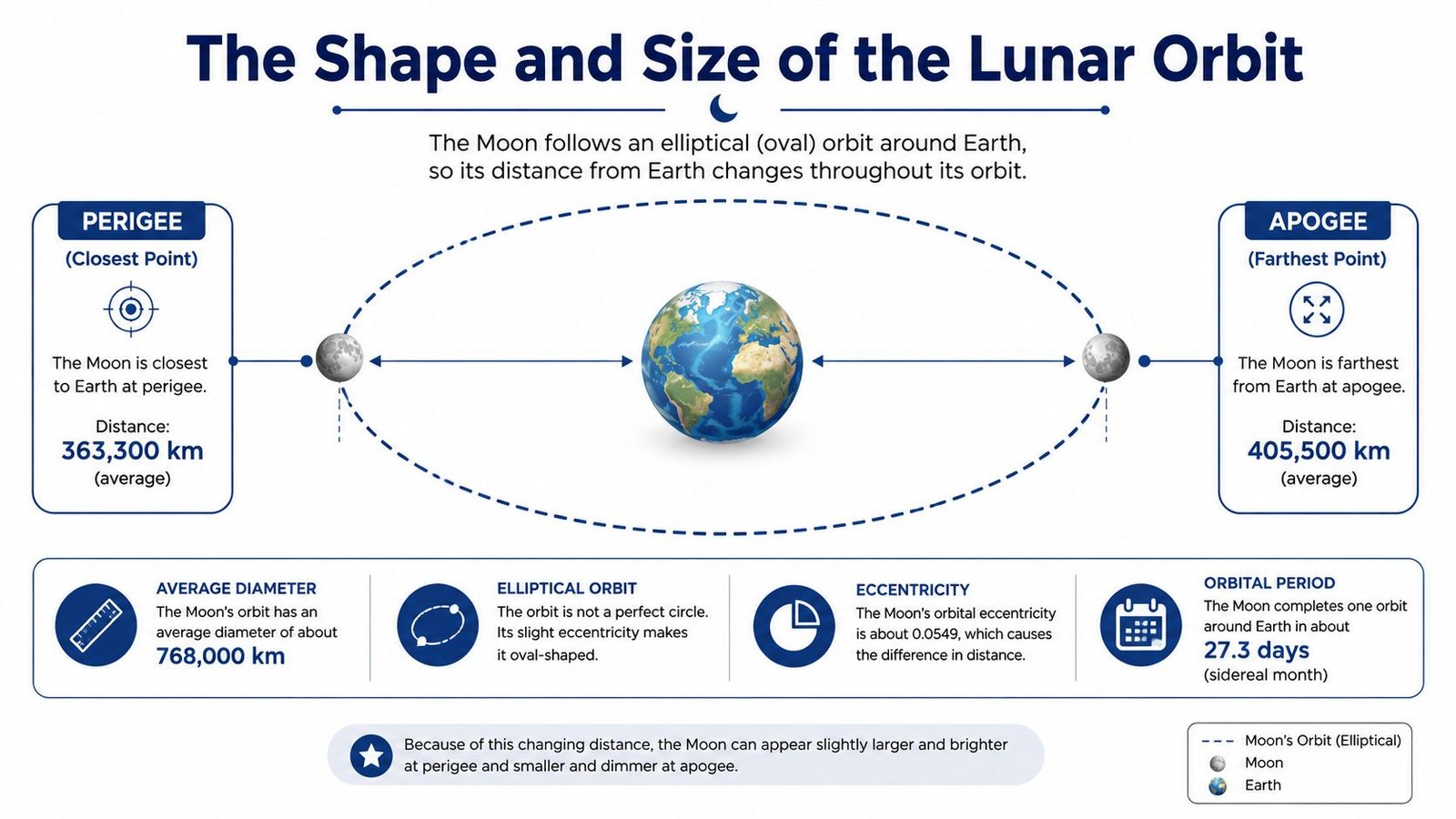
The Moon does not travel around Earth in a perfect circle. Its path is slightly oval, more like a stretched track than a ring, so the Earth-Moon distance changes throughout the month. Its mean eccentricity is 0.0549 (NASA eclipse geometry reference), which is astronomer-speak for “noticeably oval, but only a little.”
That small oval shape still matters. The average Earth-Moon distance is about 384,400 to 384,748 km, while perigee brings the Moon in to about 363,300 km and apogee sends it out to about 405,500 to 405,507 km (orbit reference). The difference is roughly 42,000 km from closest to farthest. That is enough to change how large the Moon appears from Earth, even though the orbit still looks nearly round at a glance.
A useful way to picture it is a path that keeps tightening and loosening slightly as the Moon moves through its monthly cycle. Sometimes it is closer to us, sometimes farther away, and our eyes notice the change as a subtle shift in apparent size. Because of that, the Moon's apparent size and distance vary by about 11.6% between perigee and apogee (orbit reference). For skywatchers, that difference is visible. For eclipse geometry, it decides whether the Moon can completely cover the Sun or leave a bright rim around it.
Why that oval shape matters
The Moon takes about 27.32166 days to complete one orbit relative to the fixed stars, the sidereal month (NASA eclipse geometry reference). That is not the same as the phase cycle people follow on calendars, but it is the clean orbital clock used in eclipse geometry. The Moon's path through space is the framework underneath the changing phases, like the track underneath a moving train.
Here is the part that matters for observers. When the Moon is larger in the sky, it can cover the Sun's disk more completely. When it is smaller, it may leave a thin ring of sunlight, or only cover part of the Sun if the alignment is not exact. The same orbit that gives us a changing Moon also decides whether an eclipse is total, annular, or partial.
The orbit is not just a shape on paper. It decides whether the Sun disappears completely or only nearly disappears.
That 42,000 km swing is enough to change how big the Moon looks from Earth, and for eclipse geometry, it is decisive.
Lunar Nodes and the Gatekeeper for Every Eclipse
The Moon's orbit is tilted, not flat. Its orbital plane sits about 5.145° relative to the ecliptic, the plane of Earth's orbit around the Sun (Universetoday reference). A tilted coin spinning around a marble is a better image here. Most of the time, the coin passes above or below the marble's center line, and only on the right pass does it line up closely enough to matter.
That tilt explains why eclipses do not happen every month. Most New Moons pass a little above or below the Sun-Earth line, so the Moon's shadow misses Earth entirely and moves through empty space. A solar eclipse becomes possible only when the New Moon arrives near one of the two lunar nodes, the points where the tilted orbit crosses the ecliptic. Those crossings are the ascending node and the descending node.
The nodes are the gates
A solar eclipse needs more than a New Moon. The New Moon has to arrive near a node, because that is the moment when the Sun, Moon, and Earth can line up closely enough for the Moon's shadow to strike Earth. If the Moon is off that plane, the shadow slides past.
That is also why eclipse seasons exist. Each year brings narrow windows when the Sun sits close enough to a node for eclipses to become possible, and the 2026 eclipse falls inside one of those windows. The practical idea is straightforward, the geometry has to be open before the shadow can enter.
The broader rhythm ties into the saros cycle, which repeats similar eclipse geometry after about 18 years. A plain explanation of that cycle is available in this saros overview. The exact date shifts, but the pattern remains familiar because the Moon's tilt, the Sun's apparent path, and the repeating node alignments keep working in the background.
Why this matters for 12 August 2026
The date is not random. It lands during a season when the Moon is crossing the right part of its tilted path, which is why the shadow can reach northern Europe at all. Without the node crossing, there is no eclipse. Without the season, there is no alignment. With both, the Moon can line up closely enough with the Sun for observers in Iceland and Spain to see either totality or a deep partial eclipse, depending on where they stand and how the geometry falls at sunset.
That gatekeeper role is what makes the nodes so important. They set the conditions for eclipse day, and they decide whether the Moon's shadow has a path to Earth at all.
The 18.6-Year Precession That Shifts the Eclipse Calendar
The nodes are not fixed markers in space. They slide along the ecliptic in a slow cycle, completing a full circuit in about 18.6 years. Astronomers call that the regression of the nodes, and it's one of the reasons eclipse patterns drift across decades instead of repeating in the same places on the calendar.
A spinning top is a decent analogy. The top turns quickly, but its axis also traces a slow circle. The Moon's orbit does something similar, its tilted plane wobbles relative to Earth's orbital plane, and the node positions creep westward over time. That wobble changes where eclipse seasons land and which latitudes sit under favorable geometry.
Why eclipse paths migrate
When the nodes shift, the shadow path shifts too. That's why a location can wait a long time for totality even though eclipses keep happening somewhere on Earth. The geometry isn't locked to one longitude or one latitude. It moves.
The same 18.6-year cycle is also tied to lunar standstill, when the Moon's maximum declination swings toward its extremes and tides can become more pronounced. I'm keeping that point qualitative here, because the important lesson is the pattern, not a headline number. The Moon's long cycle affects both the sky and the shoreline, which is why this rhythm shows up in more than one part of astronomy.
For the 2026 eclipse, the slow drift matters because it places the node in the right seasonal window for northern Europe. That's the long view behind the map you'll use on the ground. A decade-scale wobble in the orbit changes who gets a total eclipse this year and who has to wait for the next one.
The same principle also explains why eclipse calendars don't feel intuitive. The Moon circles Earth every month, but the node cycle is dragging that path across the seasons behind the scenes. So the calendar is never just about the month name. It's about where the orbit's tilted line happens to be at the moment New Moon arrives.
Perigee Apogee and Why the Moon Sometimes Looks Bigger
Once the Sun, Moon, and Earth are lined up, the Moon's distance becomes the tie-breaker. That extra bit of apparent size decides whether the lunar disk covers the Sun completely, leaves a bright ring, or only hides part of it. The geometry is simple at this stage. The Moon either looks large enough for totality, or it does not.
The Moon follows an elliptical path around Earth, so its distance changes through the month. As noted earlier, that shift is called perigee when the Moon is closer and apogee when it is farther away, and the Moon's apparent size changes along with it (orbit reference, Moon overview reference). That changing size is the reason one aligned eclipse can turn total while another becomes annular, even before you look at the exact shadow track.
How eclipse type follows distance
Perigee gives the Moon a slightly larger-looking face in the sky, so the solar disk is easier to cover completely. Apogee shrinks that apparent face, and the Sun can remain visible as a ring around the Moon. Partial eclipses sit between those outcomes, where the Moon covers only part of the Sun even though the alignment is close enough to make the event obvious.
A useful rule follows from that. Closer Moon, more forgiving eclipse geometry. Farther Moon, less room for error.
That matters for the 2026 eclipse because the Moon's apparent size is large enough along the path of totality to produce a full blackout of the Sun there, not just a near miss. The relevant question is no longer whether the line-up happens. It is whether the Moon's disk has enough apparent width to close the gap.
| Apparent Size at Key Orbital Positions | Earth-Moon Distance | Moon Angular Size | Eclipse Type It Produces |
|---|---|---|---|
| Perigee | About 363,300 km (orbit reference) | Larger apparent disk | More likely total |
| Mean distance | About 384,400 to 384,748 km (orbit reference) | Middle ground | Depends on alignment |
| Apogee | About 405,500 to 405,507 km (orbit reference) | Smaller apparent disk | More likely annular |
The practical lesson is direct. Alignment sets the stage, and distance decides whether the Moon covers the Sun fully or leaves a ring.
How Orbit Geometry Shapes the 12 August 2026 Path
On 12 August 2026, three orbital pieces come together at once. The New Moon occurs near a node, the Moon is close enough to its favorable distance to cover the Sun with margin to spare, and the shadow track falls across northern Europe. That is why the eclipse is total along the path and not just impressive everywhere in view.
The track begins in the Arctic, touches western Iceland, crosses the North Atlantic, and reaches northern Spain just as the Sun is low in the west. In Spain, the Sun sits only about 10 to 12° above the western horizon during totality, a low altitude that comes from the season, latitude, and the angle of the eclipse path itself. A detailed path overview is available here.
Iceland and Spain do not get the same view
Iceland sees totality with the Sun higher in the sky than Spain does, so the eclipse can be easier to frame and less squeezed by the horizon. Spain gets a more dramatic geometry, because totality happens close to sunset, where the western horizon and local terrain matter much more.
That's where the difference between total and deep partial becomes obvious. The path of totality is about 290 km wide, and cities outside it, including Madrid and Barcelona, may still experience near-total-looking coverage but not true totality. The visual jump between those two experiences is not subtle. A deep partial still leaves the Sun in the sky.
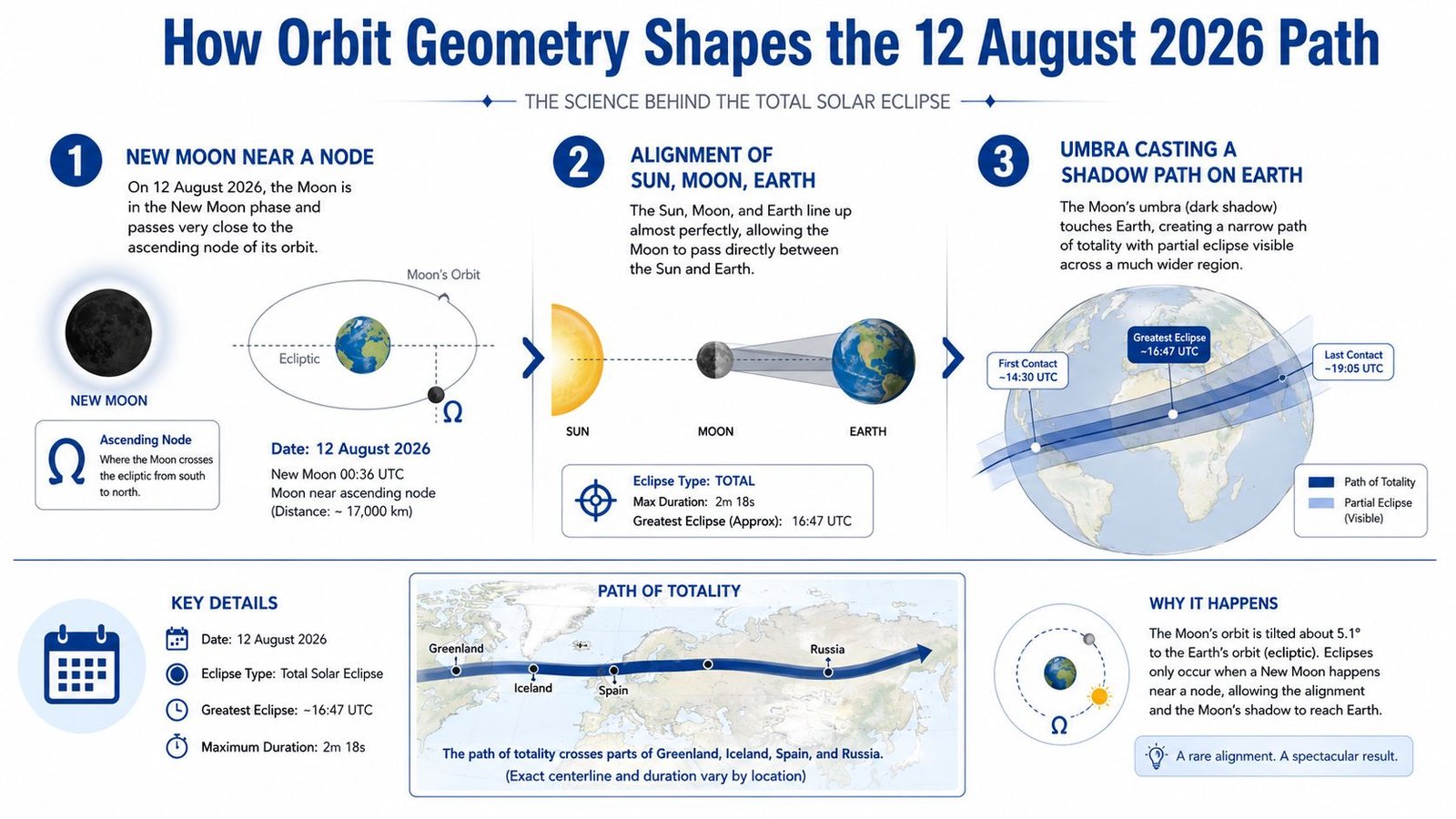
The practical lesson is simple. The Moon's orbit sets the shadow path, the node crossing makes the eclipse possible, and the distance decides whether the shadow can fully erase the Sun. On 12 August 2026, all three line up well enough for totality in the path, with the most striking low-sun viewing reserved for western Europe near sunset.
Practical Takeaways for Observers and Photographers
The orbit tells you what kind of event you're getting, but it also tells you how to prepare. If you're outside the path, you're planning for a spectacular partial eclipse. If you're inside it, you're planning for a very short totality window, and the rules change at the instant the Sun disappears.
- Use ISO 12312-2 solar filters during partial phases. The Moon's orbit doesn't make staring at a partial eclipse safe. Filters come off only during totality, and only if you are fully inside the path.
- Choose a low western horizon in Spain. Because totality happens with the Sun only 10 to 12° up, terrain, trees, and coastal haze can block the best view even when you're geographically close enough.
- Prefer inland sites at higher ground if weather allows. The low Sun angle means a clear western line of sight matters more than usual, and inland locations can help reduce horizon clutter.
- Carry a stable tripod for photography. The low-altitude geometry makes framing more delicate, especially as the Sun sinks and the shadow race slows visually near the horizon.
- Plan for mobility on eclipse day. Local cloud and haze can ruin a fixed spot, so a flexible route matters more than a perfect reservation.
The city tools at Total Solar Eclipse 2026 Live combine local timing, coverage, and path information for observers deciding where to stand. That kind of location-by-location planning is exactly what orbital mechanics demands. The Moon's path may be global, but your experience is local.
For photographers, the same logic applies. Keep your filter on for the partial phases, then switch to a short bracket during totality if you're in the path. The low Sun over Spain means foreground silhouettes, coastline shapes, and horizon lines can all become part of the composition, but only if you've already solved the geometry before the shadow arrives.
From Orbital Mechanics to the Moment of Totality
Totality is rare because three conditions have to line up together, the New Moon, a node crossing, and a Moon distance that's close enough for full coverage. Miss one piece and you get a partial eclipse instead. That's why a 99% partial still isn't totality, even though it looks close on a map.
The same orbital rules that explain the Moon's path also tell you where to stand on 12 August 2026. If you want the full event, check city-specific timing, percent coverage, and path markers before you travel, because the difference between inside and outside the path is the difference between totality and near-totality.
The Moon's orbit doesn't just choreograph the eclipse. It tells you when the show starts, where it lands, and why the wrong side of a border can change the sky completely.
Visit Total Solar Eclipse 2026 Live for city-level eclipse timing, path-of-totality maps, and safety guidance for Iceland, Spain, and the rest of Europe. If you're planning a viewing trip, use it to match the Moon's geometry to your exact location before eclipse day arrives.