July 15, 2026
7 Stars in Constellation Lyra for Eclipse 2026 Observers
You're probably doing what most serious eclipse travelers are doing right now. Checking maps, comparing Iceland against Spain, worrying about weather, and wondering whether your camera rig or binocular setup will behave when the light drops fast on eclipse day. That's the right instinct. For the total solar eclipse of August 12, 2026, preparation matters as much as location.
The night sky can help you prepare better than another round of gear shopping. Lyra is one of the most useful summer constellations for observers heading to Europe, because its stars give you practical targets for focus testing, optical checks, atmospheric assessment, and twilight practice. Vega anchors the pattern and stands out easily. The rest of Lyra offers a graduated set of observing challenges that tell you whether your site and equipment are really ready.
Your Celestial Toolkit for the 2026 Solar Eclipse starts here. As Europe prepares for the stunning sunset solar eclipse of August 2026, the essential work for observers begins months in advance. While the sun is the star of the show, the night sky holds the key to a perfect viewing experience. The constellation Lyra, high in the summer sky, isn't just beautiful. It's a celestial proving ground. This guide reveals 7 stars in constellation Lyra you can use to test your gear, evaluate your location, and sharpen your skills for totality.
Table of Contents
- 1. Vega The Brightest Star in Lyra and Navigation Reference for Eclipse Observers
- 2. Epsilon Lyrae The Double-Double System and High-Magnification Observing Challenge
- 3. Beta Lyrae An Eclipsing Binary System Demonstrating Eclipse Mechanics Before August 12 2026
- 4. Delta Lyrae A Wide Binary System and Optical Separation Benchmark for Eclipse Observers
- 5. Zeta Lyrae A Close Binary Revealing Atmospheric Turbulence and High-Resolution Observing Limits
- 6. Theta Lyrae A Mid-Brightness Binary for Accessible Atmospheric Assessment and Equipment Verification
- 7. Mu Lyrae A Colorful Multiple System Demonstrating Stellar Diversity and Night-Sky Contrast During Twilight Eclipse Conditions
- From Lyra's Stars to a Perfect Eclipse
- From Lyra's Stars to a Perfect Eclipse
1. Vega The Brightest Star in Lyra and Navigation Reference for Eclipse Observers
You arrive at an eclipse site in northern Spain with an hour of usable twilight, a camera bag full of gear, and no time for guesswork. Vega is the star to use first. It is bright, easy to identify, and strong enough to serve as a repeatable reference while you sort out focus, framing, and sky quality before August 12, 2026.
For observers heading to Iceland or Spain, eclipse preparation involves more than solar filters and contact timings. You need one reliable evening target that appears quickly, cuts through lingering twilight, and exposes setup problems before eclipse day. Vega does that better than almost any other star in Lyra.
What Vega does better than most test stars
Use Vega for fast diagnostic work. It helps confirm whether your lens is at infinity focus, whether haze is softening star images, and whether your mount or tripod setup returns to the same framing from night to night.
The practical advantage is speed. With a dimmer target, you can waste valuable twilight trying to confirm whether the problem is the sky, the optics, or your own aim. Vega removes that uncertainty. If you are rehearsing a wider environmental sequence, a solar eclipse time-lapse workflow is much easier to test when you have one unmistakable star to lock onto at the start.
Practical rule: If Vega looks soft, bloated, or smeared near the center of the frame, check focus, lens dew, and haze before blaming your tracker or optics.
Best use before the 2026 eclipse
Vega also works well as a field reference because it is part of the Summer Triangle, which many traveling observers already know. That familiarity matters in real conditions. At a new site, under time pressure, a recognizable star saves minutes and reduces setup mistakes.
Use it in a disciplined way:
- Focus target: Set manual focus on Vega with live view, then tape the focus ring if your lens tends to drift.
- Atmospheric check: Compare its sharpness and steadiness across several evenings to judge whether a site regularly suffers from haze or poor seeing.
- Framing reference: Build and repeat the same twilight composition before eclipse week so your wide-field shots are not improvised on the day.
- Exposure rehearsal: Use Vega in test frames to see how your camera handles the transition from bright twilight sky to darker post-sunset conditions.
There is a trade-off. Vega is bright enough to make poor conditions look better than they are if you only glance at the rear screen. Zoom in. Check star shape at the center and corners. For eclipse photographers, that habit catches focus drift, slight lens decentering, and thin cloud that would otherwise go unnoticed until the event itself.
Guides often start beginners on Vega because it is easy to find. Experienced eclipse observers keep using it for a different reason. It gives a quick, honest read on whether the rest of the session is worth trusting.
2. Epsilon Lyrae The Double-Double System and High-Magnification Observing Challenge
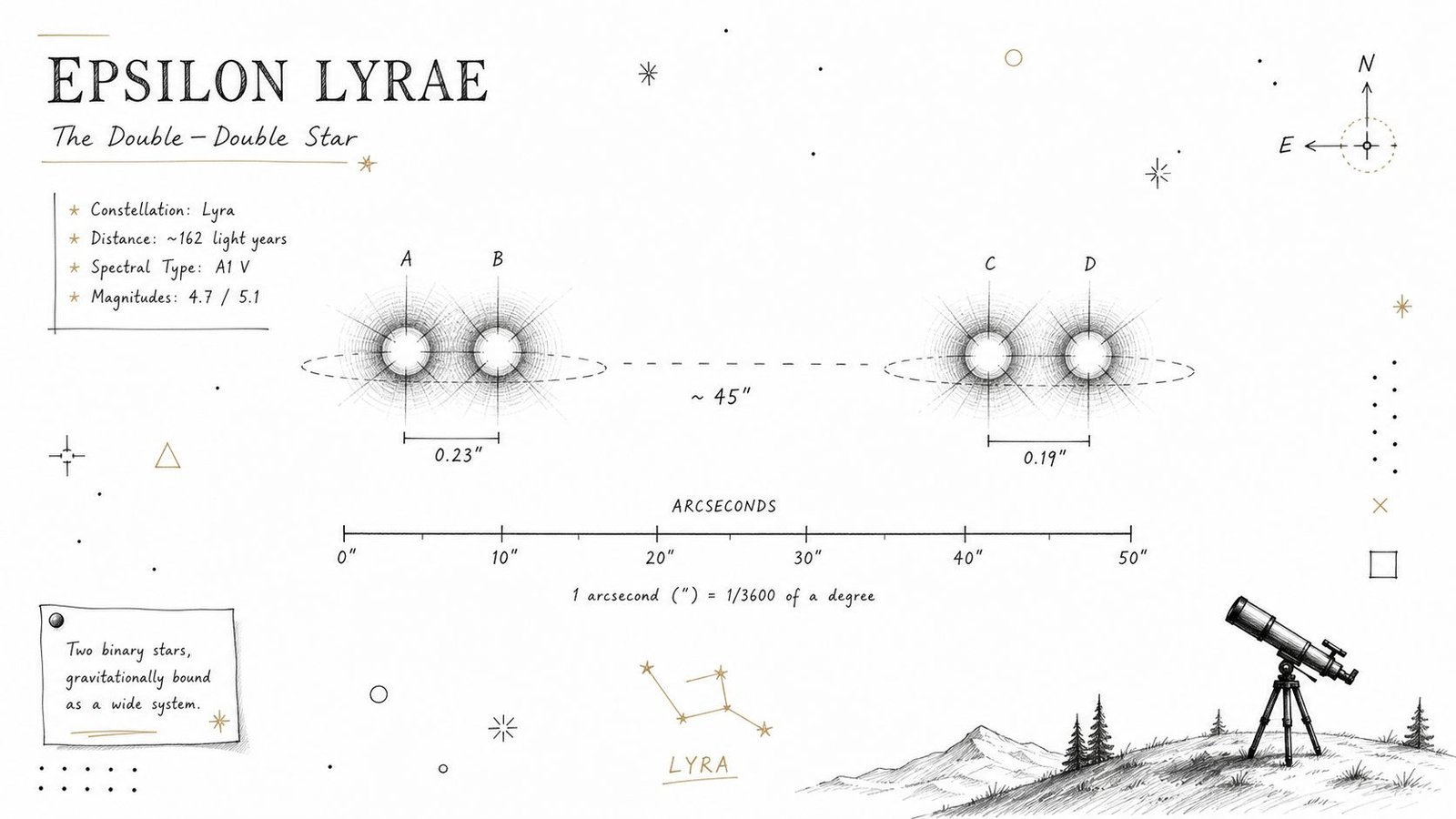
Epsilon Lyrae is where casual stargazing ends and useful testing begins. Many observers know it as the Double-Double, and it's one of the best stars in constellation Lyra for checking whether your telescope, diagonal, eyepiece, and local seeing are working together or fighting each other.
This target is valuable because it exposes problems fast. A telescope that looks fine on bright single stars can still struggle once you ask it to separate a more demanding multiple system. If you're carrying a refractor, Maksutov, or Schmidt-Cassegrain to Spain or Iceland for eclipse week, Epsilon Lyrae gives you an honest answer before the Sun does.
How to use it as an eclipse diagnostic
Use the same visual or imaging configuration you plan to bring into your solar workflow. That means the same mount, same focuser tension, same eyepiece or camera train, and the same observing chair height if comfort affects steadiness. Field habits matter more than people admit.
If all four components look distinctly separated, your system is probably in good shape. If the split looks uncertain, don't assume your optics are bad. Check thermal equilibrium, collimation, and local air movement first. A hotel terrace, parking lot, or sun-baked rooftop can ruin a perfectly good test.
Don't evaluate Epsilon Lyrae over warm concrete if you can avoid it. Grass, open ground, and exposed coastal air usually tell you more about the optics and less about the pavement.
What works and what doesn't
Good practice with Epsilon Lyrae is repeatable and specific:
- Use your real eclipse setup: Don't test with one eyepiece at home and a different imaging train in the field.
- Repeat over multiple evenings: One good or bad split doesn't tell the whole story.
- Check before sunset and after dark: Twilight steadiness can differ from full-night conditions.
- Log what you saw: “Clean split,” “touching,” or “unresolved” is enough to spot patterns.
What doesn't work is casual swapping of gear in the dark. People lose time comparing barlows, adapters, and diagonals when they should be deciding whether the site itself is stable enough. Epsilon Lyrae helps you make that call cleanly. For telescope users planning high-precision eclipse capture, that's exactly what you want.
3. Beta Lyrae An Eclipsing Binary System Demonstrating Eclipse Mechanics Before August 12 2026
Beta Lyrae is the teaching tool in this list. If you want a star that connects directly to eclipse thinking, this is the one. It's an eclipsing binary, so its changing brightness gives you a practical way to think about one body blocking another, light fading, and then returning.
That makes it useful before a total solar eclipse because many observers underestimate how quickly visual conditions change near key moments. Beta Lyrae won't reproduce the drama of totality, but it does train your mind to watch transitions instead of staring only at the peak event. That habit pays off.
Why Beta Lyrae helps eclipse timing instincts
When people first chase a total eclipse, they often focus on the center of totality and neglect the sequence around it. Beta Lyrae encourages a better mindset. You begin looking for progressive change, not just the headline moment.
That translates well to rehearsing contact awareness, bracket timing, and spoken cues for group viewing. If you're explaining eclipse geometry to family, students, or a travel group, this solar and lunar eclipse explainer pairs naturally with a real evening observing session on Beta Lyrae.
A practical way to observe it
Don't overcomplicate this target. You're not trying to produce a research-grade result. You're trying to become more attentive to gradual change.
Try this approach:
- Compare visually: Use nearby stars in the same field as rough reference points and note whether Beta Lyrae appears brighter or dimmer across sessions.
- Sketch the field: A notebook sketch slows you down enough to notice genuine differences.
- Time your sessions consistently: Similar observing times reduce confusion from changing sky conditions.
- Practice exposure discipline: If you image the field, keep settings controlled so your comparisons stay meaningful.
A strong use case is education. A small group in northern Spain can watch Beta Lyrae on successive nights, discuss what eclipse “ingress” and “egress” mean in plain terms, and then arrive at August 12 with better intuition. That kind of preparation sounds modest, but it often separates calm observers from rushed ones.
4. Delta Lyrae A Wide Binary System and Optical Separation Benchmark for Eclipse Observers
Delta Lyrae is the fast test. It doesn't demand a premium mount or a night of perfect seeing. That's exactly why it belongs in a field routine. When you arrive at a new site, especially after travel fatigue, you need one target that tells you whether your binoculars or small telescope are behaving normally.
Delta Lyrae earns its place among the most practical stars in constellation Lyra. It's a useful first-light check for rented binoculars, travel scopes, and camera lenses that have been packed, bumped, or exposed to moisture.
A smart arrival-night target
A lot of eclipse travelers waste their first clear night on an ambitious target. That's usually the wrong move. Start with Delta Lyrae instead.
If the pair looks clean and stable, move on to something harder. If it doesn't, stop and inspect the simple causes first. Fogged optics, a slightly loose diagonal, poor interpupillary adjustment, or mild collimation issues in binoculars are more common than people think.
A practical arrival routine looks like this:
- Scan the field slowly: Learn the nearby pattern before you judge the split.
- Check both eyepieces: Uneven brightness or softness often points to setup issues, not the sky.
- Watch for color fringing: Excessive false color near the stars can reveal alignment or optical stress.
- Repeat on eclipse morning: Overnight temperature swings can change performance.
Where Delta Lyrae fits in a real workflow
For group leaders and beginners, Delta Lyrae is a confidence builder. It's easier than Epsilon Lyrae and less frustrating on mixed nights. In a travel group, one person can center it in the field and let others confirm whether the optics feel right before anyone touches the solar gear.
If your binocular view of Delta Lyrae looks uneven from eye to eye, fix that before eclipse day. A binocular problem you ignore at night won't become harmless in daylight.
I've seen this kind of test save a trip from small but costly mistakes. A dew-softened objective or a bumped bino hinge can hide in daylight. Delta Lyrae makes those faults obvious.
5. Zeta Lyrae A Close Binary Revealing Atmospheric Turbulence and High-Resolution Observing Limits
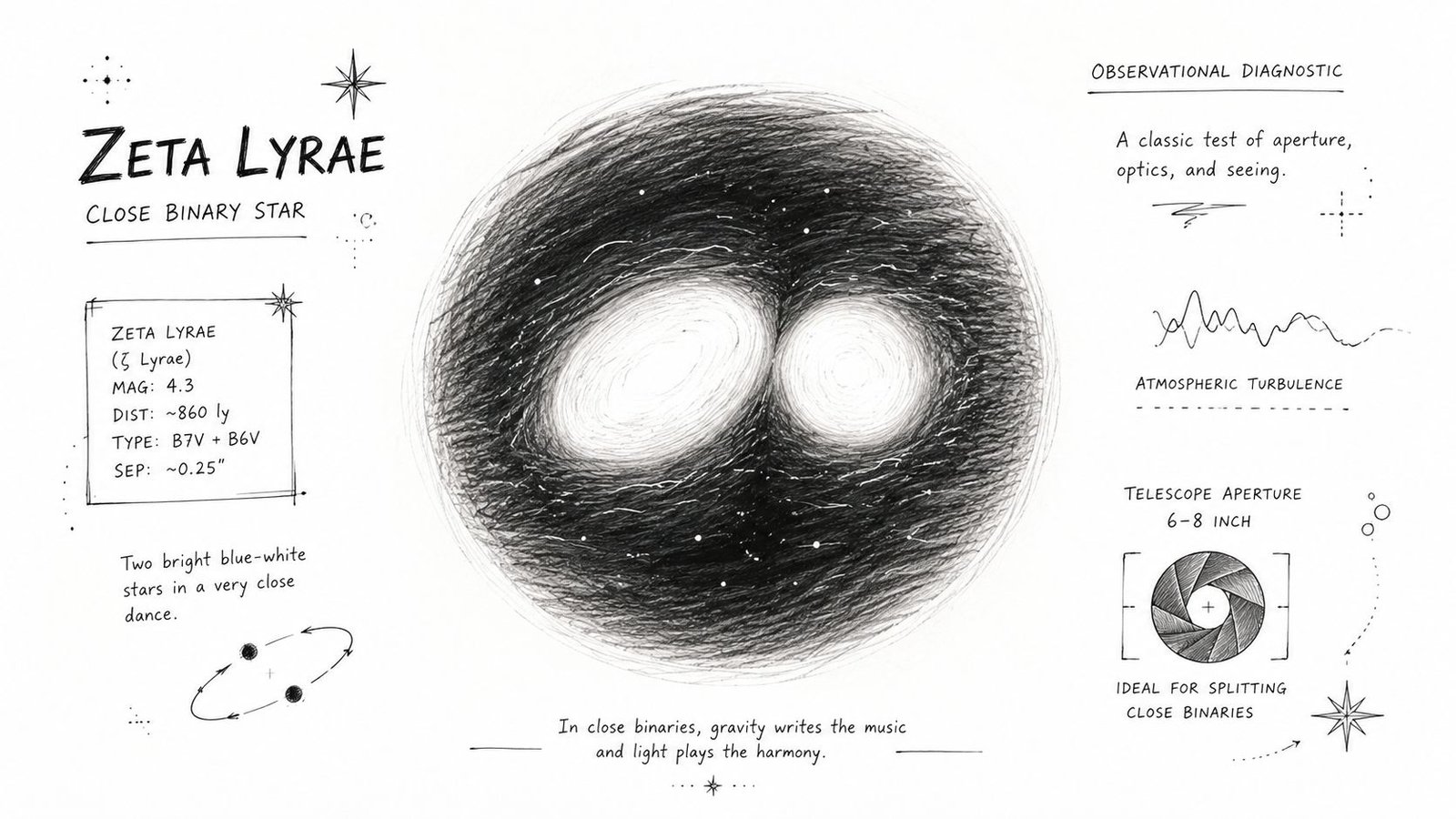
You arrive at a promising eclipse site, the forecast looks fine, and the horizon is open. Zeta Lyrae is the star that tells you whether the air above that site can support demanding work. I use it to judge whether a location is good enough for precise focus, tight double-star resolution, and final camera checks before the 2026 eclipse.
That matters in both Iceland and Spain. A coastal setup can offer a beautiful view and still suffer from restless air. An inland site can look less dramatic and produce steadier stars. Zeta Lyrae exposes that trade-off quickly.
What Zeta Lyrae tests that easier stars do not
Zeta Lyrae pushes beyond a basic optics check. Delta Lyrae can reveal obvious alignment or fogging problems. Zeta Lyrae goes after the next limit, seeing. If the atmosphere is unstable, this pair softens, smears, or flickers before your equipment has a fair chance to show what it can do.
That is why I would not use it as the first target of the night.
Use it after focus is already close, the mount is behaving, and the telescope has cooled. If you are practicing with one of the auto-tracking telescope setups for eclipse imaging, Zeta Lyrae is a good star to test whether the system can hold a small target steadily enough for repeatable fine focus.
The broader point is straightforward. Lyra is not only a navigation constellation for eclipse travelers. Its stars let you sort equipment faults from sky faults, and Zeta Lyrae is one of the best stress tests in the pattern.
How to read the view
Keep the magnification consistent for several minutes. Constant eyepiece changes waste time and can hide the underlying problem.
Judge the result in plain terms:
- Clean, steady separation: The air is supporting high-resolution work, and your site is a strong candidate for photography rehearsal.
- Intermittent split with wavering edges: The setup is usable, but fine focus and small detail will come and go with the seeing.
- Soft elongation with no stable separation: The atmosphere is setting the limit, not your ambition.
This is the kind of test that saves people from false confidence. A bright star can look attractive through thin haze or mild turbulence, but a close pair forces an honest answer.
Use the result to make site decisions
If Zeta Lyrae stays unstable over multiple looks, adjust the plan instead of arguing with the sky. Move away from rooftops radiating stored heat. Try a different surface, such as grass instead of pavement. Compare the same instrument from a sheltered inland stop and an exposed coastal one if your itinerary allows it.
For eclipse preparation, that gives you something more useful than a pretty observing session. It tells you where to rehearse critical tasks, where to trust high magnification, and where to lower expectations for fine-detail imaging even if totality itself will still be excellent.
6. Theta Lyrae A Mid-Brightness Binary for Accessible Atmospheric Assessment and Equipment Verification
Theta Lyrae sits in the sweet spot between “too easy to tell you much” and “too hard to be useful on an average night.” That makes it ideal for borrowed gear, travel groups, and fallback practice when conditions aren't good enough for Zeta Lyrae but still good enough to learn something.
If I had to choose one practical training star for mixed-skill observers, Theta Lyrae would be high on the list. It gives beginners a real double-star success, but it also gives experienced observers a baseline for judging how much detail the sky is willing to support.
Why Theta Lyrae is a strong fallback target
On a trip, not every night is premium. Wind shifts, thin haze, fatigue, and awkward setup locations can all lower your standards. Theta Lyrae still lets you verify whether your optics are aligned, whether your finder and main scope agree, and whether your focusing routine is disciplined.
That's why it's such a good companion target for people using compact mounts and modern travel setups. If you're testing portable tracking systems or evaluating whether a lightweight rig is stable enough, a look at auto-tracking telescopes for eclipse use makes more sense once you've tried centering and holding a moderate double like this in the night sky.
A practical routine for groups and beginners
Theta Lyrae works well when you need structure without intimidation:
- Start low power: Confirm the field and general separation first.
- Increase only after success: Don't jump straight to the highest magnification.
- Use it as a handoff target: One observer centers it, the next confirms the split.
- Pair it with setup checks: Recheck finder alignment, diagonal seating, and focuser smoothness.
A moderate double star is often the best truth serum for travel gear. It's demanding enough to expose sloppiness, but not so demanding that every failure looks like bad weather.
This matters for eclipse prep because confidence is cumulative. Observers who have a few clean nights on stars like Theta Lyrae usually manage eclipse equipment more calmly. They've already solved their small mistakes in the dark.
7. Mu Lyrae A Colorful Multiple System Demonstrating Stellar Diversity and Night-Sky Contrast During Twilight Eclipse Conditions
Set up in Spain the evening before totality, point west, and one problem shows up fast. Low-angle light changes everything. Contrast drops, haze thickens near the horizon, and camera color can drift more than expected. ESA notes that the 12 August 2026 eclipse in Spain will occur with the Sun low in the western sky, which is why site selection matters so much for this event, as outlined in ESA's 2026 eclipse viewing guidance.
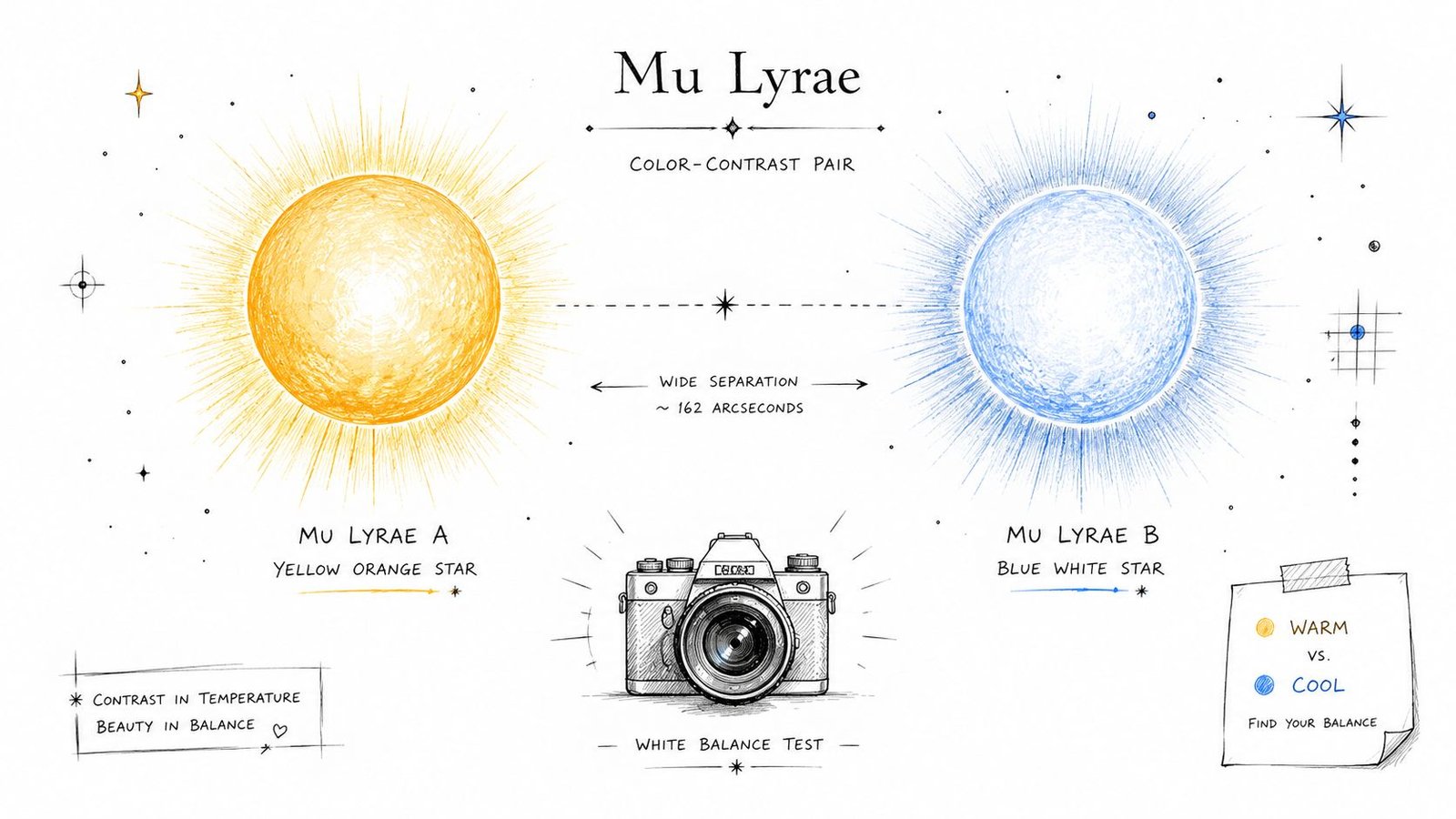
Mu Lyrae is useful here because it gives you more than a simple bright-star check. Its multiple-star character and visible color contrast make it a practical target for testing how your eyes and imaging setup respond as twilight deepens. For eclipse work, that matters. A rig that looks fine on a neutral star can still render warm and cool tones poorly once the sky starts shifting.
This is one of the better Lyra targets for white-balance discipline. If you shoot Mu Lyrae at fixed settings, then repeat with auto white balance, the comparison usually shows whether your camera is making helpful corrections or introducing inconsistency. That is the trade-off. Auto settings can save time in the field, but they can also change frame to frame right when you want a stable record of corona color, horizon glow, and environmental light.
It also works well for visual observers. Some people pick up the color difference quickly. Others mainly notice brightness order and separation. Both responses are useful because eclipse observing is full of subjective judgment under changing light, and Mu Lyrae gives groups a clean way to compare what each person sees.
A better rehearsal target for twilight color control
Use Mu Lyrae with a repeatable routine, not as a casual glance target.
- Keep framing consistent: Use the same focal length, exposure plan, and composition across multiple twilight sessions.
- Log your white-balance choice: Daylight, auto, and custom settings can produce very different star and sky colors.
- Check the horizon layer carefully: If haze strips away color contrast early, expect the same problem near eclipse time.
- Compare visual notes with files later: Human vision adapts fast. Your camera does not adapt the same way.
- Test with the full team: One observer can call out perceived color, another can review histograms, and a third can watch for contrast loss in binoculars.
Mu Lyrae earns its place on this list because it trains judgment, not just pointing accuracy. In Spain, it is a strong pre-eclipse test for low-altitude twilight behavior. In Iceland, where conditions may be very different, it still helps calibrate color response and sky contrast before eclipse day. That makes it one of the more practical stars in constellation Lyra for observers who want fewer surprises when totality starts.
From Lyra's Stars to a Perfect Eclipse
A clear rehearsal night in Iceland or Spain usually exposes the weak point before eclipse day does. Focus slips in cooling air. White balance shifts as twilight deepens. A mount that looked fine at home starts drifting after travel. Lyra gives you seven fast checks that reveal those problems early, while there is still time to fix them.
Use the stars here as a field checklist, not just a constellation tour. Vega is the fast orientation and focus target. Epsilon and Zeta Lyrae test how far your optics and local seeing will go. Delta and Theta Lyrae are better for quick confirmation when conditions are average and time is short. Beta Lyrae trains timing discipline. Mu Lyrae shows whether your color and contrast decisions hold up in low light.
That approach matters for the August 12, 2026 total solar eclipse because site conditions will vary sharply between western Iceland and northern Spain. Sky & Telescope's eclipse planning coverage maps the track across Iceland and Spain and explains why local weather and solar altitude should shape site choice: https://skyandtelescope.org/astronomy-news/plan-now-for-the-2026-total-solar-eclipse-in-europe/. The broader path summary and timing reference for greatest eclipse are listed in Wikipedia's eclipse entry: https://en.wikipedia.org/wiki/Solar_eclipse_of_August_12,_2026.
The practical takeaway is simple. If Lyra looks clean, stable, and repeatable through your exact eclipse setup, you have already removed several common failure points before first contact. If it does not, change the setup, lower magnification, revise exposure plans, or pick a better site. That kind of adjustment is what turns eclipse preparation into successful eclipse observing.
From Lyra's Stars to a Perfect Eclipse
Learning these stars in constellation Lyra does more than make you a better stargazer. It makes you a more prepared eclipse observer. Vega gives you a dependable orientation point and a simple twilight focus target. Epsilon Lyrae pushes your optics and your site hard enough to reveal whether your setup is ready for the task. Beta Lyrae teaches you to pay attention to changing light, which is one of the most important habits for eclipse day.
The rest of the list rounds out the field craft. Delta Lyrae is your quick equipment check after travel. Zeta Lyrae tells you whether the air is steady enough for demanding work. Theta Lyrae gives you a realistic fallback when conditions are average and you still want a meaningful test. Mu Lyrae helps you understand color and contrast, which matters even more when the eclipse arrives low in the sky.
That practical mindset matters because the August 12, 2026 total solar eclipse is a real travel event, not just an observing exercise. The path of totality is approximately 293 km wide and stretches over 8,260 km, beginning in northeastern Siberia, crossing the Greenland ice cap, clipping western Iceland including Reykjavík, and traversing northern Spain before exiting southeast of the Balearic Islands, according to Sky & Telescope's planning coverage. At greatest eclipse, totality will last 2 minutes 18.21 seconds at a point 45 km off Iceland's western coast at coordinates 65°10.3' N, 25°12.3' W, as listed in the August 12, 2026 eclipse reference.
Those facts are useful, but they don't replace rehearsal. If you want your eclipse trip to go smoothly, use Lyra in the weeks beforehand. Test focus. Test seeing. Test your timing. Learn what your equipment looks like when it's working well, and when it isn't. By the time totality arrives, you shouldn't be troubleshooting fundamentals.
For interactive maps, city-specific timings, path details, and practical viewing guidance for Iceland and Spain, build the rest of your plan with Total Solar Eclipse 2026 Live.
If you're planning to view the August 12, 2026 eclipse in Europe, Total Solar Eclipse 2026 Live is the right place to finish your prep. It brings together path maps, local timing tools, city-by-city coverage details, safety guidance, and practical advice for Spain, Iceland, and the rest of Europe so you can turn a good eclipse plan into a reliable one.