July 29, 2026
The Real Scale of the Solar System Explained
Most solar system diagrams teach the wrong lesson. They make the planets look neatly spaced and roughly comparable in size, when the real scale of the solar system is dominated by one enormous star and by astonishing amounts of empty space.
That mistake matters even more in 2026, because a total solar eclipse gives you a rare chance to see geometry at work. The Moon can blot out the Sun from Earth only because size and distance line up in a very specific way, and that alignment is easy to misunderstand if your mental image of the solar system came from a flat classroom poster.
Table of Contents
- Why Every Solar System Diagram You Have Seen Is Wrong
- The Sun Dominates Everything in the Solar System
- Building a True Scale Model at 1 to 10 Billion
- Walking the Distances Between Planets
- How Solar System Scale Creates the 2026 Eclipse
- Classroom and Backyard Scale Activities
- Rethinking Space Through True Proportions
Why Every Solar System Diagram You Have Seen Is Wrong
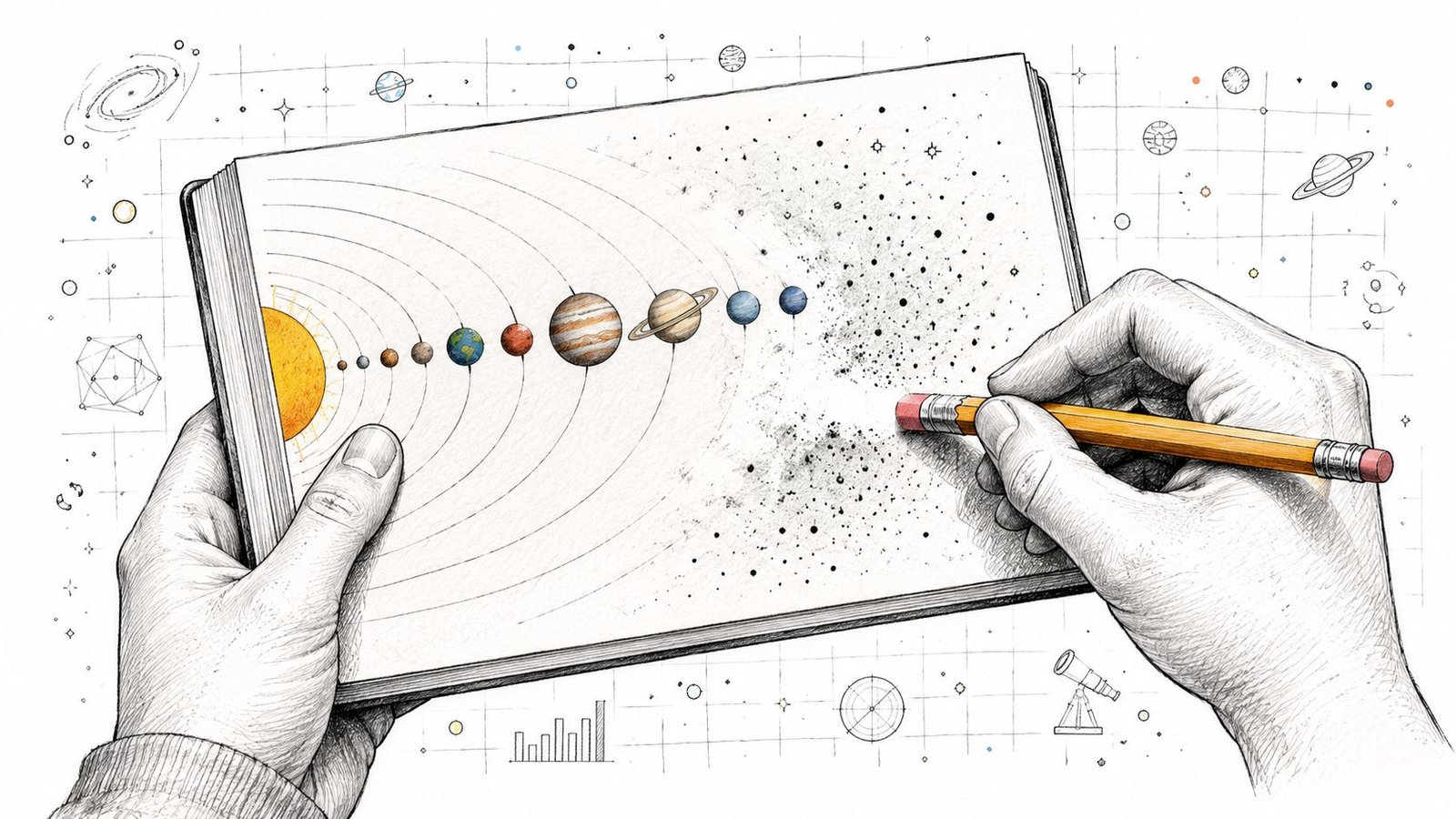
Textbook solar system diagrams usually compress the orbit spacing so aggressively that the planets seem clustered around the Sun. That visual trick is useful for showing the order of the planets, but it breaks the physical truth, because planet sizes and planet distances live on completely different scales.
Why the page lies
A page or screen has limited room, so artists have to choose between two distortions. If they keep the planets visible, the orbits get squeezed together. If they keep the spacing honest, the planets become too tiny to see.
That tradeoff is the core problem. The real scale of the solar system is not a neat circle of evenly spaced marbles, it is a very large central star surrounded by small worlds separated by huge gaps. NASA's field model drives that home with a memorable comparison, if the solar system were shrunk to an American football field, the Sun would still be only about 17 mm across, while Neptune would sit about 60 yards away, and the system would still feel mostly empty space (NASA scale visualization).
Practical rule: if a diagram lets you see every planet clearly at once, it probably isn't showing true scale.
That's why readers often leave with the wrong intuition. They remember the relative order of the planets, but not the shocking gap between what planets are and where they are. In real astronomy, distance matters at least as much as size, and sometimes much more.
The easiest way to tell a truthful model from a misleading one is to ask a simple question, are diameters and orbital distances being shrunk by the same factor? If the answer is no, the model is teaching convenience, not scale.
The Sun Dominates Everything in the Solar System
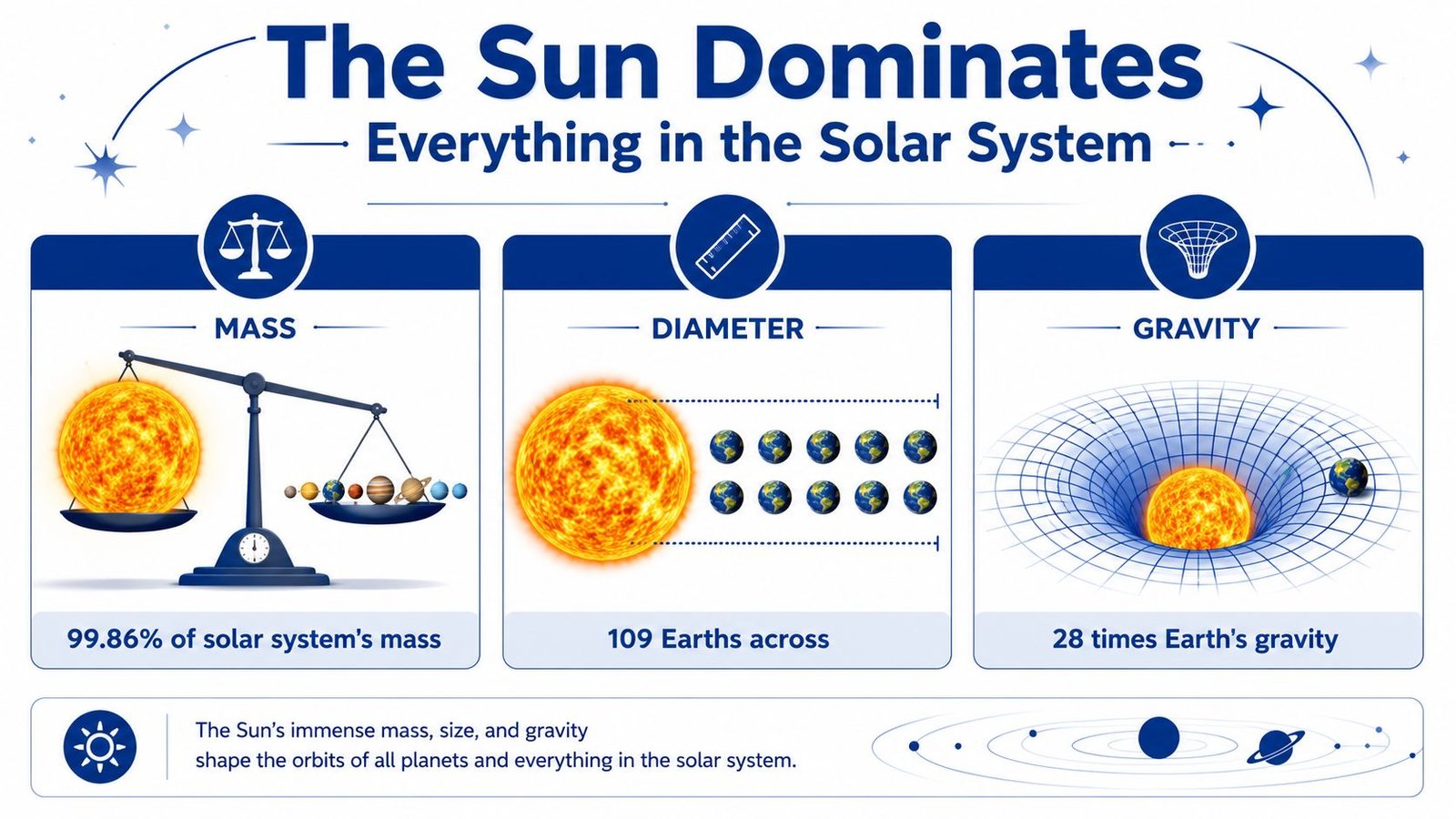
The solar system is a star system, not a set of equal neighbors circling one another. The Sun controls almost all of it, and the numbers make that clear. It contains about 99.86% of the solar system's known mass, which leaves every planet, moon, and asteroid sharing a tiny remainder (solar system mass overview).
Mass is the first reality check
Jupiter, the largest planet, still has only about 318 Earth masses. That sounds huge until you compare it with the Sun, because the comparison is planet versus star, not planet versus planet.
The Sun is also about 109 times Earth's diameter, and its volume could hold roughly 1 million Earths. Those figures explain why any serious scale model has to start with the Sun. Once the star is set, the planets stop looking like a tidy lineup and start looking like what they are, tiny objects in a system dominated by one enormous center.
Gravity and visual intuition
The infographic's gravity well is not just a decorative choice. The Sun's mass shapes the structure of the whole system, so the planets do not sit near one another as equals. They move around the object that owns almost everything.
A true-scale model makes that imbalance visible in a way a flat diagram cannot. The Sun is the anchor, and the rest of the system becomes a set of small bodies moving through very large spaces.
Key takeaway: if you mentally shrink the Sun, you usually shrink the whole system into a false sense of symmetry.
That is why the familiar row of planets is so misleading. It turns the Solar System into a crowd, when the actual picture is a vast central star with small companions spread through wide, mostly empty paths.
That perspective also helps when you think about events such as the 2026 solar eclipse. From Earth, the Moon can cover the Sun because size, distance, and alignment line up in a very specific geometry. The eclipse is a reminder that what we see in the sky depends as much on spacing and perspective as it does on size, and the same lesson is what makes true-scale models so rare in practice.
Building a True Scale Model at 1 to 10 Billion
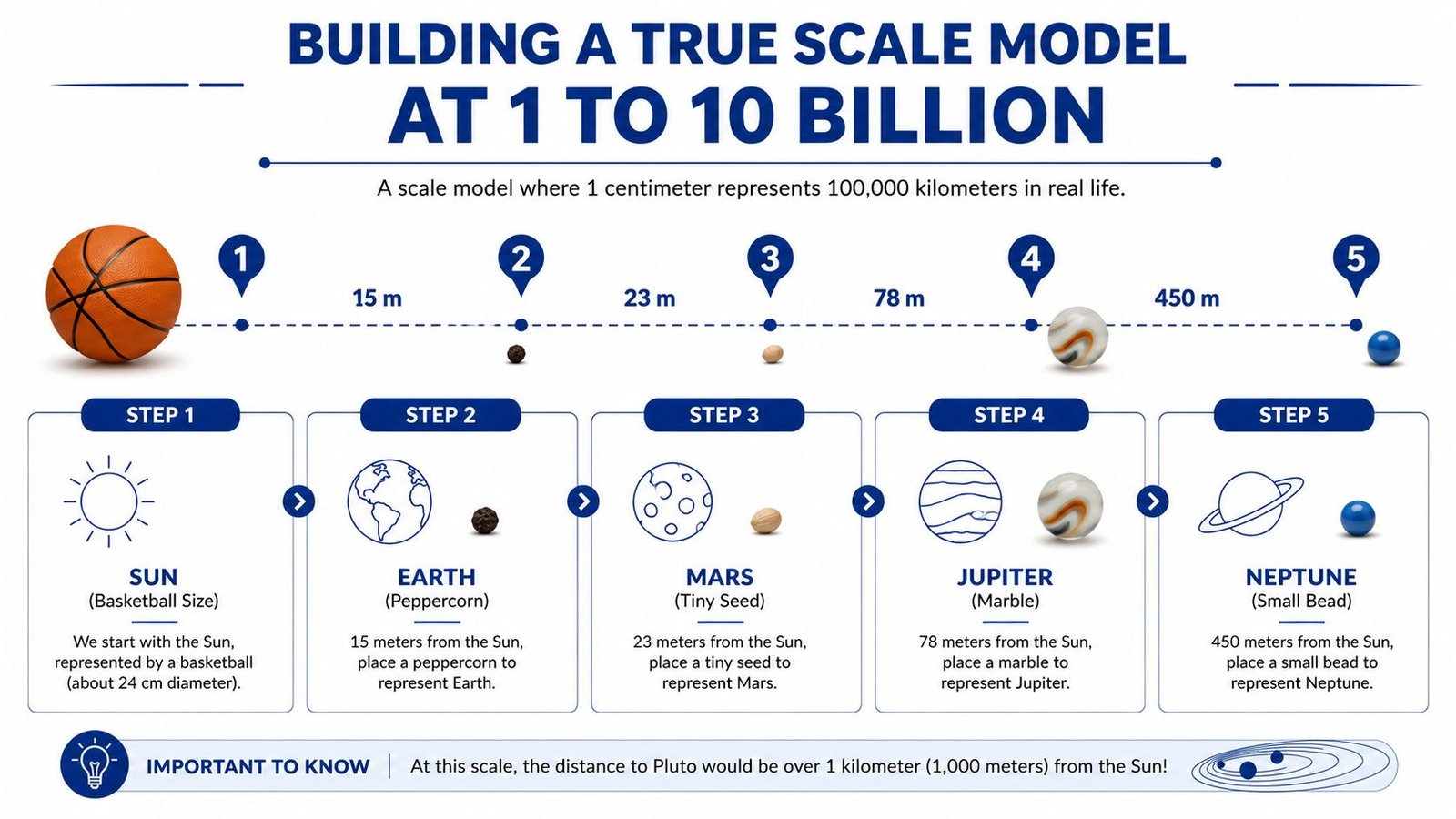
A true scale model follows one hard rule, it shrinks planet diameters and orbital distances by the same factor. At a common 1:10 billion scale, the Sun becomes roughly 139 mm across, Earth becomes about 1.3 mm, and Earth's mean distance from the Sun stretches to about 15 m (UMass scale model guide).
Start with the Sun, then place Earth
That order matters because the Sun sets the scale for everything else. Once the star is fixed, the rest of the system stops looking manageable. A 139 mm Sun is still a practical classroom object, but Earth at 1.3 mm is so small that it can disappear against a tabletop unless you know exactly where to look.
At that same scale, Earth is not “beside” the Sun in any ordinary human sense. It sits 15 m away, which is long enough to turn a model into a room-length exercise, or longer. A true-scale build makes that gap feel less like a diagram and more like a walk across a space you have to cross on purpose.
That is the point. The model forces your eyes to give up the usual habit of comparing nearby objects and to accept distance as part of the story.
Why size-only models mislead
Many popular models solve visibility by cheating one side of the problem. They enlarge the planets so you can see them, or they spread the planets out while keeping the Sun too large or too small. Either way, the result stops being a proportional system and becomes a display of selected parts.
Workshop rule: if you can hold the whole model in one hand, it probably isn't true scale.
That surprise is easy to miss until you try to build one. A grapefruit-sized Sun does not give you a clearly visible Earth sitting nearby. It gives you a tiny Earth far away, barely larger than a speck, and the space between them becomes the main feature of the model. That is why true proportion changes the emotional experience of the Solar System as much as the visual one.
The awkwardness is part of the lesson. A faithful model is hard to build because the Solar System itself is hard to fit into human rooms, human hands, or human intuition.
That same geometry is why the 2026 solar eclipse matters here. From Earth, the Moon can cover the Sun only when size, distance, and alignment line up in a very specific way. The eclipse shows how much of astronomy is shaped by spacing and perspective, not just by the objects themselves. True-scale models are rare because they make that spacing impossible to ignore.
Walking the Distances Between Planets
Astronomers use the astronomical unit, or AU, because raw kilometer counts get unwieldy fast. Earth orbits at 1 AU, about 150 million km or 93 million miles from the Sun, and sunlight takes about 8 minutes 20 seconds to cross that gap.
A walkable way to think about the gap
Place the other planets on that same scale, and the empty space starts to dominate the picture. Mercury orbits at about 0.387 AU, Mars at 1.524 AU, Jupiter at 5.2 AU, and Neptune at about 30 AU from the Sun. Those figures do more than mark positions, they show how quickly the gaps open up around the inner planets and keep widening toward the edge of the Solar System.
NASA's football-field analogy makes that distance easier to grasp. If the Sun were a dime on the goal line, Neptune would be 60 yards away (NASA scale visualization). A football field is a familiar piece of ground, so the comparison turns a remote orbit into something you can almost pace off.
A true-scale model makes the problem obvious. The planets do not sit in a neat cluster, they are spread across a system so large that the spacing becomes the main story, and the tiny worlds feel separated by long stretches of almost nothing.
Distance changes everything you observe
Geometry takes over once you move outward. Spacecraft travel takes time because the Solar System is built across enormous intervals, not because the planets themselves are especially large. A real-scale map replaces the compact planet lineup from posters with long routes, thin neighborhoods, and a lot of emptiness between landmarks.
That is also why scale matters for what we see from Earth, including eclipse geometry. The same relationship between size, distance, and alignment that makes the Solar System hard to model also explains why a solar eclipse can happen at all. For a clear explanation of that alignment, see what solar and lunar eclipses are.
| Planet | Orbital position from the Sun | What that means in practice |
|---|---|---|
| Mercury | 0.387 AU | Close, but still far enough away to feel distant in human terms |
| Mars | 1.524 AU | A little beyond Earth's orbit, yet still on the inner side of the system |
| Jupiter | 5.2 AU | Deep into the outer system |
| Neptune | 30 AU | Far beyond the region most people picture when they hear “planet” |
The table makes one point hard to miss. The planets are not arranged like a compact neighborhood, they are scattered across a system that expands faster than our intuition can comfortably follow.
How Solar System Scale Creates the 2026 Eclipse
The eclipse on 12 August 2026 is a geometry lesson you can watch with your own eyes. The total phase is expected to be visible across Iceland and northern Spain, and in Spain totality occurs around 20:30 local time, with the Sun only 10 to 12 degrees above the horizon, which makes low western horizon views especially important (2026 eclipse overview).
Why the Moon can erase the Sun
The key is not just that the Moon is in the right place. The key is that the Sun is about 400 times larger than the Moon and also about 400 times farther away, so their apparent sizes from Earth are nearly the same. That coincidence is what allows the Moon to cover the Sun completely during totality.
This is the same kind of scaling logic that governs the whole solar system, just compressed into one sky event. Distance changes apparent size, and apparent size changes what you can observe. A solar eclipse is not magic, it is the visible result of precise proportions.
Europe, the horizon, and what observers actually see
For eclipse chasers in Europe, the low solar altitude matters as much as the timing. A 10 to 12 degree Sun sits close to the horizon, so hills, buildings, sea haze, or tree lines can easily ruin the view even when you are inside the path of totality.
That's why the event feels so different from a high-noon eclipse. The light behaves differently near sunset, shadows sharpen in unusual ways, and the scene becomes far more dramatic than a simple “Sun covered, Sun uncovered” description suggests. Geometry decides both the spectacle and the practical viewing challenge.
The most valuable part of eclipse planning isn't just knowing the date, it's knowing where the sky is actually open.
Readers who want a basic refresher on eclipse mechanics can use this concise guide on what makes a solar and lunar eclipse different. The reason that distinction matters here is simple, the 2026 event is a direct, real-world demonstration of scale, alignment, and distance working together.
Classroom and Backyard Scale Activities
A scale lesson lands when people have to move through it with their own feet. Solar system activities work best when they stop being poster exercises and become space exercises that ask you to walk, pace, turn, and look back over your shoulder.
Three ways to feel the scale
| Scale Model Comparison | Sun Size | Neptune Distance | Space Needed |
|---|---|---|---|
| Hallway model | 17 mm ball | about 79 yards | a long hallway or outdoor field |
| Playground model | 10 cm per AU | about 10 feet from Sun to Neptune | a modest open area |
| Walking tour | virtual or mapped path | depends on route | online maps and a phone or tablet |
The hallway version follows NASA's 17 mm Sun visual, where Neptune stretches to about 79 yards away (NASA scale visualization). The lesson is plain, you cannot stand in one place and absorb the whole system at once. You have to move through it, because the model stops fitting inside your field of view long before the solar system does.
The playground model works differently. If you use 10 cm per AU, the Sun-to-Neptune spacing is still small enough for a schoolyard, but it already outgrows most indoor rooms. That is why true scale so often becomes a problem of space, permission, and logistics before it becomes a problem of math.
For a more flexible version, use a walking tour with a map app and place pins at proportional intervals. Students can trace the route, compare the gaps visually, and see how the outer solar system is not just larger, it is far more spread out than casual observers mentally picture from textbook diagrams.
What each activity teaches
- Hallway model: shows how quickly proportion outgrows indoor space.
- Playground model: shows that even tiny objects need room when the spacing is honest.
- Virtual tour: lets you compare scale without being limited by physical distance.
Read more about telescope planning at good stargazing telescope guidance if you want to connect scale teaching with actual night-sky observing. That pairing works well in classrooms and backyard sessions, because it links a model of the solar system with the way real viewing depends on setup, sightlines, and patience.
Rethinking Space Through True Proportions
True scale changes the whole picture. Once the distances are honest, the solar system stops looking like a neat row of objects and starts feeling like a wide, mostly empty structure where the Sun anchors everything and the planets occupy tiny islands of space.
That is why spacecraft navigation becomes a geometry problem, not a simple trip from one place to another. Distances grow much faster than object sizes, so mission planners have to work with trajectories, timing, and alignment. A straight line on paper can hide a very different path in space.
Why eclipse season changes the way people think
The 2026 eclipse gives people a rare chance to see scale as an event instead of a diagram. If you are inside the path and the horizon is clear, you are not just watching the Moon cover the Sun, you are seeing the solar system line up in a way that turns distance and size into something visible for a few minutes.
The same kind of scale thinking helps with structures far beyond our own system. For a broader comparison, read how big nebulae really are. That contrast makes one point very clear, our solar system is enormous by human standards, yet it still sits inside a much larger cosmos that dwarfs familiar intuition.
The simplest takeaway is also the one that stays with you. True scale changes what you think you know. It replaces the tidy diagram with the actual thing, vast, sparse, and beautifully ordered.