July 16, 2026
Find a Good Stargazing Telescope for 2026 & Beyond
You're probably in the same place many first-time buyers land. You've looked at a few telescope listings, seen huge magnification numbers printed on boxes, and wondered which one will show you something memorable instead of a dim blur. You might also have one eye on a special date. August 12, 2026, when Europe gets a total solar eclipse worth planning around.
That combination changes the buying decision. A good stargazing telescope for casual Moon viewing isn't always the best choice for deep-sky observing, and the scope you'd use for galaxies isn't automatically the smartest tool for an eclipse trip. The right purchase is the one that matches what you want to see, how much setup you'll tolerate, and whether you want one instrument that can serve you on ordinary nights and on one extraordinary afternoon.
Table of Contents
- Why Choosing a Good Telescope Matters
- The Core Specs Aperture and Focal Length
- Telescope Designs Refractor Reflector and SCT
- Mounts The Foundation for a Steady View
- Telescope Tiers for Every Budget and Ambition
- Special Focus Viewing the 2026 European Eclipse
- Essential Accessories and Your First Night Out
Why Choosing a Good Telescope Matters
A good stargazing telescope changes the sky from a flat backdrop into a place you can explore. With the wrong one, beginners spend their first night fighting shaky mounts, narrow views, and confusing controls. With the right one, the first session usually includes a genuine moment of surprise. Saturn stops looking like a bright point and starts looking like a tiny world with rings. The Moon stops being “the Moon” and reveals its intricate features.
That's why this purchase matters more than it first appears. You're not just buying hardware. You're choosing how easy it will be to step outside on a weeknight and see something rewarding in ten minutes.
A telescope should fit the experience you want
Some people want crisp lunar and planetary views from a balcony. Others want to sweep through star fields from a dark site. Others are planning travel around the upcoming eclipse and want equipment that's portable, safe, and simple to use under pressure.
Those are different jobs.
A long refractor on a sturdy mount can make the Moon look spectacular. A Dobsonian reflector can make faint nebulae and clusters far more satisfying. A compact catadioptric design can fit travel plans better than either. If you buy only by advertised magnification, you'll miss the real question. What do you want to see most often, and from where?
A telescope that gets used often beats a more powerful telescope that stays in a closet.
There's another point many buying guides skip. A telescope isn't always necessary for a good start. NASA's skywatching guidance notes that binoculars or even naked eyes can be better for meteor showers and constellations because telescopes have a tiny field of view, and it also highlights that binoculars are easier to carry and often a better beginner path for immersive deep-sky viewing on the NASA skywatching page.
The 2026 eclipse makes this choice more concrete
If you're in Europe, or traveling there, the eclipse gives your purchase a real deadline and a real purpose. You're not buying a telescope in the abstract. You're choosing gear that might serve you on ordinary nights this year, then help you observe one of the sky's most dramatic events in August 2026.
For many people, that changes the balance. Portability matters more. Safety matters far more. Wide views become more appealing than raw power. The best telescope for your life may not be the biggest one you can afford. It may be the one you can transport, set up calmly, and trust.
The Core Specs Aperture and Focal Length
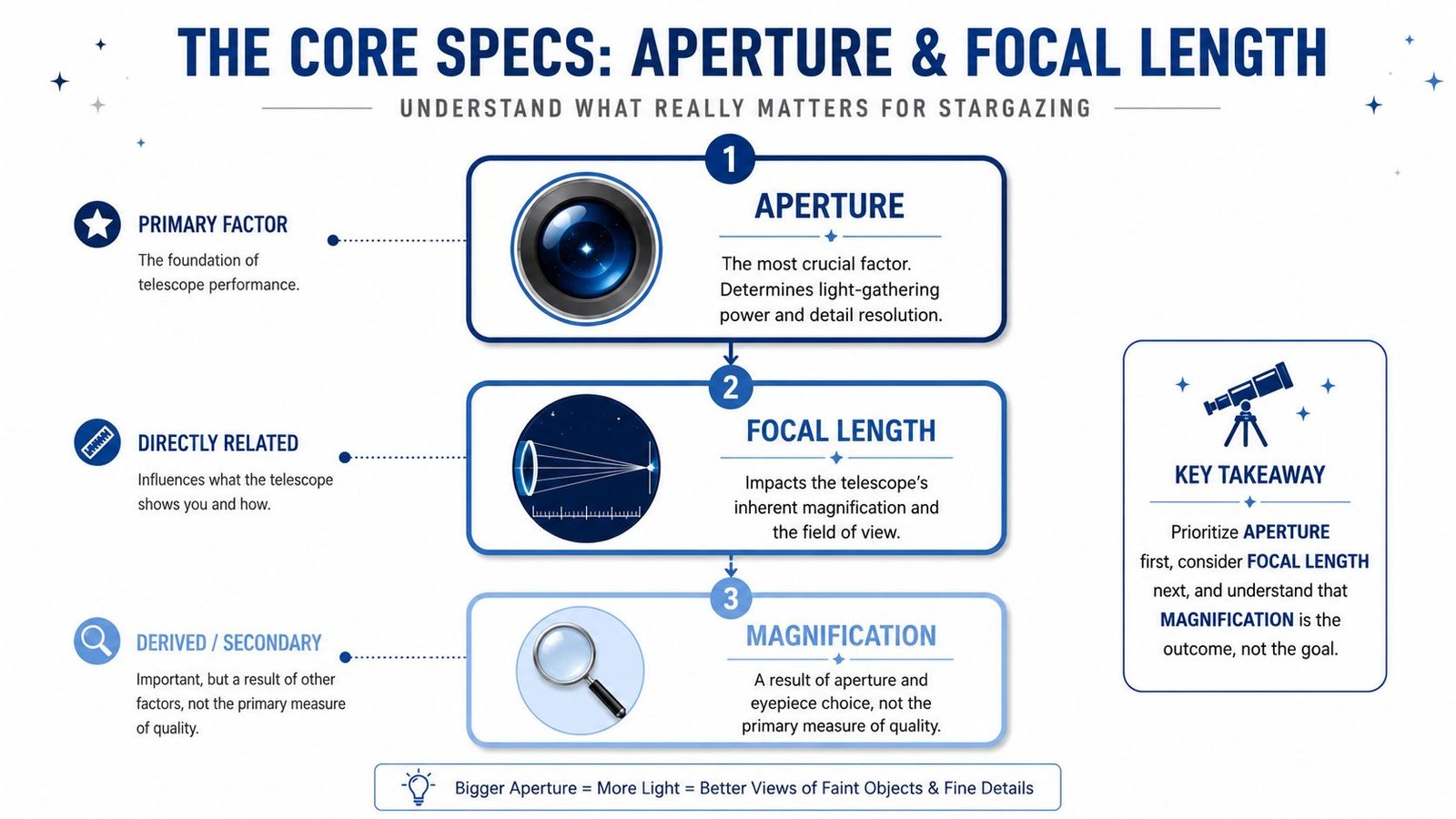
The biggest trap in telescope shopping is thinking magnification tells you quality. It doesn't. Aperture matters first.
Aperture is the light bucket
Aperture is the diameter of the main lens or mirror. Think of it as a bucket collecting rain. A larger bucket catches more rain. A larger aperture gathers more light. That extra light is what makes faint galaxies, nebulae, and star clusters easier to see, and it also helps reveal finer detail on bright targets.
This is why experienced observers care so much about aperture. It affects both brightness and resolving power. More light gives your eye more signal to work with. Better resolution lets the instrument separate finer details instead of smearing them together.
Marketing often pushes magnification because it sounds exciting. But a telescope can only magnify the detail it captures. A practical benchmark is that maximum useful magnification is about twice the aperture in millimeters, so a 100 mm telescope supports about 200× before you slide into empty magnification, where the image looks bigger but not sharper, as described in this telescope aperture benchmark guide.
Practical rule: If a telescope ad shouts about huge magnification but says little about aperture, keep scrolling.
What focal length changes
Focal length matters too, but in a different way. It shapes how the telescope behaves. In simple terms, longer focal lengths tend to favor higher magnification with a given eyepiece. Shorter focal lengths tend to give wider views of the sky.
That affects what observing feels like. A shorter, wider-field scope is often more relaxed for scanning the Milky Way, open clusters, and eclipse framing. A longer focal length instrument is often more comfortable for planets, double stars, and close-up lunar work.
Here's a simple way to think about the relationship:
| Spec | What it changes most | What you notice at the eyepiece |
|---|---|---|
| Aperture | Light gathering and detail | Brighter faint objects, better resolution |
| Focal length | Native magnification tendency and field of view | Wider sweep or narrower close-up |
| Eyepiece choice | Final magnification | How large the object appears |
Confusion usually starts when people mix these together. A telescope with modest aperture and long focal length can produce a big image, but it may still be dimmer and less detailed than a larger-aperture scope at lower power. That's why a good stargazing telescope usually starts with enough aperture for your targets, then uses focal length to fine-tune the style of observing.
Telescope Designs Refractor Reflector and SCT
Once you understand aperture, the next question is the design. Here, personal preference starts to matter. The three common families each have a personality.
Refractor
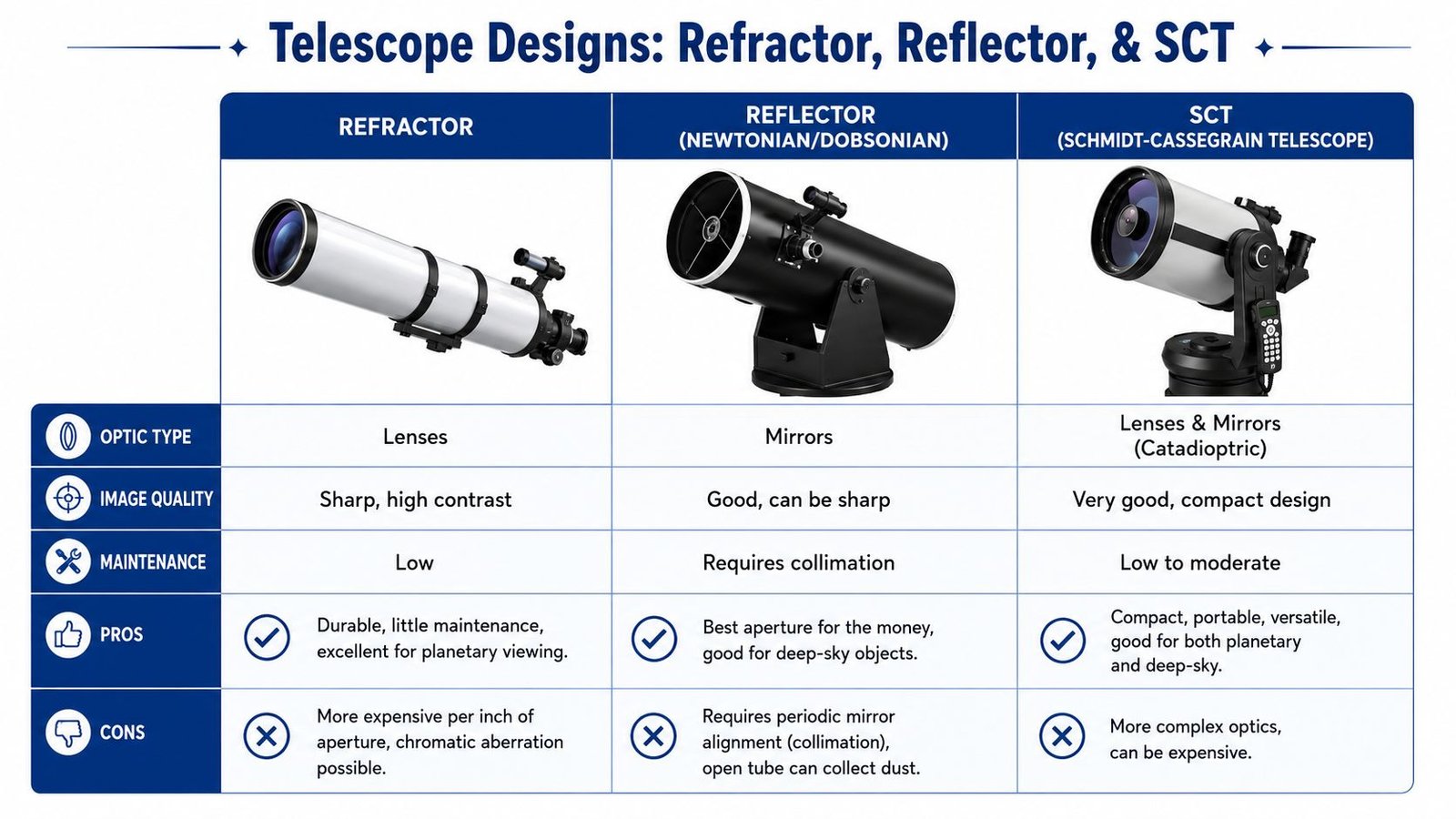
A refractor uses lenses. It's the design often envisioned when the word telescope is heard. Light enters through the front lens and travels down a sealed tube to the eyepiece.
For beginners, refractors have a lot going for them. They're usually clean, straightforward, and low-maintenance. They cool quickly, hold alignment well, and often give pleasing contrast on the Moon and planets. If you want a telescope that feels predictable and easy to grab on a clear evening, a refractor is often the most inviting choice.
The trade-off is cost per inch of aperture. Larger refractors get expensive fast, and lower-cost models can show chromatic aberration, which is color fringing around bright objects.
Reflector
A reflector uses mirrors, usually in a Newtonian layout. In a Dobsonian version, that optical tube sits on a simple, sturdy base that swings up, down, left, and right.
For pure visual value, many amateurs recommend a Dobsonian reflector first. You get more aperture for the money, and that matters a lot on deep-sky objects. If your dream is to scan bright nebulae, clusters, and galaxies from a dark location, a reflector can be the most satisfying path into serious observing without making the budget painful.
The cost is bulk and upkeep. Reflectors can need collimation, which means aligning the mirrors. That sounds intimidating at first, but many observers learn it quickly. The bigger issue for some buyers is storage and transport. A Dobsonian can be wonderful in the garden and awkward in a small car.
A quick visual comparison helps:
SCT
An SCT, or Schmidt-Cassegrain Telescope, folds light through a compact tube using lenses and mirrors together. That folded design is the reason so many people like them. You get a lot of focal length in a smaller package.
This makes SCTs attractive if you want a telescope that stores easily, travels well, and can handle a wide variety of observing. An SCT can do lunar and planetary work nicely, and it can also tackle many deep-sky targets. For someone planning a road trip or flight for the 2026 eclipse while still wanting one all-purpose telescope at home, an SCT often looks like the compromise that makes sense.
Refractors feel easy. Reflectors feel generous. SCTs feel adaptable.
Their downsides are complexity and price. They can take time to cool, and their narrower native field can make wide sweeping views less natural than in a short refractor. That doesn't make them bad. It just means they fit the observer who values compact versatility.
Mounts The Foundation for a Steady View
A shaky telescope can make excellent optics feel cheap. A steady telescope can make modest optics feel far better than their price suggests. Beginners often spend all their attention on the tube and treat the mount like packaging. That's backward.
Why the mount decides whether you enjoy the telescope
Every telescope magnifies movement as well as detail. If the mount vibrates when you touch the focuser, the image will jump. If the tripod flexes, planets will swim around the field when you try to center them. If the head slips, finding objects becomes a chore.
That frustration is what pushes many new owners out of the hobby. They think they bought the wrong telescope, when really they bought the wrong support.
Here's what a stable mount gives you:
- Easier focusing: Fine details snap into view instead of wobbling away.
- Less fatigue: You spend more time observing and less time correcting.
- Better sharing: If friends or kids take a look, the target stays in view.
- More confidence during eclipse use: You won't want to fight vibrations when timing matters.
Alt-Az and Equatorial in real use
An Alt-Az mount moves up and down, left and right. It's intuitive. Dobsonians use this idea in a very practical form, and many beginner-friendly travel mounts do too. For visual observing, especially if you value simplicity, Alt-Az is hard to beat.
An Equatorial mount is built to track the sky's motion in a more astronomy-specific way. It takes more learning, and setup is less casual, but it becomes useful when smooth tracking matters for long viewing sessions or imaging. If you're curious about motorized options, this guide to auto-tracking telescopes for eclipse and skywatching shows where tracking starts to become valuable.
A small travel refractor on a solid Alt-Az mount can be a smarter eclipse companion than a larger telescope on a weak tripod. That's not glamorous advice, but it's honest advice.
Telescope Tiers for Every Budget and Ambition
Telescope buyers rarely shop by optical design alone. They shop by what they can spend and what they hope to see. That's the right way to approach it. A good stargazing telescope should feel proportionate to your expectations.
Starter tier
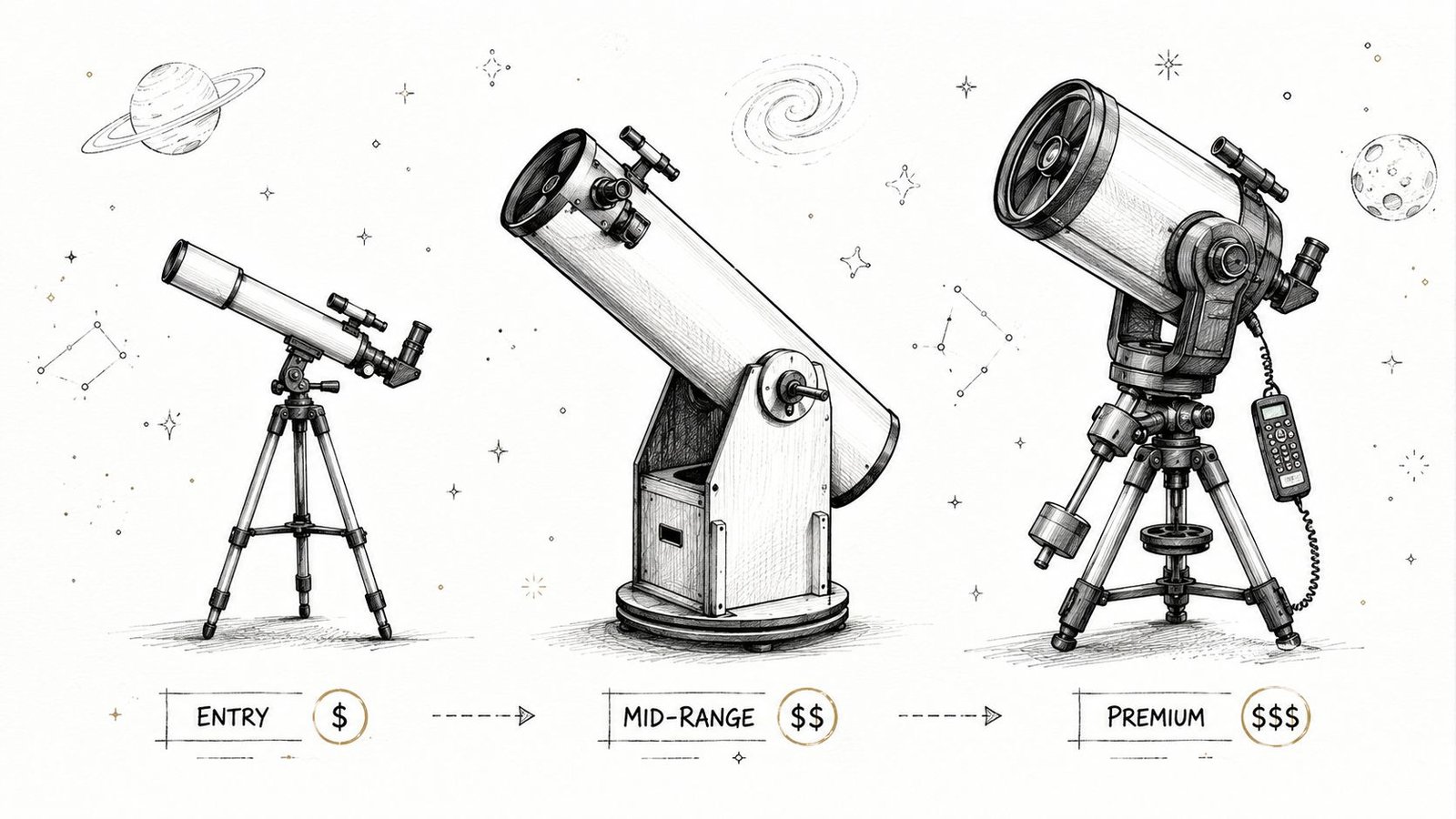
At the entry level, the best buys are usually small refractors, tabletop Dobsonians, or beginner Newtonians on mounts that aren't flimsy. Focus on realistic capabilities rather than overly ambitious goals. You're aiming for crisp Moon views, Jupiter's moons, Saturn's rings, and brighter clusters.
This tier is also where binoculars remain a smart rival. If someone is undecided, a modest telescope plus binoculars can be a stronger first setup than stretching the budget for a disappointing “high-power” package.
A few sensible examples include a short-tube refractor for wide-field scanning or a tabletop Dobsonian that puts aperture first. These won't show every faint object in dramatic detail, but they can absolutely hook a beginner.
Middle tier
For many, the hobby truly opens up. With more aperture and a better mount, star clusters become richer, brighter nebulae become more rewarding, and galaxies stop feeling like theoretical targets. You'll still need realistic expectations. Visual astronomy is subtle. But the jump from beginner gear to solid middle-tier gear is often where sessions become satisfying.
For deep-sky use, magnification has to stay sensible. Sky & Telescope notes an optimal range of 8× to 40× per inch of aperture for deep-sky observing, with deep-sky specialists often using 4× per inch to maximize field of view and light capture in its guide to choosing a telescope for observing targets. That's why a larger telescope at moderate power often beats a smaller telescope pushed too hard.
If your ambition includes seeing Saturn regularly, this practical roundup of a telescope you can see Saturn with helps connect telescope classes to real viewing expectations.
Upper tier
At the high end, you're usually paying for one of three things. More aperture, better mechanical quality, or greater portability in a premium design. It is here that larger Dobsonians become serious light buckets, apo refractors become beautifully refined visual tools, and compact SCT systems start making sense for observers who want one instrument to do many jobs.
A short comparison may help:
| Tier | Best fit | Typical strengths | Main caution |
|---|---|---|---|
| Starter | First-time observer | Easy lunar, planetary, bright clusters | Weak mounts and inflated magnification claims |
| Middle | Regular observer | Better deep-sky reach, steadier views | More bulk, more setup |
| Upper | Dedicated observer | Stronger optics, mechanics, versatility | Cost and complexity can rise quickly |
Buy the tier that matches your patience as much as your budget. A telescope that asks too much of you won't get many nights under the stars.
The hidden truth is that many people are happiest in the middle. Enough capability to grow into, not so much complexity that every session becomes a project.
Special Focus Viewing the 2026 European Eclipse
The August 2026 eclipse changes this buying guide from general advice into travel-and-observation planning. If you want one telescope that can handle ordinary stargazing and also serve you well for eclipse viewing in Europe, you need to think differently.
What makes this eclipse special
At the point of greatest eclipse, the total solar eclipse on August 12, 2026 will have a maximum totality of 2 minutes and 18.21 seconds, located 45 km off the western coast of Iceland at 65°10.3' N and 25°12.3' W, according to this 2026 total solar eclipse reference.
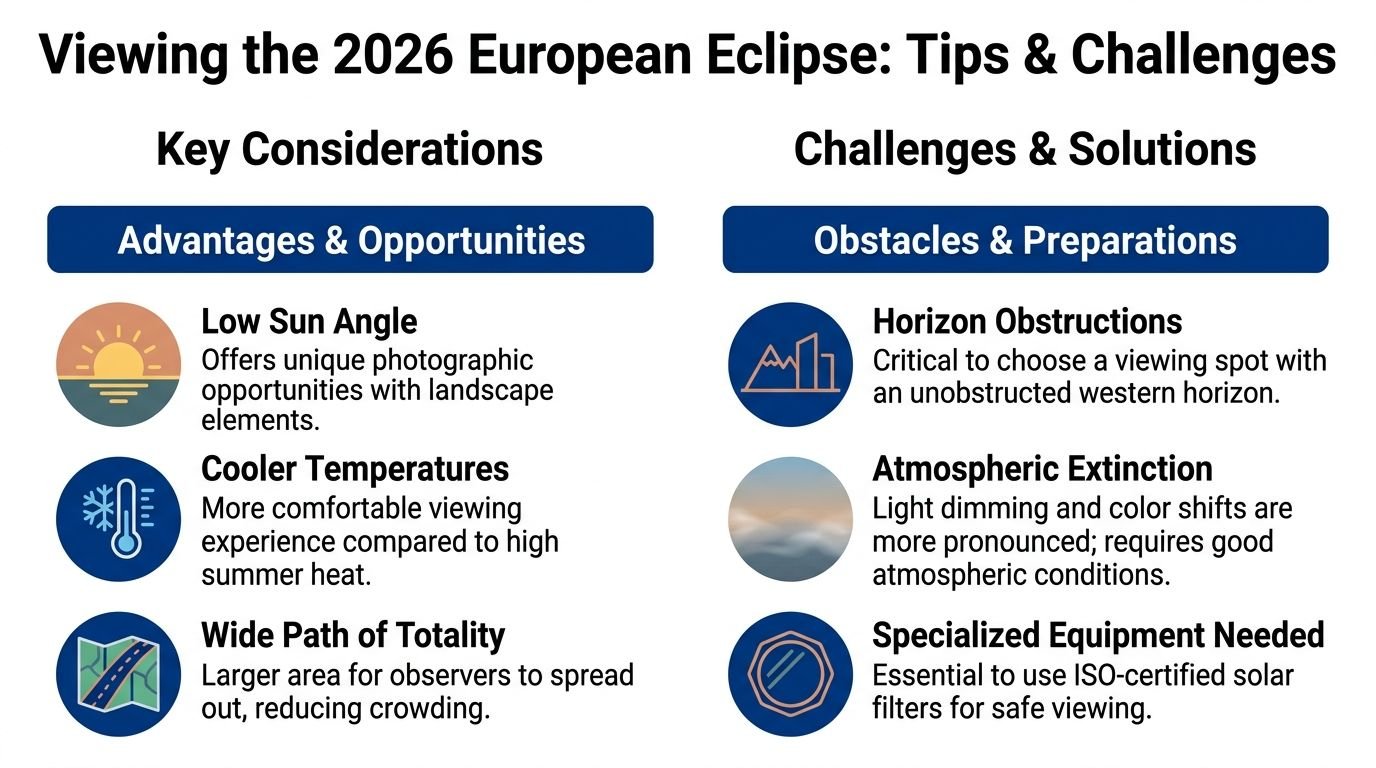
For observers in Europe, this isn't just a matter of being outside at the right time. Location matters. Horizon matters. Mobility matters. In Spain especially, the low Sun angle near sunset means your western horizon has to be clean. A hill, building line, or haze bank can ruin a carefully planned day.
A useful prep step is watching examples of how the event unfolds visually. This 2026 eclipse time-lapse guide is useful for understanding how quickly the scene changes and why rehearsing your setup helps.
Safety rules that matter more than optics
Solar observing is not forgiving. It's the one area where casual shortcuts can cause permanent injury. If your telescope package includes a cheap solar accessory and you're unsure what it is, stop and verify before using it.
NASA's skywatching guidance highlights a safety gap many shopping guides barely mention. It warns that unsafe solar filters can cause total blindness, and beginners should use only proper ISO-compliant equipment while discarding dubious filters rather than trusting them. That warning matters more than any discussion of magnification.
Use these rules:
- Use front-mounted solar filtration: The filter should cover the front of the telescope, not sit at the eyepiece.
- Verify compliance: For direct solar viewing gear, look for ISO 12312-2 compliance.
- Inspect before use: If a filter is scratched, loose, or questionable, don't use it.
- Practice before eclipse day: Attach, remove, and check the system in advance so you aren't improvising.
During the partial phases, proper solar protection is mandatory. Totality is the brief exception, and only while the Sun is completely covered.
What telescope works best for eclipse day
Many newcomers assume a larger telescope is automatically better for an eclipse. Often it isn't. For eclipse viewing, a small, wide-field refractor can be the sweet spot. It's easier to mount, easier to frame, and less stressful to handle quickly. A compact SCT can also work well if you're already comfortable with it, but very narrow fields can make the event feel cramped.
For travelers, the best eclipse telescope often has these traits:
- Portable enough to carry easily
- Simple enough to set up without drama
- Wide enough to frame the solar disk and surrounding sky comfortably
- Mounted steadily enough that focusing and sharing views stay calm
That same telescope can still be excellent for open clusters, the Moon, and bright deep-sky objects at night. That's why the eclipse often nudges buyers toward modest, high-quality setups rather than oversized ones.
Essential Accessories and Your First Night Out
A telescope alone is rarely the full kit. A few small add-ons make the difference between a clumsy first night and a smooth one.
What to buy with the telescope
Start with practical accessories, not novelty extras.
- A second eyepiece: One lower-power and one higher-power option give you flexibility.
- A red flashlight: White light ruins dark adaptation. Red light helps you read charts without blasting your own eyes.
- A star app or chart: Stellarium is a familiar example many amateurs use to learn the sky.
- A comfortable observing stool: Stability isn't only for the telescope. If you're comfortable, you'll notice more.
- A simple storage case or dust cover: Equipment that's easy to store stays ready to use.
If eclipse use is part of your plan, add a proper front-mounted solar filter from a reputable supplier well before the event. Don't make that a last-minute purchase.
How to make the first session a success
Keep the first night simple. Aim at the Moon first if it's up. It's bright, easy to find, and full of detail. Then try Jupiter, Saturn, or a bright cluster depending on the season.
A few habits help right away:
- Set up before full dark so you can learn the knobs and locks without fumbling.
- Align the finder carefully on a distant object in daylight or twilight.
- Start at low power because it makes finding targets much easier.
- Be patient with focus because the sharpest point is often subtler than beginners expect.
Your first telescope doesn't need to be perfect. It needs to make you want to go outside again tomorrow night.
If the 2026 eclipse is part of your plan, keep a dedicated planning resource bookmarked. Total Solar Eclipse 2026 Live helps with Europe-focused timing, path details, safety guidance, and practical location planning for observers heading to Spain, Iceland, and other viewing areas.