July 18, 2026
How Big Are Nebulae? a Guide to Cosmic Cloud Sizes
The size of a nebula doesn't just stretch your sense of distance. It breaks it. The Orion Nebula is about 20 light-years across, and that works out to roughly 267 million million kilometers or 167 million million miles according to this nebula reference. Even that famous object isn't close to the upper end. The N44 Super Bubble reaches 250 light-years wide, which puts it in a very different class of cosmic cloud according to this overview of nebula dimensions.
That's why “how big are nebulae” has no one-line answer. Some are compact shells from dying stars. Others are sprawling star-forming regions spread across huge stretches of interstellar space. The beauty of astronomy is that scientists don't guess these sizes. They measure them with careful geometry, light analysis, and distance estimates, then compare very different kinds of nebulae to build a clearer picture of how stars live and die.
Nebulae also connect deep-space wonder to skywatching closer to home. The same curiosity that draws people to glowing cosmic clouds often draws them outdoors for dramatic events overhead, including people searching for viewing solar eclipse in Europe in August 2026.
Table of Contents
- The Unfathomable Scale of a Nebula
- How Astronomers Measure Cosmic Clouds
- A Universe of Sizes by Nebula Type
- Touring the Giants Famous Nebulae and Their Dimensions
- Making Sense of Immensity Putting Nebula Size in Perspective
- From Deep Space Wonders to Skies Above
The Unfathomable Scale of a Nebula
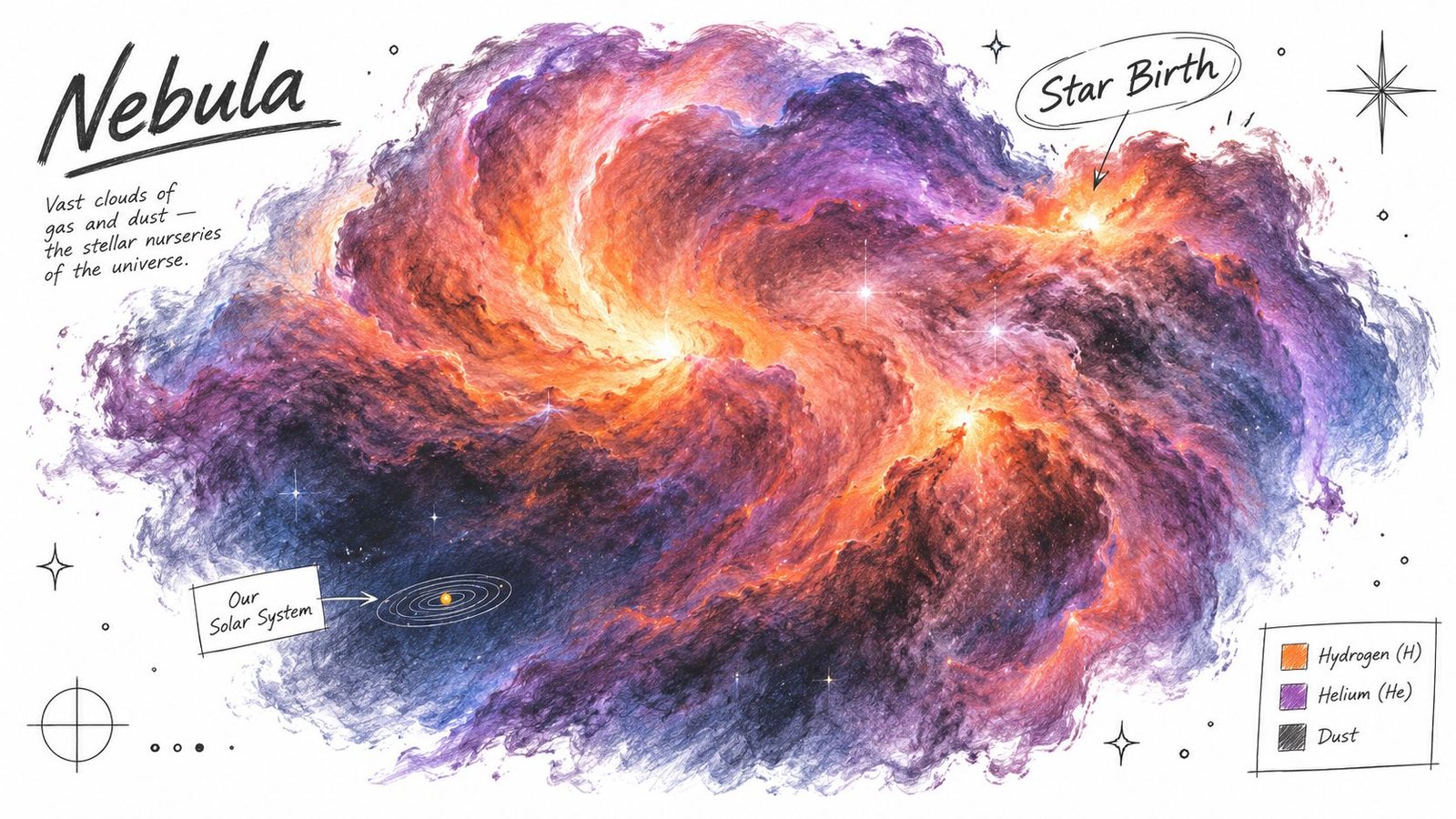
A single nebula can stretch across hundreds of light-years, which means one cloud of gas can occupy a region of space so wide that light itself needs centuries to cross it (Wikipedia's nebula overview). That number is the first shock. The second is that these vast objects are also extremely thin and wispy, more like faint smoke spread through a cathedral-sized room than anything solid or sharply edged.
Big doesn't mean crowded
A nebula is a cloud of gas and dust, but that simple description hides a lot of variety. Some nebulae are stellar nurseries where new stars take shape. Others are the cast-off outer layers of dying stars. So “how big is a nebula?” works a bit like asking “how big is a cloud?” A mist bank, a thunderstorm, and a hurricane are all clouds, yet they occupy very different amounts of sky.
The Orion Nebula is a good starting example because it is famous, bright, and large on a human scale of comparison. It spans about 20 light-years across. If that still feels abstract, an eclipse offers a useful reality check. The Moon can cover the Sun from Earth because both appear similar in angular size, even though their true sizes are wildly different. Nebulae create the opposite kind of confusion. They can look like modest smudges in a telescope while occupying regions of space far larger than our everyday intuition expects.
Why nebula size varies so much
Nebulae do not come in one standard size because they do not form in one standard way.
A planetary nebula is usually far smaller than a major star-forming nebula. It comes from a single aging star shedding its outer layers, so its scale is limited by that star's history and the speed of the expanding gas. Large emission nebulae and superbubbles can spread much farther because they are shaped by whole neighborhoods of stars, intense radiation, and stellar winds working across enormous distances. Some of these regions reach hundreds of light-years across, while smaller planetary nebulae are often closer to about 1 light-year in radius.
That wide range is part of what makes nebulae so fascinating. The label describes a category of cosmic cloud, not one fixed kind of object.
The hidden twist in their size
Nebulae are huge partly because space is so empty. Their material is spread out with remarkable thinness, often around 100 to 10,000 particles per cubic centimeter. Here on Earth, even a laboratory vacuum would seem crowded by comparison.
So the wonder of a nebula is not only its width. It is the combination of scale and delicacy. A structure can be vast enough to span distances that dwarf the Solar System, yet still be diffuse enough to glow like a ghostly stain against the dark.
How Astronomers Measure Cosmic Clouds
Measuring a nebula sounds impossible at first. You can't stretch a tape measure across space. Astronomers get around that by solving two simpler problems. First, they estimate how much of the sky the nebula appears to cover. Second, they determine how far away it is. Put those together, and the cloud's true size starts to emerge.
Angular size is the sky version of apparent size
Hold up your thumb and close one eye. Nearby objects seem to shift more than faraway ones. A nebula works a bit differently, but the core idea is similar. Astronomers measure how wide the nebula appears against the sky. That's its angular size.
A distant building can look small even if it's huge. If you know both its distance and how much of your field of view it occupies, you can estimate its actual width. Nebula measurement follows that same logic.
Here's the rough chain:
- Observe the nebula's outline against the sky.
- Measure its apparent span as an angle.
- Determine its distance using other methods.
- Convert apparent width into physical width.
Distance is the harder half
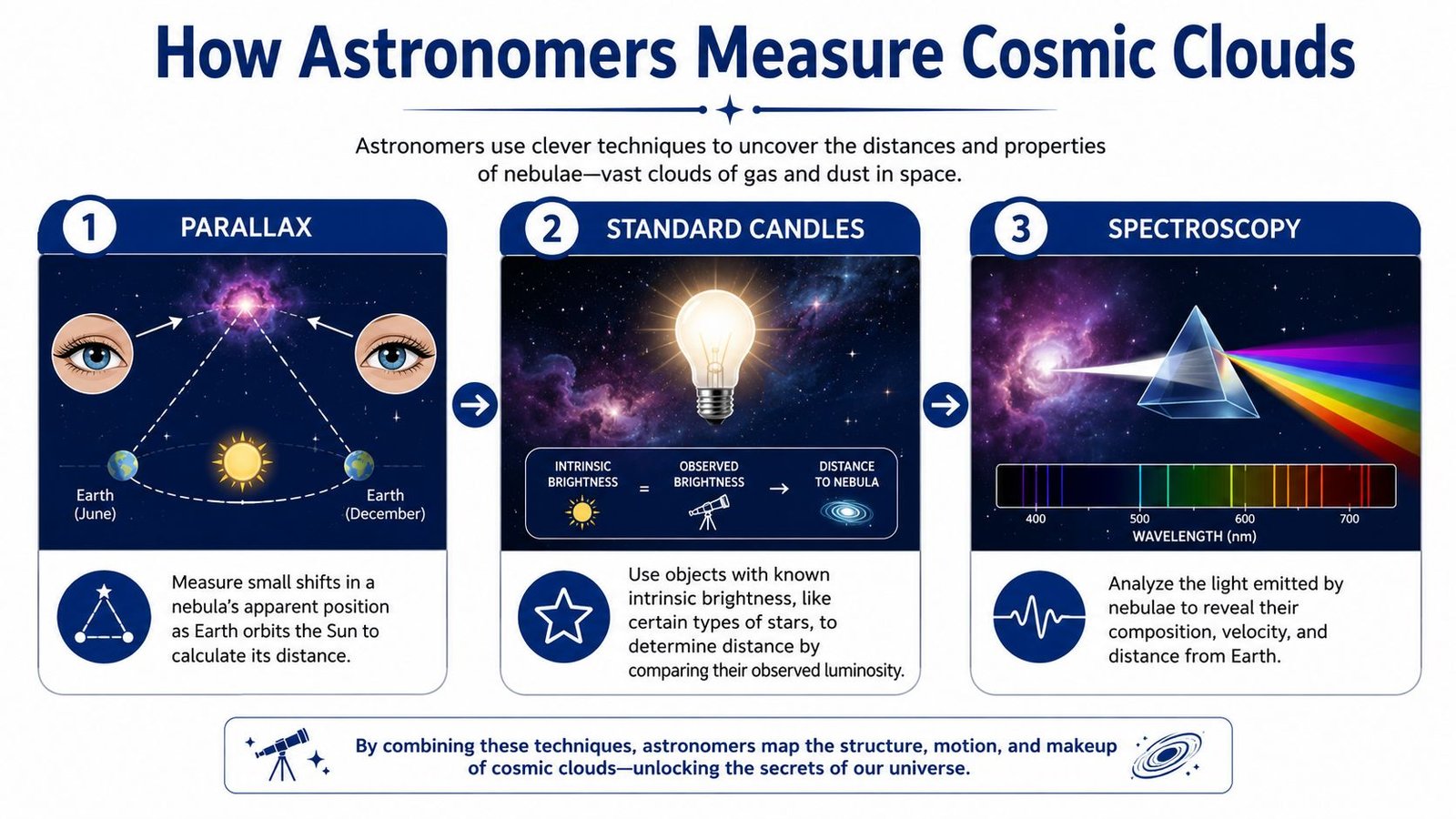
Astronomers use several techniques to estimate cosmic distances. For nearby objects, parallax helps. Earth moves around the Sun, so an object can appear to shift slightly against more distant background stars. That tiny shift gives clues to distance.
For more distant regions, astronomers may use standard candles, meaning objects with known intrinsic brightness. If you know how bright something really is and compare that with how bright it appears, you can infer distance. Spectroscopy adds more context by analyzing light from the object and helping astronomers understand motion, composition, and other useful physical details.
Practical rule: A nebula's real size isn't read directly from a photo. Scientists combine how wide it looks with how far away it is.
Why measurements can feel slippery
Readers often expect a nebula to have a crisp edge like a planet. It usually doesn't. Nebulae fade gradually, with brighter cores and fainter outer regions. That means size can depend on where astronomers define the visible boundary.
This is one reason different images of the same nebula can feel contradictory. A narrow, high-contrast image may emphasize the bright central structure. A deeper image may reveal a much wider surrounding cloud. The measuring method is still sound. The tricky part is deciding which glowing layers count as the main body.
A Universe of Sizes by Nebula Type
Nebulae span an astonishing range of sizes. Some are compact shells left behind by a single dying star. Others are sprawling star-forming regions or giant cavities carved by many hot stars working on the same cloud over long stretches of time.
That variety can be confusing at first because the word nebula sounds like one kind of object. It is really a family name. A planetary nebula, a dark nebula, and a glowing emission nebula can all share the same label while differing enormously in width, structure, and even in how clearly their edges can be traced.
Why different nebulae end up different sizes
The size often follows the story.
A planetary nebula forms when a Sun-like star sheds its outer layers near the end of its life. The result is usually a relatively small, expanding bubble of gas. An emission nebula comes from a much larger reservoir of interstellar gas, lit and energized by nearby young stars, so it can spread across a far broader region.
Reflection nebulae and dark nebulae are trickier. They are made visible by lighting conditions and contrast. A reflection nebula shows dust by bouncing starlight toward us. A dark nebula shows dust by blocking light behind it. In both cases, the measured size can shift depending on how faint a boundary an image reveals. That is one reason processed astrophotography can show much wider structures than the eye notices at the telescope. Tools used for stacking astronomy photos to reveal faint nebula detail make that difference easier to understand.
Nebula Size and Type Comparison
| Nebula Type | Typical Diameter (Light-Years) | Origin / Description |
|---|---|---|
| Planetary Nebula | Often around 1 light-year across | Gas expelled by a dying star, usually relatively compact |
| Emission Nebula | Can extend for hundreds of light-years | Glowing gas energized by nearby stars |
| Reflection Nebula | Varies widely | Dust cloud reflecting nearby starlight rather than glowing strongly on its own |
| Dark Nebula | Varies widely | Dense dust cloud that blocks background light |
| Super Bubble structure within a nebula | Can become extremely large | Large cavity shaped by stellar winds and stellar explosions from hot stars |
A better way to read the table
The categories above are less like rigid boxes and more like clues about scale.
If the nebula comes from one aging star, it tends to stay on the smaller side. If it forms inside a giant cloud where many stars are being born, it can grow into a structure so large that calling it a "cloud" almost sounds too gentle. Some regions are more like weather systems spanning a chunk of a galaxy.
There is also a measurement lesson hidden here. Bigger does not always mean brighter, and smaller does not always mean simpler. A dark nebula may stretch across a huge area but only reveal part of itself because it is outlined by blocked starlight. A planetary nebula may be much smaller yet look sharply defined because its glowing shell stands out clearly.
That makes nebula types useful in two ways. They tell you what physical process you are seeing, and they give you a first clue about how wide that object might really be in space.
Touring the Giants Famous Nebulae and Their Dimensions
A tour of real nebulae changes size from an abstract number into something you can hold in your mind. One object can be the fading shell from a single dying star. Another can be a star nursery so broad that our Solar System would disappear inside it like a grain of dust in a valley.
Orion Nebula
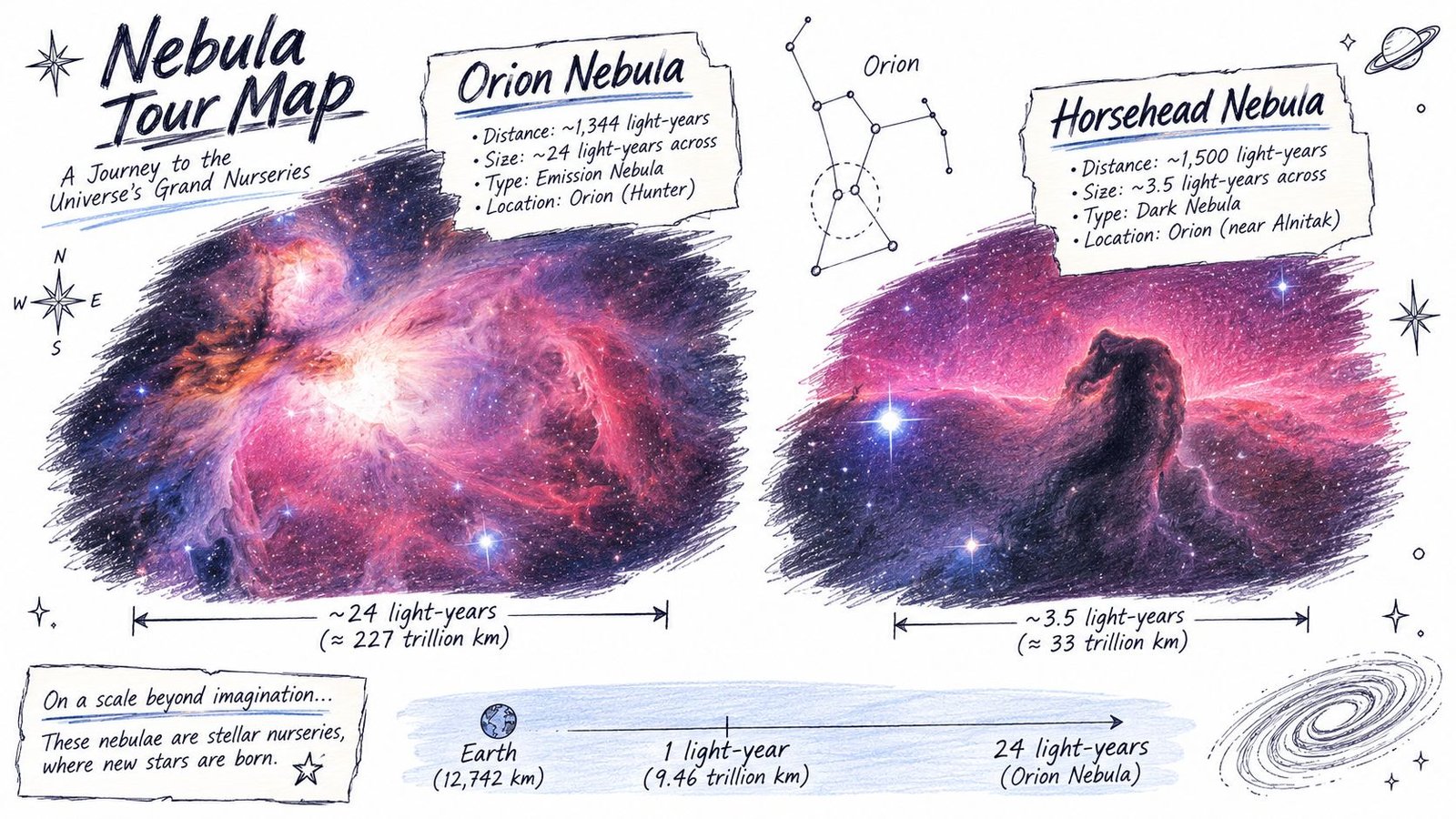
The Orion Nebula is a favorite stop because it teaches two lessons at once. It is a star-forming region, and it is close enough and bright enough to connect textbook astronomy with something people can find in the sky.
Its size is often described as about 20 light-years across. The helpful part is not just the number. It is how astronomers get it. They combine the nebula's apparent width in the sky with its estimated distance from Earth. That is the same basic geometry that lets you judge how wide a mountain range is once you know how far away it stands, except the ruler is the sky itself.
Orion also links deep-space scale to familiar skywatching. The constellation appears in the same night sky that gives us striking events such as eclipses. In one case, the Moon briefly covers the Sun. In the other, a glowing cloud spans an enormous region behind a tiny-looking patch of sky. Both remind you that what looks small overhead can correspond to something enormous in space.
For readers who enjoy imaging the night sky, guides to astronomy photo stacking software help explain why nebula photographs reveal layers, color, and structure that your eyes usually cannot catch at a glance.
Helix Nebula
The Helix Nebula represents a more compact kind of grandeur. It is often given a diameter of about 2.5 light-years.
That sounds smaller only by astronomical standards.
The Helix formed from material shed by a dying Sun-like star. So the scene is different from Orion. Orion is a busy stellar nursery. Helix is more like an expanding smoke ring from a star's final act, except the ring spans distances that still defy ordinary intuition. Astronomers estimate that width by measuring its angular size on the sky and combining that with distance estimates, then converting the result into a physical diameter.
A moving visual helps make that difference sink in:
Planetary nebulae and the upper extreme
Many planetary nebulae cluster around the compact end of the nebula scale. A useful rule of thumb, as noted earlier, is that they are often measured in a few light-years or less rather than tens or hundreds. The key idea is proportion. Even the "small" examples are vastly larger than anything in our Solar System.
At the opposite extreme, giant star-forming regions can contain cavities and bubble-like structures that stretch across hundreds of light-years. The N44 region is a good example of that upper range. Hot stars inside the cloud drive powerful winds and past explosions have helped hollow out a huge chamber, turning part of the nebula into something closer to a cosmic basin than a cloud.
That contrast is the primary lesson from the tour. Nebulae do not come in one standard size. Astronomers measure them by pairing distance with apparent size, and that method reveals a universe where a stellar death shroud and a sprawling star factory can both be called nebulae, even though they differ in scale as dramatically as a cottage and a continent.
Making Sense of Immensity Putting Nebula Size in Perspective
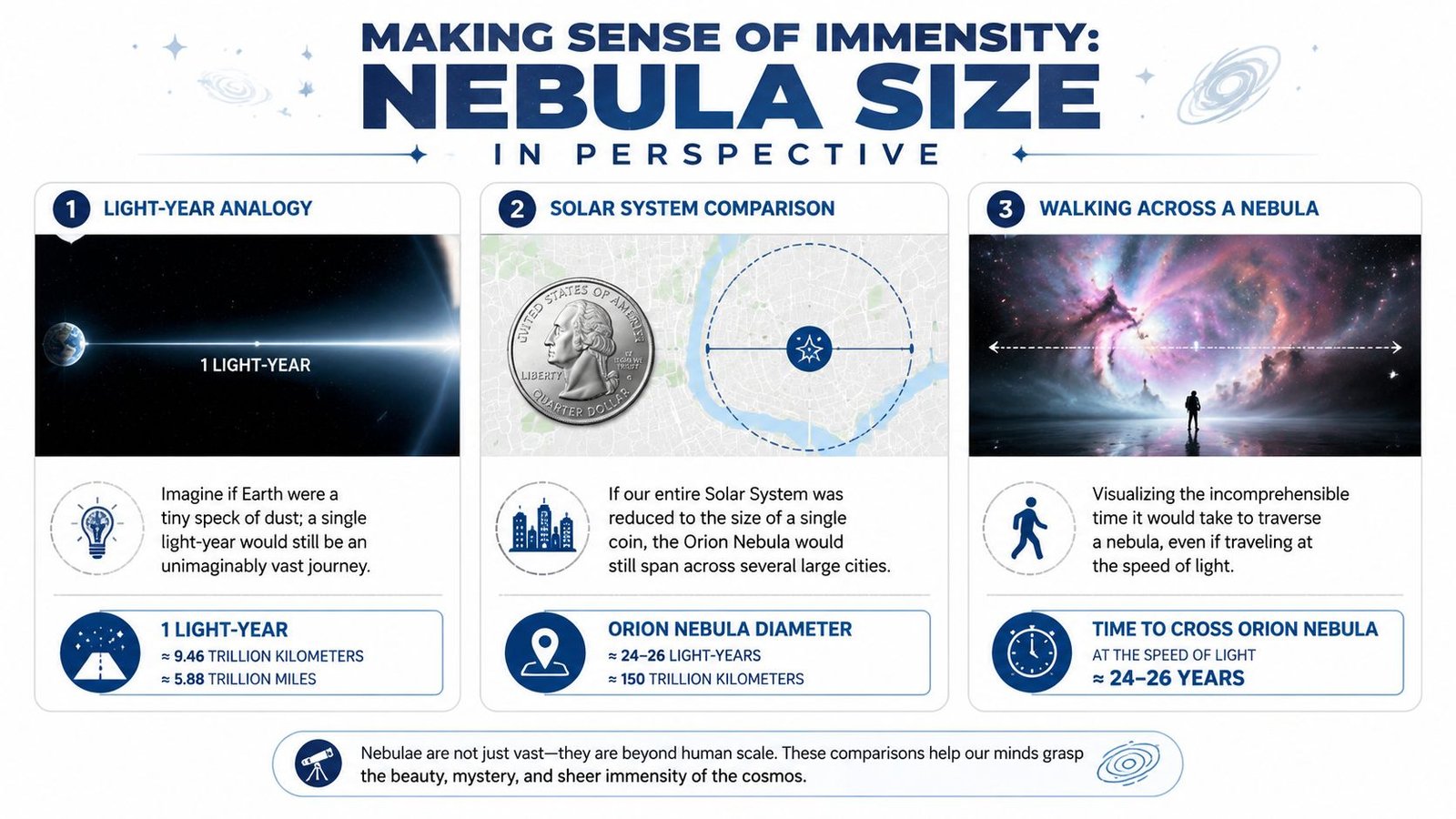
A single light-year is about 9.46 trillion kilometers. That number is accurate, but it does not feel real until you anchor it to something familiar.
Start with the Moon comparison
The Orion Nebula offers a useful scale check. As noted earlier, its width is so large that you can compare it to many full Moons lined up side by side. That comparison helps because the Moon is one sky object nearly everyone has seen and can judge without a telescope.
The key lesson is not that Orion looks gigantic to the eye. The key lesson is that physical size and apparent size are different measurements. A distant object can be enormous and still occupy only a modest patch of sky. That is the same basic idea astronomers use when they measure nebulae. They start with how wide the object appears, then combine that with distance to estimate its true span.
Then correct the “cloud” picture
The word nebula invites the wrong mental image. Earth clouds are thick enough to block sunlight in a dramatic way. A nebula is usually nothing like that. It is spread across an immense volume, with matter scattered so thinly that the whole structure is better understood as a vast trace of gas and dust than as a dense floating blanket.
That mismatch explains why photographs can fool us a little. Long exposures and image processing reveal shape, color, and texture beautifully, but they also compress a huge, diffuse region into a bright picture your brain reads as solid.
Build a mental ladder for scale
A simple three-step ladder helps.
- First rung: A planetary nebula may count as “small” by nebula standards, yet it still dwarfs the Solar System in any everyday sense.
- Second rung: A well-known star-forming region such as Orion expands the scale from large to hard-to-grasp.
- Third rung: A giant bubble or sprawling emission complex occupies so much space that it begins to feel less like an object and more like a piece of galactic weather.
That ladder matters because size labels in astronomy can hide huge differences. The same thing happens with smaller space bodies. This guide to what comets and asteroids have in common shows how two categories can sound tidy while covering a wide range of sizes, materials, and histories.
A final perspective helps tie all of this together. During a solar eclipse, the Moon can cover the Sun with astonishing precision, and that familiar alignment makes sky geometry feel personal and immediate. Nebulae operate on a far grander stage, but the habit of understanding them is similar. You compare apparent size, distance, and real physical scale until the numbers stop being abstract and start becoming a place.
The hardest part of answering how big nebulae are is not the math. It is teaching the human brain to hold on to wonder while staying precise.
From Deep Space Wonders to Skies Above
Nebulae teach a valuable astronomical lesson. Size in the universe is rarely intuitive. A compact planetary nebula can still span about a light-year. A famous star-forming nebula can stretch far wider. A superbubble can spread across a region so large that ordinary distance language starts to fail.
They also show how astronomy works at its best. Scientists measure what seems unmeasurable by combining apparent size, distance, and the evidence carried by light. That method turns glowing clouds into physical places with structure, scale, and history.
The same habit of looking up links deep-space wonder with events people can stand beneath. A total solar eclipse does that especially well. The total solar eclipse of August 12, 2026 will have a maximum totality of 2 minutes and 18.21 seconds, at a point 45 km off the western coast of Iceland, according to the eclipse record for August 12, 2026. Its path of totality is about 293 km wide and 8,260 km long, crossing from remote northeastern Siberia through Greenland, western Iceland, the North Atlantic, and into northern Spain, with two-thirds of the path over water, according to Sky & Telescope's Europe eclipse planning article.
That makes northern Spain and Mallorca especially appealing for many land-based travelers, while still reminding observers that location and sky conditions matter. If you're preparing for eclipse day or building a broader observing setup, a guide to choosing a good stargazing telescope can help you think through optics, portability, and what kind of sky experience you want most.
The same sky holds all of it. Faint nebulae far beyond reach. The Moon crossing the Sun in broad daylight. A human observer, standing still for a moment, trying to absorb the scale.
If you're planning to watch the August 12, 2026 eclipse, Total Solar Eclipse 2026 Live is a practical place to start. It brings together Europe-focused timing, path details for Iceland and Spain, safety guidance, and planning tools that help turn a rare celestial event into a well-prepared viewing experience.