July 17, 2026
The Next Eclipse in California: Dates & Details for 2026
The next eclipse in California happens on August 12, 2026, but it will be a very minor partial eclipse. In California, it starts at 1:34 p.m., peaks at 1:58 p.m. with only 4.3% of the Sun covered, and ends at 2:21 p.m., so the main event that day will be thousands of miles away in Europe.
That surprises a lot of people. Many readers search for the next eclipse in California expecting the kind of sky-darkening spectacle they saw from photos of total eclipses, but California won't get that in 2026. It gets a tiny bite out of the Sun.
The big event on August 12, 2026 is the total solar eclipse in Europe, where totality crosses Greenland, Iceland, Spain, Russia, and a small area of Portugal according to the California eclipse timing page at Time and Date. If you're in California, the practical question isn't just "When is the next eclipse?" It's also "Is this one worth planning around locally, or should I think bigger and travel for totality?"
Table of Contents
- The Next California Eclipse Is Not What You Think
- Your Guide to the 2026 Partial Eclipse in California
- The Main Event The 2026 Total Solar Eclipse in Europe
- How to Plan Your Eclipse Trip to Spain or Iceland
- Safe Viewing and Photography for Any Eclipse Phase
- The Long Wait California's Next Total Eclipse Is in 2045
- Frequently Asked Eclipse Questions
The Next California Eclipse Is Not What You Think
If you typed "next eclipse in California" into a search bar, the direct answer is simple: August 12, 2026. The confusing part is what kind of eclipse that is.
A lot of coverage makes the 2026 event sound like California is getting a major solar show. It isn't. As KRON4's eclipse coverage notes, many summaries blur together small partial eclipses and the much bigger total eclipse California won't get until much later. That leaves readers with the wrong mental picture.
The difference between partial and total
A partial eclipse means the Moon covers only part of the Sun from your location. The daylight stays bright. Shadows don't suddenly sharpen into eerie patterns for most casual observers. You don't get the black disk of the Moon surrounded by the corona.
A total eclipse is different in kind, not just degree. You must be inside the path of totality. Outside that narrow path, even a deep partial eclipse is still not totality.
Practical rule: If you're staying in California in August 2026, plan for a modest observing moment, not a life-changing darkness event.
That doesn't make the day uninteresting. It just means your expectations need to match the geometry. The Moon, Sun, and Earth do line up on August 12, 2026, but California sits far from the narrow track where the alignment becomes total.
Where the real spectacle happens
The same eclipse that barely nicks the Sun for Californians becomes a total solar eclipse over parts of Europe and the North Atlantic. That's the celestial twist. One event, two completely different experiences.
For local observers, 2026 is a quick and subtle afternoon partial. For travelers in the right parts of Iceland or Spain, it's one of astronomy's greatest live performances.
Your Guide to the 2026 Partial Eclipse in California
Here is the key California reality. On August 12, 2026, you will get a real solar eclipse, but from California it will be a small partial eclipse that is easy to overlook unless you know the timing and use safe viewing gear.
For the reference California location cited earlier, the eclipse begins at 1:34 p.m. local time, reaches maximum at 1:58 p.m., and ends at 2:21 p.m.. The Moon covers only a small slice of the Sun at maximum, so this is the kind of event you plan like a short observation session, not a dramatic day-darkening experience.
What Californians will actually see
A small partial eclipse changes the Sun's shape more than it changes the world around you. The visible effect is a slight bite along one edge of the solar disk, and the change is easiest to notice through eclipse glasses or a properly filtered solar viewer.
That point matters because many Californians hear "2026 eclipse" and picture the eerie twilight, temperature drop, and black solar disk that belong to totality in other places. California does not get that version in 2026. California gets a brief, subtle alignment that rewards attention and good timing.
If you want a quick mental picture before eclipse day, this partial solar eclipse diagram shows why a shallow partial phase looks modest even though the Sun, Moon, and Earth are lining up correctly.
Small partial eclipses are excellent for learning how eclipse geometry works, because the drama stays low while the mechanics are easy to spot.
California city viewing table
Across major California cities, the viewing plan is broadly similar. You are watching for a slight indentation in the Sun during a short afternoon window.
| City | Maximum Eclipse Time (PDT) | Max Coverage (%) | Notes |
|---|---|---|---|
| Los Angeles | 1:58 p.m. | 4.3% | Slight notch in the Sun with proper solar viewing gear. |
| San Francisco | 1:58 p.m. | 4.3% | Brief, subtle partial phase. |
| San Diego | 1:58 p.m. | 4.3% | Afternoon viewing window, with only a small visible bite. |
How to plan a local watch
Keep your plan simple.
- Choose an easy location: A backyard, schoolyard, observatory plaza, or office parking lot is fine if you have a clear view of the Sun.
- Bring proper solar protection: Eclipse glasses or a handheld solar viewer matter much more than driving to a special site.
- Be ready before maximum: If your schedule is tight, step outside a few minutes before 1:58 p.m. so you do not miss the best part.
- Use it as a teaching moment: This eclipse is perfect for explaining why location changes everything. A tiny shift on Earth can mean the difference between a small partial view in California and totality over Spain or Iceland.
That last point is the exciting one. Californians get a careful observer's eclipse. Travelers in Europe get the full show.
The Main Event The 2026 Total Solar Eclipse in Europe
The August 12, 2026 eclipse becomes extraordinary when you move into the path of totality. That's where the Moon covers the entire bright face of the Sun and the familiar daytime solar disk vanishes.
Why Europe gets the unforgettable view
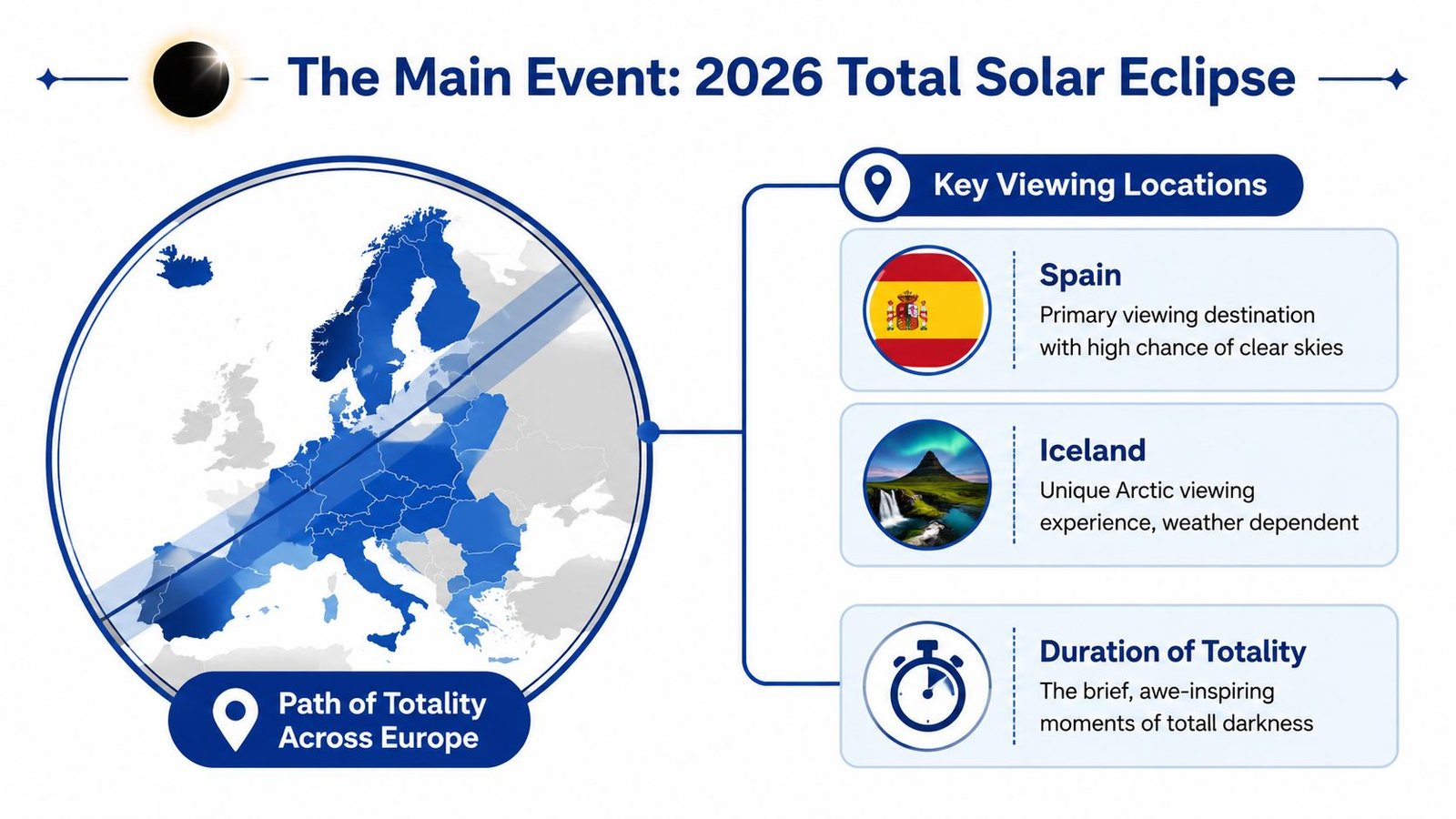
The path of totality for this eclipse crosses Greenland, Iceland, Spain, Russia, and a small area of Portugal, while California remains outside it, as shown in the August 12, 2026 eclipse path data. The longest totality for the eclipse reaches 2 minutes and 18.21 seconds, though not at a land location. That maximum occurs just off the western coast of Iceland.
That matters because totality is brief by nature. Every second counts. A difference of even a few moments can shape how much time you have to absorb the corona, horizon glow, and sudden drop in daylight.
You don't travel for a percentage point. You travel to stand inside the path where the Sun becomes a black hole in the sky.
In Iceland, the attraction is obvious. You get a dramatic North Atlantic setting and a rare chance to see totality at high latitude. The tradeoff is weather. Conditions can change quickly, so mobility matters.
Spain's low-sun totality
Northern Spain offers one of the most fascinating viewing setups of the entire eclipse. As The Washington Post's 2026 eclipse report explains, totality begins there at 8:26 p.m. local time (CEST) with the Sun only 11 degrees above the horizon. Cities such as Burgos can get about 1 minute and 45 seconds of totality.
That low solar altitude changes everything about planning. You need a clear western horizon. Hills, buildings, trees, and even distant terrain can ruin an otherwise perfect site.
It also creates a special aesthetic. Spain's eclipse comes late in the day, with the Sun low and warm-toned, so totality can feel like sunset suddenly crossed with nightfall. For many eclipse chasers, that geometry is the main reason Europe in 2026 feels so compelling.
How to Plan Your Eclipse Trip to Spain or Iceland
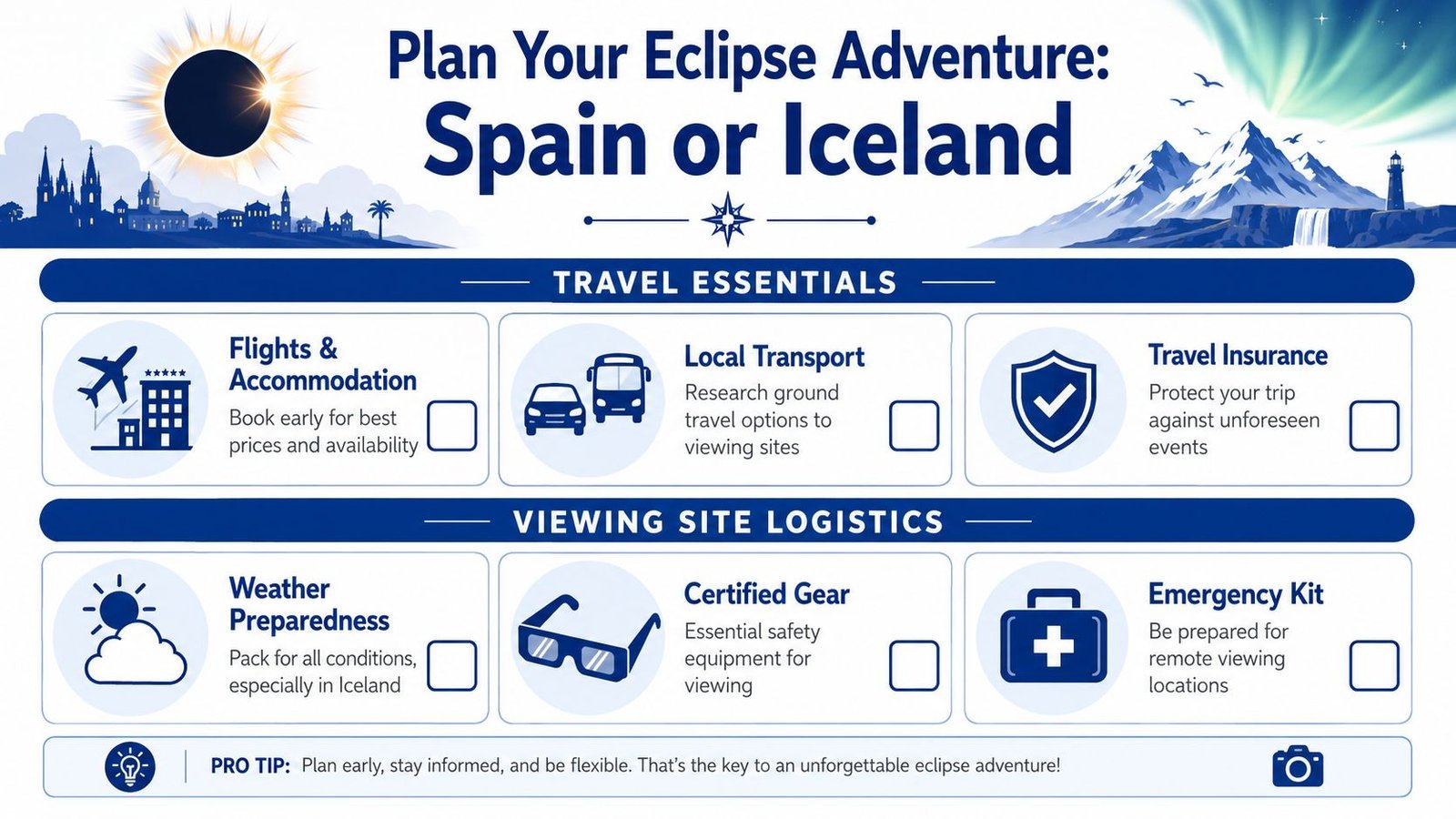
Travel for a total solar eclipse works best when you plan it like a weather-sensitive field trip, not a normal city vacation. Your goal isn't just to arrive in Spain or Iceland. Your goal is to be in the path of totality with a realistic cloud strategy and a workable view of the sky.
Choose your country based on experience
Spain and Iceland offer very different eclipse personalities.
- Spain suits horizon planners: Northern Spain combines the appeal of land access, recognizable cities, and the special low-sun evening geometry. Because the Sun will be low, your chosen site needs an open western view.
- Iceland suits weather-flexible travelers: Iceland can deliver a spectacular setting, but you should be ready to move if clouds threaten.
- August crowds matter in both places: Peak holiday season means accommodations in eclipse-relevant areas can tighten early, especially in places such as Palma and Bilbao, so earlier reservations are the safer move.
A useful way to think about it is this. Spain rewards site selection. Iceland rewards adaptability.
For readers who want a sense of the eclipse's visual progression, this solar eclipse time-lapse is a helpful preview.
Build a flexible eclipse day plan
A smart eclipse itinerary has layers:
Primary site
Pick the place you most want to view from, ideally one that is easy to reach and has a clear horizon if you're in Spain.Backup site
Choose an alternate direction or town ahead of time. Weather strategies for eclipse day emphasize mobility, and that matters especially in Iceland and along coasts.Transport plan
Decide whether you'll use a rental car, train, bus, or a guided group. On eclipse day, simplicity wins.
Here's a practical planning aid many travelers find useful before they book routes and gear:
A few planning habits that prevent problems
In northern Spain and western Iceland, the best weather strategy isn't optimism. It's the ability to relocate.
- Check horizon obstructions in advance: Satellite view and street-level imagery can reveal whether a ridge or apartment block will sit where the eclipsed Sun should be.
- Keep eclipse day light: Don't stack museum tickets, lunch reservations, and long fixed commitments onto the same afternoon.
- Pack for waiting: Water, layers, charged batteries, paper maps, and offline directions make eclipse day calmer, especially outside city centers.
The closer you get to totality, the less you want logistical friction.
Safe Viewing and Photography for Any Eclipse Phase
No matter where you watch, eye safety comes first. A partial eclipse in California and the partial phases in Europe both require proper solar protection when any part of the bright Sun is still visible.

What your eyes need
Use ISO 12312-2 certified eclipse glasses or a handheld solar viewer for all partial phases. That means California observers need them for the entire August 12, 2026 event. Travelers in Europe need them until totality begins, and then again the instant totality ends.
The reason is simple. Even a Sun that looks mostly covered is still dangerously bright. Your eyes don't have a built-in warning system for this kind of damage.
Safety check: If any bright part of the Sun is visible, your eclipse glasses stay on.
A pinhole projector is another good option for classrooms, families, and public events. It won't show fine detail, but it lets people watch safely without looking directly at the Sun.
What your camera needs
Cameras need the same respect your eyes do. During partial phases, use a proper solar filter on the front of your lens or telescope. Don't point an unfiltered camera, binoculars, or long lens at the Sun.
For totality in Europe, the rules change briefly. During the fully total phase only, observers can remove visual filters and photographers can capture the corona without solar filtration. Then filters go back on as soon as the first bright sunlight returns.
If you want to process multiple eclipse frames afterward, this astronomy photo stacking software guide is a useful starting point for building a cleaner final image.
A final photography tip matters more than settings. Practice beforehand. Eclipse minutes disappear fast, and fumbling with menus is the easiest way to miss the experience itself.
The Long Wait California's Next Total Eclipse Is in 2045
California's next total solar eclipse doesn't arrive until August 12, 2045, when the path of totality is projected to cross parts of the state, including Los Angeles, San Diego, and parts of the Central Coast, according to the United States solar eclipse list. Depending on location, totality is projected to last about 3 to 4 minutes.
Why 2045 matters so much
That 2045 event is expected to be the first coast-to-coast total solar eclipse across the lower 48 states since 1806, and California is part of the reason it draws so much attention. For residents who want totality without leaving the state, that's the date to circle.
Until then, California gets other eclipse events, but not a total solar eclipse crossing the state. That's why the 2026 misunderstanding matters so much. If someone reads a vague headline and assumes California gets a major eclipse in 2026, they may miss their best near-term chance to experience real totality by traveling abroad.
For many Californians, the decision is straightforward. Watch the subtle local partial in 2026 if it's convenient. Travel to Europe in 2026 if you want the unforgettable version.
Frequently Asked Eclipse Questions
Is a 99.9 percent partial eclipse basically the same as totality
No. A deep partial eclipse still leaves direct sunlight visible, which means the sky doesn't behave like true totality and you still need eye protection. Totality is the moment when the Sun's bright surface is fully covered and the corona becomes visible.
If I stay in California, will it get dark
Not in the dramatic way people mean when they talk about eclipse darkness. California's 2026 event is a small partial eclipse, so think subtle notch, not twilight.
Spain or Iceland for first-time travelers
Spain is often easier for travelers who want a clear western horizon and a more urban-to-rural range of options. Iceland appeals to people who like wild scenery and can stay flexible with weather.
What if clouds show up on eclipse day
Mobility is your friend. A fixed hotel balcony is comfortable, but a movable plan is usually smarter for eclipse chasing.
Which Spanish cities get attention from eclipse travelers
Places along the path in northern Spain, including Burgos, stand out because they're associated with totality rather than a near miss.
If you're planning to see the August 12, 2026 eclipse from Europe, Total Solar Eclipse 2026 Live is a useful place to check city timing, path geometry, safety guidance, and practical planning details for Spain, Iceland, and the rest of the European viewing region.