July 20, 2026
New Zealand Solar Eclipse Guide for 2026 Events
Most New Zealanders searching for the August 12, 2026 eclipse are looking up the wrong event for their sky. The famous total solar eclipse in August will be visible along a northern track through northern Russia, the Arctic, Greenland, Iceland, and northern Spain, and New Zealand won't see any phase of it at all because the eclipse happens in the Northern Hemisphere daylight zone while New Zealand is in the Southern Hemisphere night zone at that time, according to NASA's 2026 total eclipse path data.
That sounds backwards if you've been seeing headlines about the “2026 eclipse” everywhere. But the confusion is real. People often mix up the big European August event with the actual New Zealand solar eclipse opportunity in February 2026. If you're in New Zealand, the practical question isn't “How do I watch totality in August from home?” It's “What can I really see from New Zealand, and how should I plan for it?”
Table of Contents
- The Two Solar Eclipses of 2026
- Why New Zealand Misses the August Total Eclipse
- Your Guide to the February 2026 Partial Eclipse
- City by City Viewing Times and Coverage
- Essential Safety and Photography Guide
- Future Eclipses Over New Zealand
The Two Solar Eclipses of 2026
There are two different eclipse stories circulating for 2026, and mixing them together creates most of the confusion.
One story is the one drawing global attention. August 2026 brings a total solar eclipse that has huge appeal for travelers, photographers, and anyone planning to view a solar eclipse in Europe in August 2026. That excitement is justified. Total eclipses are rare, dramatic, and worth serious planning if you're traveling into the path.
The other story is the one that matters if you live in New Zealand. It isn't the August total eclipse. It's the February 17, 2026 partial solar eclipse, which is the event New Zealand observers should prepare for.
A lot of online content blurs those two events together. The result is simple but misleading: people search for a New Zealand solar eclipse, find articles about Europe, and assume New Zealand gets the same show. A useful background summary of that content gap appears in this overview of the August 2026 eclipse. If you want a quick refresher on eclipse basics before going further, this plain-language guide on solar and lunar eclipses is a good starting point.
Two events, two very different experiences
A total solar eclipse and a partial solar eclipse are not just different in degree. They feel different.
- August 2026 in Europe and the far north: observers inside the path of totality get the full alignment, where the Moon completely covers the Sun.
- February 2026 in New Zealand: observers see only part of the Sun covered, with the exact effect depending on location.
That distinction matters because expectations shape the experience. If you expect a midday blackout in New Zealand in August, you'll be disappointed because nothing will be visible there. If you expect a well-planned partial eclipse in February, you can have an excellent observing session.
Key point: The phrase “2026 eclipse” is too vague to be useful for New Zealand. You need the date and the location together.
Why this matters for travel and local planning
If you're based in New Zealand, there are really two sensible paths.
The first is to treat August 12, 2026 as an overseas travel event. That's the right frame if you want totality and are considering Europe, Iceland, or other locations on the northern track.
The second is to treat February 17, 2026 as your local observing event. That's the right frame if you want to watch from home, organize a school session, test photography gear, or enjoy the sky safely without international travel.
Why New Zealand Misses the August Total Eclipse
New Zealand does not miss the August total eclipse by a little. It misses it completely.
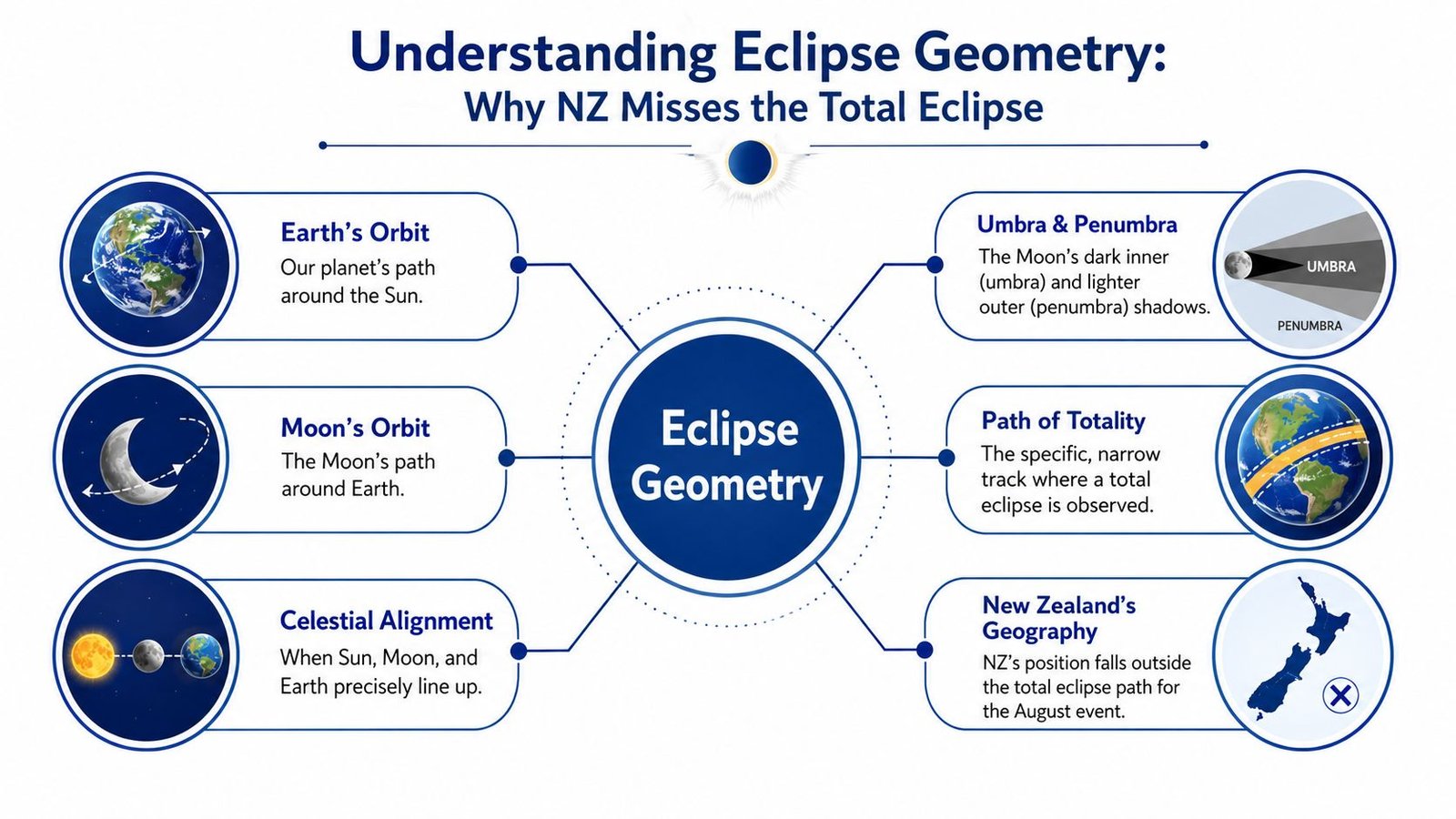
A solar eclipse is not a global sky show. It is a shadow event, and shadows only fall in specific places at specific times. For the total solar eclipse of August 12, 2026, the Moon's darkest shadow crosses far northern parts of Earth. New Zealand is far outside that geometry.
The geometry is simple once you picture the globe
The Moon casts two main shadows during a solar eclipse. The small inner shadow, called the umbra, is where the Sun is fully covered. The broader outer shadow, called the penumbra, is where only part of the Sun is covered. A total eclipse happens only if the umbra reaches your location.
That path is narrow. It works like a thin line drawn across a spinning globe, not a blanket spread over a hemisphere. If your location is not under that moving line, you do not get totality. If your location is not even under the wider penumbral zone while the Sun is up, you see nothing at all.
If the terms are unfamiliar, this partial solar eclipse diagram helps clarify how the Moon's shadow zones work.
As noted in NASA's path data mentioned earlier, the track for the total eclipse of August 12, 2026 stays in northern latitudes, passing across parts of the Arctic and sections of Europe. That is the core reason for the confusion. People see headlines about a major 2026 eclipse, then assume the event is somehow shared worldwide. It is not.
Why New Zealand gets no view at all
There are two separate requirements for seeing any solar eclipse from a given place. Your location must be inside the Moon's shadow path, and your location must be on the day side of Earth at the time.
New Zealand fails both tests for this August event. It is nowhere near the eclipse track, and it is also on the night side of Earth during the eclipse. So there is no total phase, no partial phase, and no brief glimpse near sunrise or sunset.
That last point is the one many readers need made plainly. New Zealand does not get a reduced version of the August eclipse. It gets no solar eclipse visibility from that event.
Why the confusion keeps spreading
The phrase "the 2026 solar eclipse" causes trouble because it bundles two different events into one idea. News coverage often focuses on the dramatic one, the August total eclipse, because totality attracts travel planning, weather analysis, and photography interest in Europe and the far north.
For New Zealand readers, that coverage is easy to misread. If an article is discussing routes in Spain or viewing prospects in Iceland, it is talking about a travel eclipse, not a local New Zealand sky event.
The practical takeaway is simple. Treat the August total eclipse as an overseas trip option. Treat the February eclipse as the primary New Zealand observing opportunity.
Your Guide to the February 2026 Partial Eclipse
The eclipse New Zealanders should put on the calendar is February 17, 2026.
According to TheSkyLive's New Zealand eclipse details, the only solar eclipse visible from New Zealand in 2026 is the partial solar eclipse on February 17, 2026, and observers in the north can see up to 85–90% obscuration, with maximum coverage occurring around 19:45 NZDT and the Sun at roughly 15° altitude near sunset.
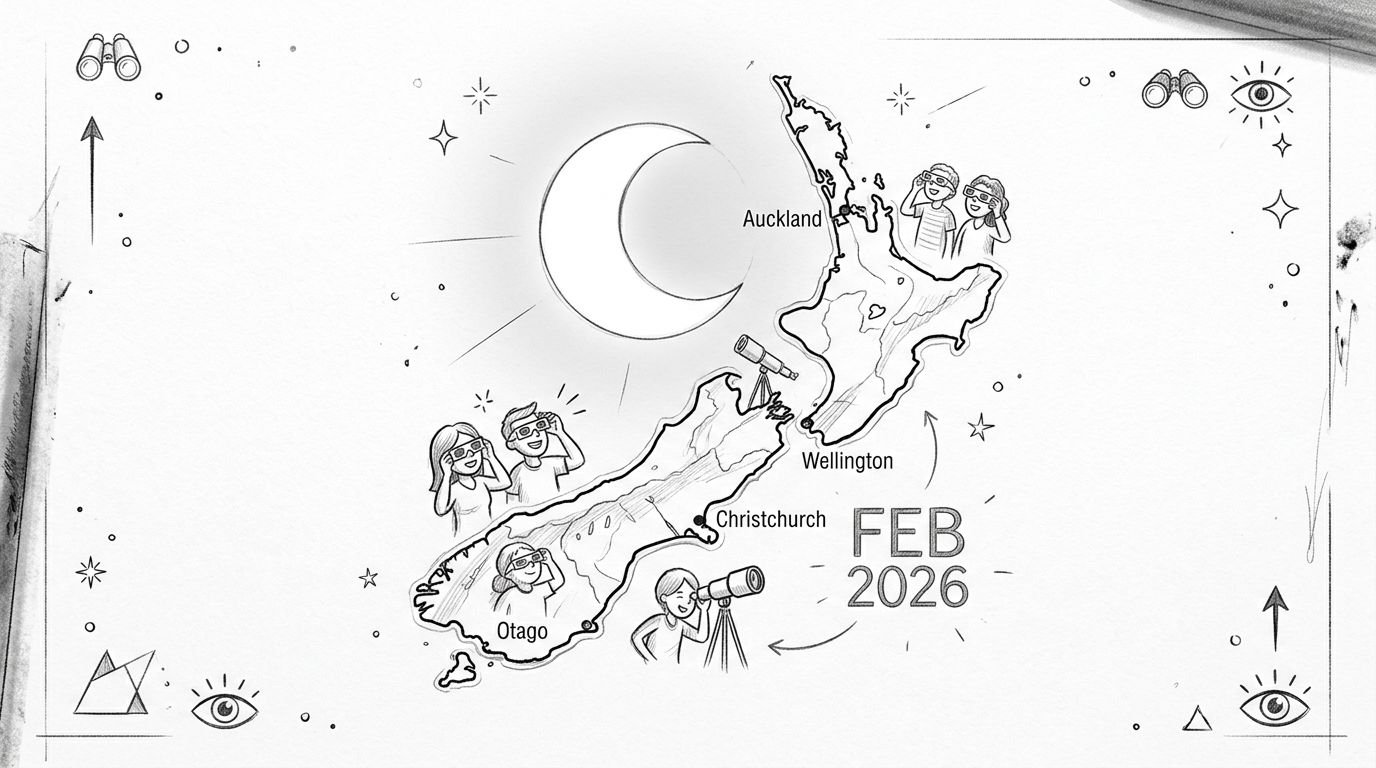
That makes this the main New Zealand solar eclipse event of the year. It's not total. It won't turn afternoon into night. But it is still a meaningful observing opportunity, especially for people in the northern part of the country.
What a partial eclipse actually looks like
In a partial solar eclipse, the Moon covers only part of the Sun's disk. The Sun looks as if a bite has been taken out of it, then gradually becomes a crescent-like shape before the Moon moves on.
That changes the experience in important ways:
- No total blackout: the sky doesn't drop into full darkness.
- No safe naked-eye phase: because some of the Sun remains visible throughout, proper eye protection is needed the entire time.
- Subtle changes in light: many people notice the light becoming oddly crisp or muted rather than dramatically dark.
If you want a visual explanation of eclipse phases, this partial solar eclipse diagram helps show what's happening.
What matters most for observers in New Zealand
The timing matters because the eclipse happens late in the day, with the Sun relatively low near sunset. That creates both an advantage and a challenge.
The advantage is that low altitude can make planning easier if you choose a site with a clean western view. The challenge is that trees, hills, buildings, and local haze become much more important than they would be for a higher Sun.
Practical rule: Choose your observing site for horizon quality first, comfort second.
A beach, headland, open sports field, high ridge, or western-facing park can all work well. A backyard surrounded by trees often won't.
For many casual observers, the best plan is simple: arrive early, test your view of the western sky, put eclipse glasses within easy reach, and watch the changing solar shape as the Sun drops lower.
Later in the event, this short explainer is worth watching before you finalize your plans:
City by City Viewing Times and Coverage
The most useful local planning question is usually, “When do I go outside?” The hard part is that reliable city-by-city precision needs a full local calculation set, and the verified data available here gives only national-level timing and broad visibility guidance for New Zealand.
So the table below is intentionally conservative. It gives a planning framework for the February 17, 2026 partial eclipse without inventing city-specific numbers that haven't been verified here.
How to use the table without overpromising precision
Use the table to organize your evening, not to assume a second-by-second timetable. The most secure verified timing point is that maximum coverage occurs around 19:45 NZDT in New Zealand, with the Sun low in the sky near sunset, as noted earlier.
Because local circumstances differ, especially with western horizon blockage, your real-world experience may be cut short by terrain or cloud even if the eclipse is still in progress geometrically.
| City | Eclipse Begins | Maximum Eclipse | Sun Coverage | Eclipse Ends |
|---|---|---|---|---|
| Auckland | Late afternoon, before sunset | Around 19:45 NZDT | Strongest in the north. Local impact varies by site | Near sunset or lost in low western sky |
| Hamilton | Late afternoon, before sunset | Around 19:45 NZDT | Partial eclipse visible. Lower than northernmost locations | Near sunset or lost in low western sky |
| Wellington | Late afternoon, before sunset | Around 19:45 NZDT | Partial eclipse visible. More modest than farther north | Near sunset or lost in low western sky |
| Christchurch | Late afternoon, before sunset | Around 19:45 NZDT | Partial eclipse visible. Local horizon matters greatly | Near sunset or lost in low western sky |
| Dunedin | Late afternoon, before sunset | Around 19:45 NZDT | Partial eclipse visible, but low altitude complicates viewing | Near sunset or lost in low western sky |
| Invercargill | Late afternoon, before sunset | Around 19:45 NZDT | Partial eclipse visible if the western horizon is clear | Near sunset or lost in low western sky |
Best viewing setup near sunset
The low Sun angle changes how you should choose a site. Don't just pick a nice place. Pick a place that works astronomically.
- Western horizon first: Find a location with a broad, unobstructed view to the west or west-southwest.
- Arrive before the useful phase: Give yourself enough time to discover whether a hill, roofline, or stand of trees blocks the Sun.
- Check the weather visually: Even when general conditions look fine, a low bank of cloud near the horizon can ruin the last part of the event.
- Bring a backup site: In coastal and hilly areas, a short drive can make the difference between a blocked horizon and a clear one.
A practical local routine works better than overcomplicated planning. Scout one site. Keep one backup. Bring certified viewing gear. Don't rely on your memory of where the Sun sets from your house unless you've checked recently.
If the Sun disappears behind a ridge ten minutes too early, the eclipse is over for you even though it's still happening above the horizon line farther away.
Essential Safety and Photography Guide
A partial eclipse is beautiful, but it never becomes safe to stare at directly without proper protection. Because the Sun is never fully covered in New Zealand's February event, eye safety is always required for the entire observation.
Eye safety comes first
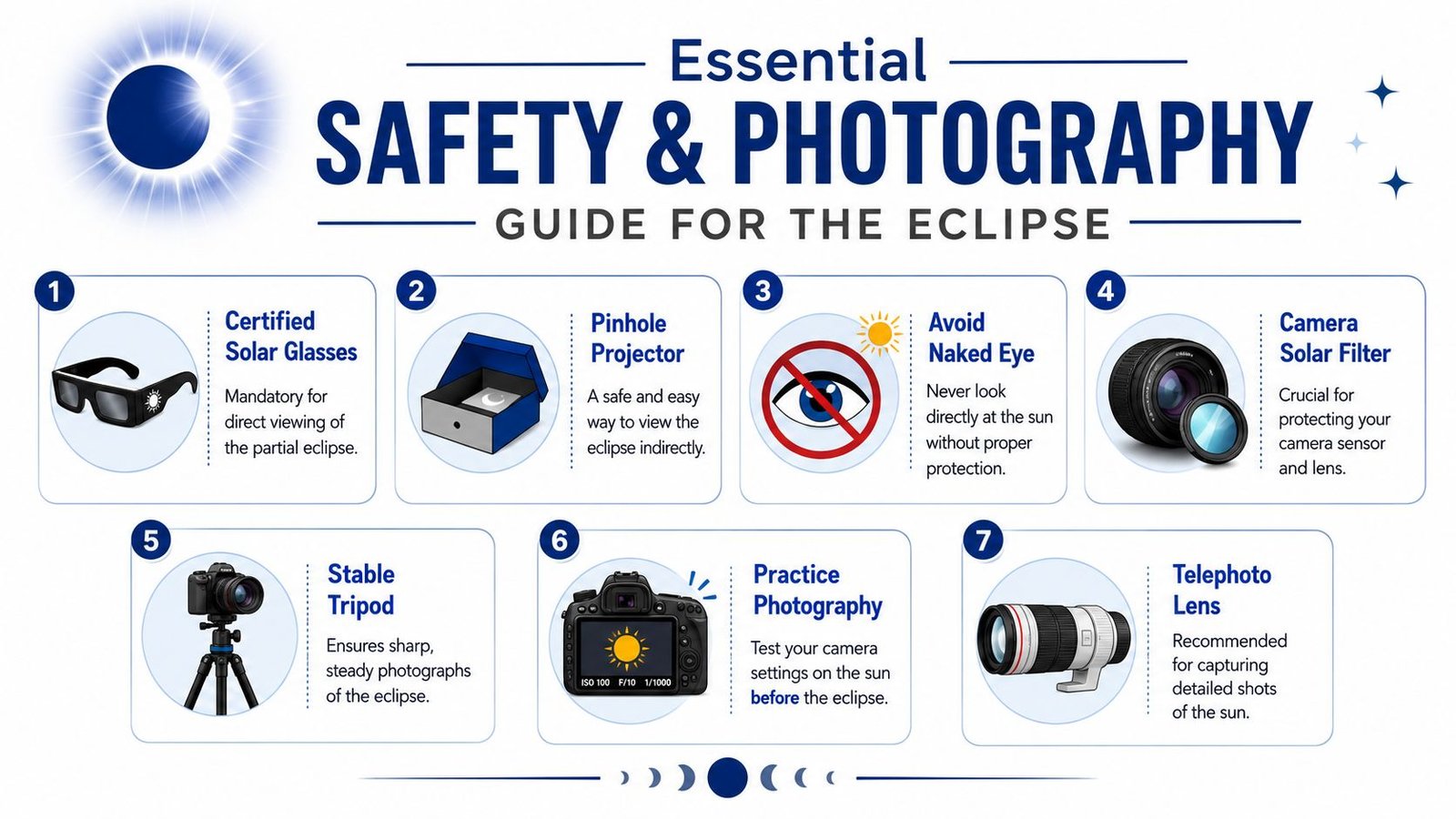
You need ISO 12312-2 certified eclipse eyewear for direct viewing. Regular sunglasses are not eclipse glasses. Smoked glass, exposed film, and improvised filters are not safe substitutes.
If you need a reference point for what compliant viewers are meant to be, this guide to eclipse safety glasses is useful.
Here are the safest ways to watch:
- Certified eclipse glasses: Recommended for general use. Put them on before looking up, and keep them on while looking at the Sun.
- Handheld solar viewer: Good for schools, public outreach, and quick repeated checks.
- Pinhole projection: A simple indirect method that lets you watch the changing solar shape without looking at the Sun itself.
Never look directly at the partial Sun through binoculars, a telescope, or a camera unless the front of the optics has a proper solar filter designed for that instrument.
Simple eclipse photography that works
Many people overcomplicate eclipse photography. For a partial eclipse, a steady and safe setup beats an ambitious one.
If you're using a DSLR or mirrorless camera, put a proper solar filter on the front of the lens before aiming at the Sun. If you're using a telescope for photography, the filter belongs over the front aperture, not at the eyepiece end.
A basic setup checklist:
- Phone users: Don't expect detailed solar close-ups without an optical aid. Use the phone to document your location, the atmosphere, shadows, and the experience.
- Tripod users: Stability matters more than fancy settings. Even a simple tripod improves results.
- Telephoto lens owners: Longer focal lengths give a larger solar disk, but only with a safe front-mounted solar filter.
- Practice before the event: Test focus, framing, and exposure on the Sun on a different day with the filter already attached.
You'll often get the most memorable photos by combining both approaches. Make one safe close-up attempt if you have the right gear, then spend the rest of your time capturing the scene around you. People wearing eclipse glasses, the low evening light, and the changing surroundings often tell the better story.
Future Eclipses Over New Zealand
The February 2026 partial eclipse is worth watching on its own terms. It also serves another purpose. It teaches good habits.
Why the February eclipse is still worth your time
A lot of first-time observers underestimate partial eclipses because they compare them to dramatic total-eclipse footage. That's a mistake. A well-observed partial eclipse teaches you how to read local sky conditions, choose a site, manage safe viewing, and handle gear without rushing.
Those are the exact skills that matter most when a bigger event comes along.
For New Zealand observers, that makes February 2026 a useful rehearsal. You can test your timing, check whether your chosen site really has a clean western horizon, and learn whether you prefer direct viewing with glasses or indirect viewing with projection.
If you want the August 2026 spectacle
If your real goal is the famous 2026 total eclipse, then the honest answer is simple. You'll need to travel.
The August event is built for observers in the northern path, especially those planning to view the eclipse in parts of Europe such as Spain or in other regions along the track like Iceland. New Zealand isn't part of that local experience.
So the practical long view is this. Treat February 17, 2026 as New Zealand's real eclipse date. Treat August 12, 2026 as a separate travel opportunity if totality is what you want. Keeping those two plans separate removes nearly all of the confusion around the phrase New Zealand solar eclipse.
If you're planning to chase the August 12, 2026 total eclipse in Europe after watching New Zealand's February partial event, Total Solar Eclipse 2026 Live is a focused resource for path geometry, city timing, safety guidance, and practical travel planning for Spain, Iceland, and other key viewing locations.