July 21, 2026
How to Watch Eclipse in Europe: Your 2026 Guide
You're probably doing one of two things right now. You're either staring at a map of Europe and wondering whether “close to totality” is good enough, or you've already circled Spain and realized this eclipse comes with a catch: the Sun will be low, late, and unforgiving of bad planning.
That's what makes the August 12, 2026 total solar eclipse so exciting. It's not just another eclipse guide situation where you pick a town and show up. In Europe, this one rewards people who understand timing, horizon, filters, and mobility. If you get those right, you can watch one of the continent's great sky events unfold over the Atlantic side of Spain at sunset. If you get them wrong, a hill, haze layer, or a tiny sliver of uneclipsed Sun can ruin the whole thing.
If you've been searching for how to watch eclipse conditions in Europe in August 2026, this is the practical version. No romance-first advice. No generic “find a dark place” filler. Just what works, what doesn't, and how to give yourself a real shot at seeing totality.
Table of Contents
- The Great European Sunset Eclipse of 2026
- Why 99 Percent Is Not Totality
- Your Guide to Essential Eclipse Eye Safety
- Strategic Site Selection for the Sunset Eclipse
- How to Photograph the 2026 Eclipse
- Your Eclipse Day Action Plan and Cloud Contingencies
The Great European Sunset Eclipse of 2026
Europe doesn't get many chances like this. On August 12, 2026, the Moon's shadow crosses Iceland and then reaches northern Spain, where many viewers will experience totality close to sunset. That alone makes it memorable. Total eclipses are already rare from any one place. A low-horizon total eclipse over Europe is rarer still.
The Iceland option appeals to people chasing the longest possible totality. The event's greatest eclipse point occurs just 45 km off the western coast of Iceland at coordinates 65°10.3' N and 25°12.3' W, where totality reaches 2 minutes 18.21 seconds, according to the August 12, 2026 eclipse record. That's the benchmark eclipse chasers look at when they want the maximum duration available for this event.
Spain offers something different. It's not about the longest darkness. It's about atmosphere in both senses of the word. You'll be watching the sky dim with the Sun already dropping toward the western horizon, and that creates a viewing problem you don't face in many eclipses. The right site can feel cinematic. The wrong one can hide totality behind a ridge, rooftop line, or coastal haze bank.
Practical rule: For this eclipse, “good location” doesn't just mean inside the path. It means inside the path with a clean western horizon.
There's also a psychological trap built into this event. Big, familiar cities near the path tempt people to stay put and accept deep partial coverage. That sounds reasonable until you understand what partial coverage can't deliver. For a first-timer, that's the most important planning mistake to avoid.
So think of this eclipse as two separate challenges. First, you must get into true totality. Second, you must choose a site that still lets you see it when the Sun is low. Get both right, and the 2026 European eclipse becomes far more than a line on a map.
Why 99 Percent Is Not Totality
A lot of eclipse disappointment starts with a sentence that sounds sensible: “I'll be close enough.”
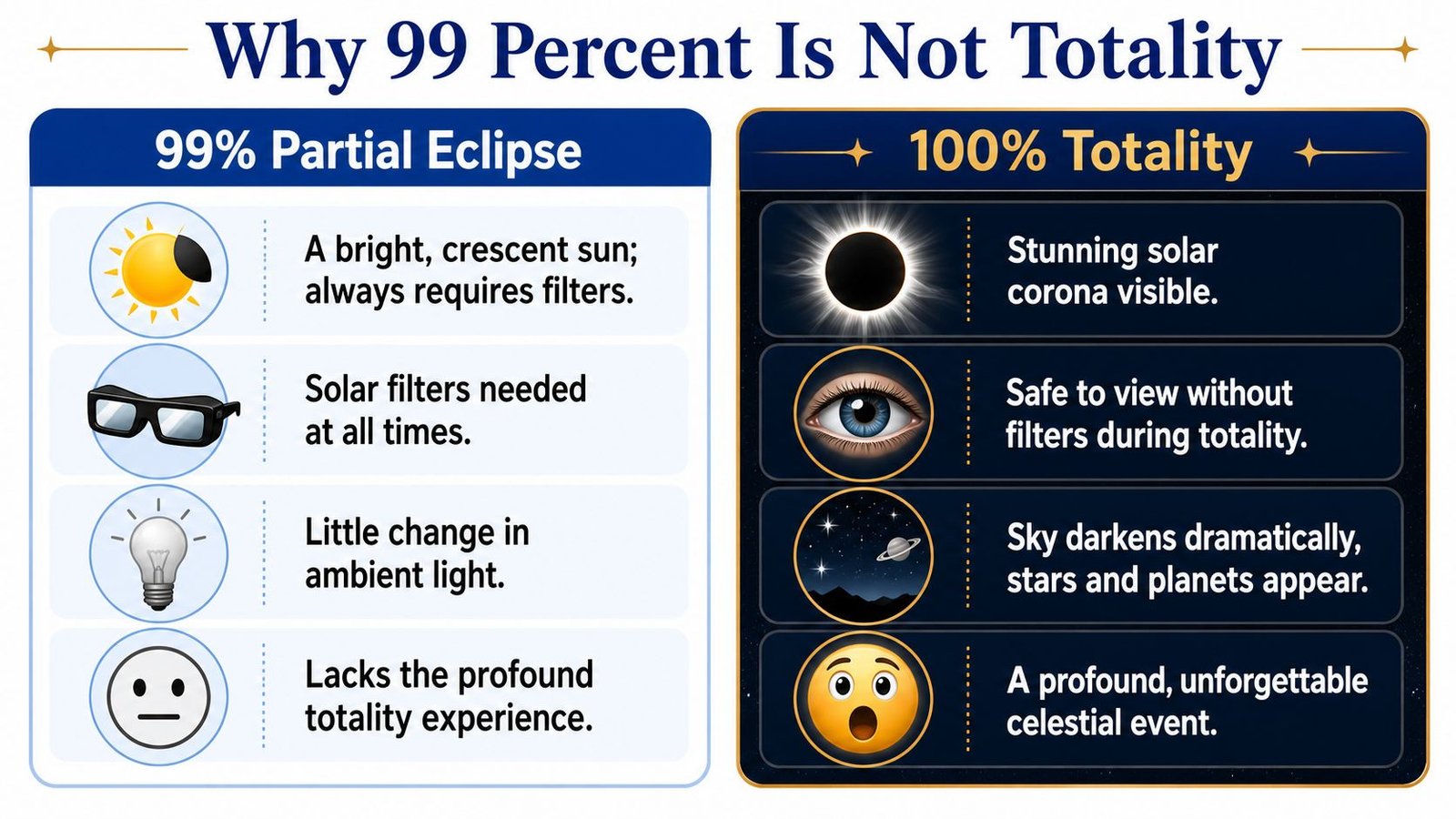
For a total solar eclipse, close enough isn't enough. At 99% coverage, the Sun still emits enough light to require eye protection and fails to produce corona visibility, temperature drops, or 360° sunset-like darkness. In Madrid and Barcelona, just outside the path, coverage remains at 98–99%, yet viewers experience no totality effects, as described in New Scientist's 2026 eclipse guide.
A thin remaining Sun changes everything
People hear “99 percent” and imagine almost complete darkness. That's not how this works. The last uncovered sliver of Sun is still bright enough to dominate the scene. It washes out the corona. It keeps the sky from taking on that uncanny all-around twilight look. It turns what should be the main event into an unusually dramatic partial eclipse.
That's why experienced eclipse chasers talk so bluntly about totality. They're not being elitist. They're trying to stop you from spending time and money on the wrong place.
A useful mental model is this:
| Location status | What you get |
|---|---|
| Outside the path | A partial eclipse, even if coverage looks extremely deep |
| Inside the path | The only conditions that produce totality |
If you want a visual explanation of how partial phases differ geometrically from totality, this partial solar eclipse diagram is worth checking before you lock in travel.
The final one percent is the whole show.
How to choose the right destination
Start with a hard rule: if your goal is the total eclipse experience, choose a location inside the path of totality, not near it. That means you should verify your intended town or viewpoint with a proper eclipse map or city simulator, not just a broad news graphic.
Then make a second decision. Do you want the longest possible totality, or the most accessible sunset spectacle? Iceland favors duration. Spain favors drama and easier access for many European travelers. Neither choice is wrong. The mistake is choosing a major city outside the path because it's convenient.
Here's what usually works better than a prestige-city plan:
- Pick totality first: Choose a site because it's in the path, not because it has the biggest airport.
- Accept a smaller town if needed: Small places often give you better horizons and less urban obstruction.
- Check the horizon, not only the map line: In Spain, being in the path without a western view can still leave you with a blocked eclipse.
When people ask how to watch eclipse events properly, this is the first answer I give. Don't optimize for hotel brands, restaurant scenes, or a famous skyline. Optimize for totality. Everything else comes after that.
Your Guide to Essential Eclipse Eye Safety
For this eclipse, eye safety is straightforward, but the timing matters. You will spend the vast majority of the event in partial phases, and during every partial phase you need proper solar protection. You remove filters only during totality, when the Sun's bright surface is fully covered. The instant that bright sunlight reappears, protection goes back on.
What safe viewing actually requires
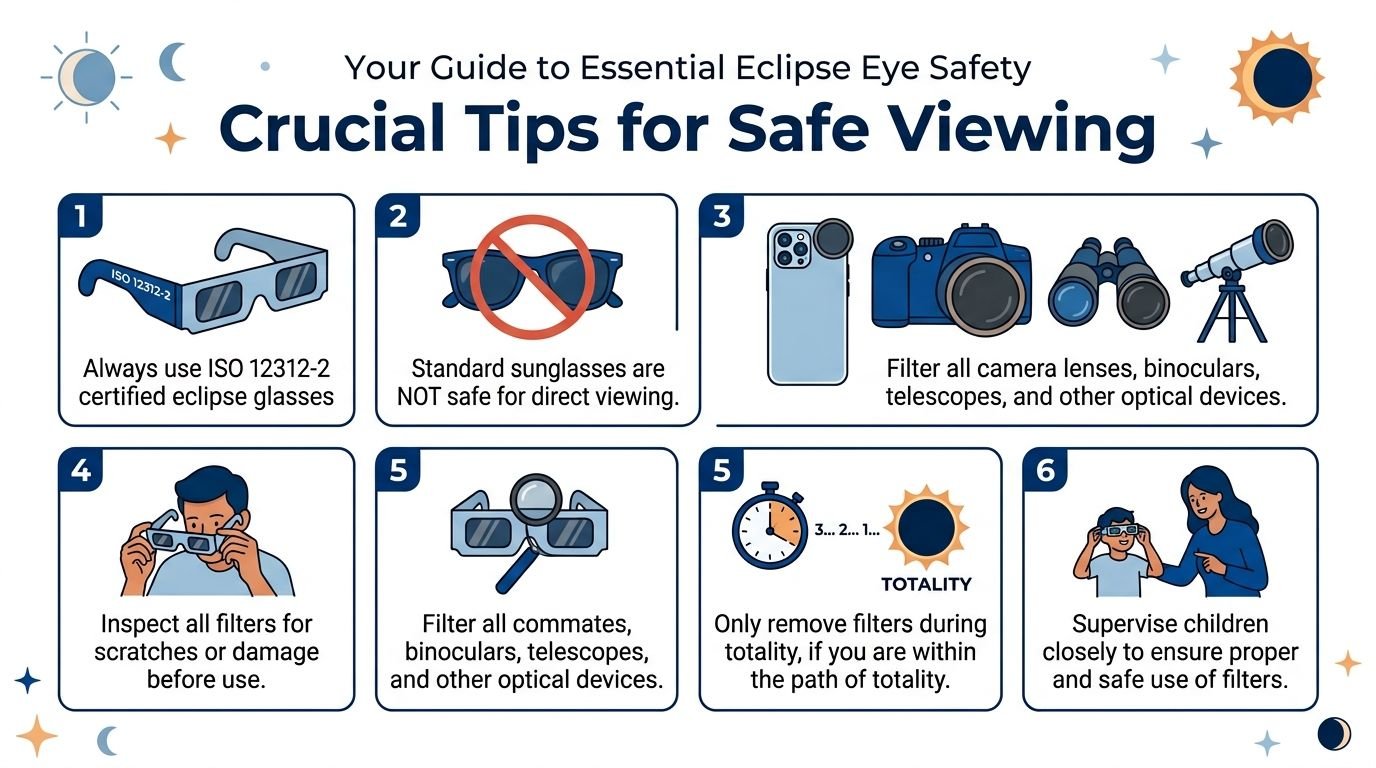
Use eclipse glasses or handheld viewers labeled ISO 12312-2. If you need a buying checklist before you travel, this guide to eclipse safety glasses covers what to check.
Regular sunglasses do not work. Neither do smoked glass, exposed film, tinted plastic, or any homemade substitute. They can reduce glare and still leave your eyes exposed to harmful sunlight.
Check your gear before eclipse day, not in the field while everyone is looking up. A quick inspection prevents the mistakes I see most often.
- Confirm the label: Use viewers marked ISO 12312-2 from a seller you trust.
- Inspect the filters: Skip anything scratched, punctured, creased, or coming apart at the edges.
- Filter every optical device: Binoculars, telescopes, cameras, and clip-on phone lenses need front-mounted solar filters of their own. Eclipse glasses do not make magnified optics safe.
- Pack a spare pair: Glasses get bent, stepped on, or misplaced. One backup pair is cheap insurance on eclipse day.
A thin crescent Sun is still direct Sun. That is where beginners get caught out.
Here's a quick visual refresher before you buy or pack gear:
The exact filter routine on eclipse day
Keep the routine simple and repeatable.
- Put your filter on before looking up.
- Keep it on through all partial phases. No brief naked-eye checks.
- Remove it only when totality is fully underway. If any bright part of the Sun is still visible, the filters stay on.
- If you are unsure, look away and keep the filter on. Uncertainty is your signal to stay protected.
- Put the filter back on as soon as the first bright bead or diamond ring appears. That is the end of safe naked-eye viewing.
Rule of thumb: If you are not absolutely sure totality has begun, keep the filters on.
Spain adds one practical complication. With the Sun low near the horizon, haze and glare can make the last moments before totality harder to judge than they would be with a higher Sun. Do not rely on brightness alone. Rely on the visible shape of the Sun, and if you are with a group, assign one person to call out the filter moments so everyone follows the same timing.
If you are supervising children or helping first-time viewers, rehearse this once before the eclipse starts. A calm, boring routine is exactly what you want when the main event begins.
Strategic Site Selection for the Sunset Eclipse
For Spain, site selection is where this eclipse gets technical. You are not just hunting for clear weather and a path line. You are hunting for totality with a usable western horizon.
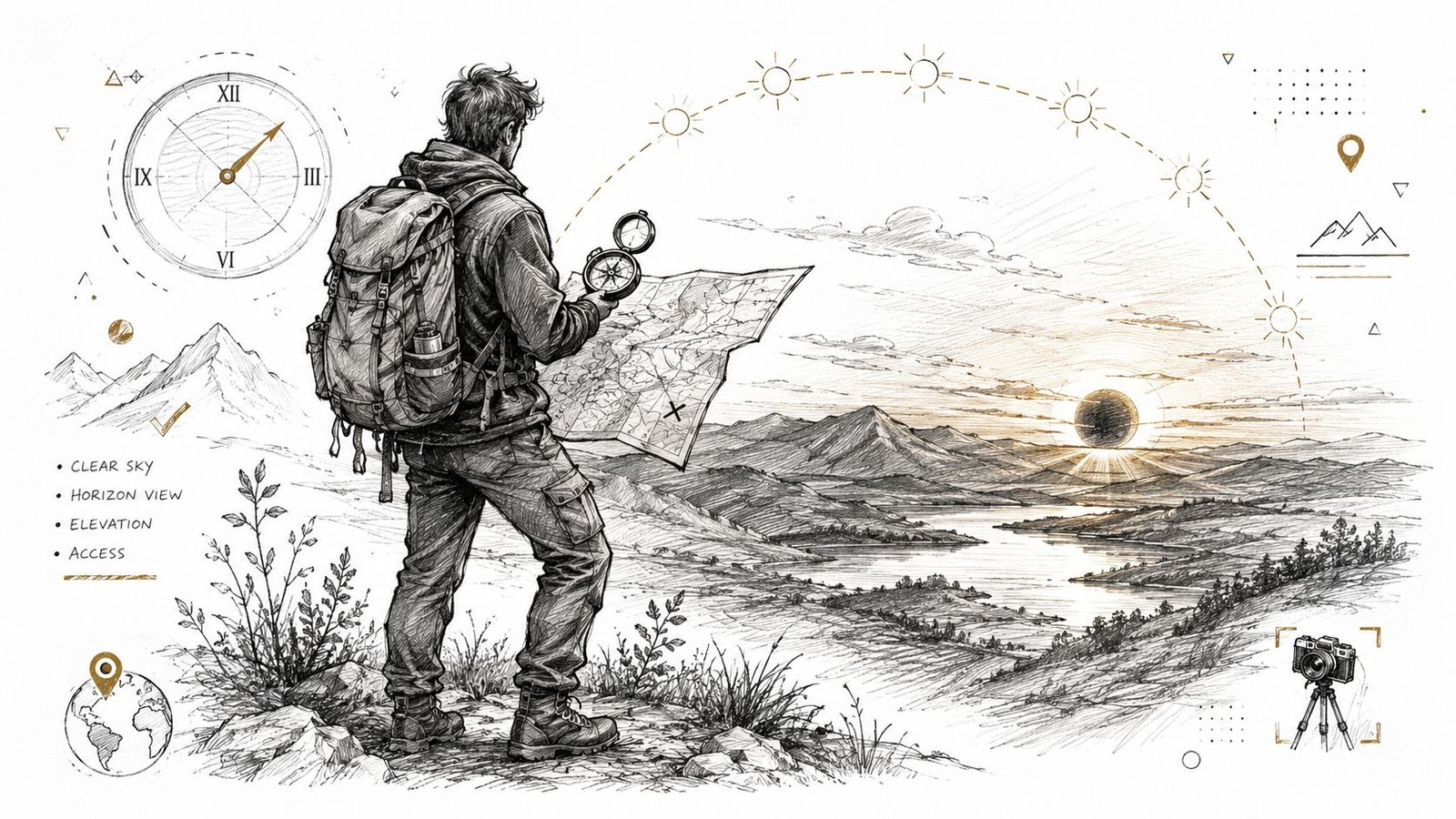
The 2026 eclipse occurs at sunset in Spain, with the Sun only 7–12° above the horizon. This low altitude magnifies risks from terrain obstructions and haze. In Mallorca, the Sun is just 2.7° high during totality, making a clear western horizon essential, according to Space.com's 2026 eclipse guide.
Why western horizon matters more than almost anything else
With the Sun low in the sky, ordinary ground features become eclipse killers. A hill that wouldn't matter at midday can erase the event near sunset. The same goes for apartment blocks, tree lines, port cranes, cliff faces, and ridges behind beach towns.
That's why a map pin isn't enough. You need to think in profile, not just latitude and longitude.
A good site for Spain usually has these traits:
- Open view to the west: Beaches, headlands, coastal promenades, and higher overlooks can work well if they don't place haze or buildings in front of you.
- Minimal local obstruction: Walk the site in advance if possible. One low rooftop line can be enough to matter.
- Room to reposition: Parking lots, broad seafront areas, and open public spaces are easier to adapt from than cramped viewpoints.
If your chosen spot only works from one exact square meter, it's a fragile plan.
What a usable eclipse site looks like in Spain
For this event, I'd rather have a modest town with a clean western horizon than a famous city with a beautiful but blocked skyline. That trade-off matters more in 2026 than in many total eclipses.
Use a simple screening process the day before:
| Site question | Good sign | Warning sign |
|---|---|---|
| Can you see the true western horizon? | Sea horizon or wide open plain | Hills, buildings, harbor infrastructure |
| Can you move quickly if needed? | Easy road access and multiple nearby alternatives | One road in, one road out |
| Will crowds pin you in place? | Several spread-out viewing options | Single iconic viewpoint everyone will choose |
Coastal cliffs can be excellent if they offer a broad western view and safe access. Beaches that are higher can work well because they combine openness with simple mobility. Urban waterfronts are hit or miss. They look convenient on paper, but local structures often intrude more than people expect.
Mallorca deserves special caution. With the Sun so low there during totality, horizon quality isn't a refinement. It's the deciding factor.
Travel and weather trade-offs
Spain in August is busy. That creates practical pressure long before eclipse day. Flights, ferries, cars, and accommodations around likely viewing regions won't get easier as the date approaches. If you already know you want to be in the path, book lodging and transport with flexibility in mind.
The best planning style for this eclipse is not “one hotel, one viewpoint, one hope.” It's a hub-and-spoke model. Stay somewhere that gives you multiple west-facing options within practical driving distance. That way, if marine haze or a cloud deck settles into one stretch of coast, you still have alternatives.
A few habits separate good eclipse plans from brittle ones:
- Arrive with a shortlist, not a single pin: Pick several candidate sites before you travel.
- Scout access and parking: A great horizon is worthless if local congestion prevents you from reaching it.
- Stay mobile on eclipse day: Keep the car ready, fuel up early, and avoid committing too soon if cloud behavior looks uncertain.
- Balance inland and coastal options: Coastlines can offer perfect horizons, but some inland elevations may give cleaner air and fewer obstructions.
When people ask how to watch eclipse events well, they usually mean safety and timing. For Spain in 2026, logistics are just as important. The people who succeed won't necessarily be the ones with the fanciest gear. They'll be the ones who can still change plans late in the day.
How to Photograph the 2026 Eclipse
Eclipse photography gets easier once you split it into two jobs. The partial phases require protection for your camera and disciplined exposure control. Totality is a different scene entirely. That's when the filter comes off and the exposure range expands fast.
Filtered partial phases and unfiltered totality
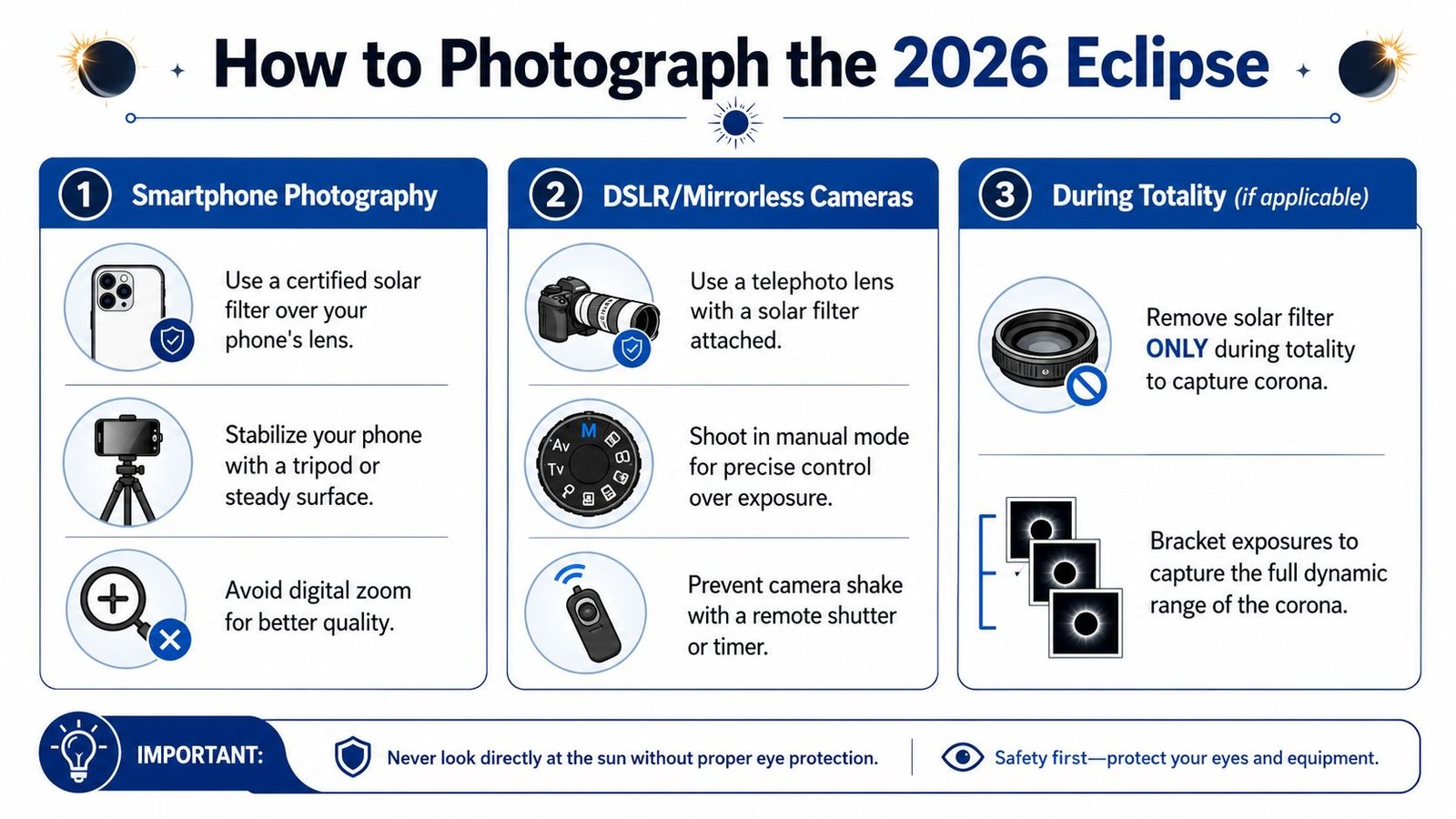
For the partial phases, your lens needs a proper solar filter mounted on the front. During totality, no filter is needed. Expert benchmarks recommend exposure brackets of 1/1000s to 2s at ISO 100–400 to capture the full range of the corona, and a common mistake is failing to remove the filter before totality begins, which leads to missed shots, as explained in the Exploratorium eclipse photography guide.
That single filter transition is where many sequences fall apart. People get so focused on protecting gear that they leave the solar filter on too long and photograph a black frame during the very phase they traveled to capture.
A practical setup differs by device:
- Phone users: Use a secure solar filter during partial phases, stabilize the phone, and don't rely on digital zoom.
- Mirrorless or DSLR users: A telephoto setup is more forgiving when mounted on a tripod, especially if you've already saved bracketed exposures and focus settings.
- Everyone: Rehearse the filter removal and replacement motion before eclipse day.
If you want ideas for sequence planning, framing, and pacing, looking through a solar eclipse time lapse can help you visualize what changes first and what disappears quickly.
A simple shooting workflow that holds up under pressure
The best eclipse camera plan is boring in advance and calm in execution.
Start with these priorities:
- Lock down your support. A tripod beats handheld every time for this kind of event.
- Pre-focus before the pressure rises. Don't wait until the last minutes to solve focus.
- Program or note your bracket sequence. Totality changes quickly, and your hands won't be as steady as you think once the corona appears.
- Decide whether you're a photographer or a witness first. If this is your first total eclipse, don't spend all of totality staring at the rear screen.
Field advice: Take the safe, expected shot first. Then look up.
For phones, simple often wins. A stabilized phone with a proper filter during partial phases and a clean transition at totality can produce a better memory than a complicated camera setup you haven't practiced. For interchangeable-lens cameras, manual control usually gives the most reliable results, but only if you've rehearsed the sequence enough that you can do it without thinking.
If you're torn between filming everything and watching it, choose a hybrid plan. Set one device to do a simple automated capture, then spend part of totality with your own eyes on the sky. You can replace a mediocre image later. You can't recreate the moment.
Your Eclipse Day Action Plan and Cloud Contingencies
By eclipse day, the hard decisions should already be made. You should know your primary site, your backup sites, your route west, your parking options, and who in your group is carrying which item. The day itself should feel like execution, not research.
What to pack and when to arrive
Arrive early enough that you can solve one problem without creating another. The most common trouble isn't astronomy. It's traffic, parking, blocked access, dead phone batteries, and realizing too late that a “clear view” included a line of trees.
A practical eclipse bag usually includes:
- Certified viewing gear: ISO-compliant glasses and any solar filters for cameras or binoculars
- Simple comforts: Water, layers, sun protection, and something to sit on
- Navigation backup: Offline maps or printed notes for alternate sites
- Power and timing: Charged batteries, power banks, and a reliable local-time reference
Use the final hour before the event to settle down, not to keep tinkering. If you're photographing, confirm your tripod position and rehearse the filter move one last time. If you're viewing only, decide where you'll stand and where children or companions should stand so nobody drifts into a blocked angle at the last moment.
If clouds threaten, act early
Clouds are the fear every eclipse chaser shares. The answer isn't panic. It's mobility and discipline.
Don't marry your first site if cloud trends look poor. Watch live satellite imagery, local forecasts, and the western horizon itself. Low cloud, haze, and marine layers matter more for this eclipse than broad “partly cloudy” language might suggest.
A workable cloud strategy looks like this:
- Commit to a decision time: Don't drift into indecision until roads clog.
- Move for horizon quality as much as sky cover: A low western bank can be worse than higher broken cloud.
- Keep alternatives realistic: A backup site that requires an impossible drive in heavy traffic is not a backup.
Sometimes the best eclipse move is leaving a nice spot for a better one before everyone else admits they should.
If the sky stays uncertain, remember the priority order: inside the path, clear western horizon, then local convenience. That hierarchy will keep your choices sane when the forecast gets messy.
For live maps, city-by-city timing, path details, safety guidance, and practical planning tools focused on Europe, follow Total Solar Eclipse 2026 Live. It's a useful reference if you want one place to check totality status, compare locations in Spain and Iceland, and refine your eclipse-day plan.