July 7, 2026
What Do Comets and Asteroids Have in Common
If comets are icy and asteroids are rocky, why do astronomers keep finding objects that refuse to stay in either box?
That question exposes the problem with the usual classroom shortcut. We often learn that comets are “dirty snowballs” and asteroids are “space rocks.” That's useful at first, but it can also hide the more interesting truth. Some asteroids grow tails. Some comets lose their visible activity and end up looking like ordinary asteroids. Once you notice that, the question what do comets and asteroids have in common gets much bigger than “they're both small.”
They share an origin, they obey the same gravity, they can both send debris into Earth's path, and in some cases they even blur into one another. That blurry boundary matters not just for astronomy textbooks, but for how scientists reconstruct the Solar System's history and think about impact hazards. And if you're planning to watch the August 12, 2026 total solar eclipse in Europe, this is part of the same wider story: the sky isn't a set of neat categories. It's a moving system, full of leftovers, crossings, and surprises.
Table of Contents
- The Cosmic Question of Ice vs Rock
- Shared Ancestry as Leftovers of Planet Formation
- Traveling Companions Through the Solar System
- The Great Blur Where a Comet Looks Like an Asteroid
- A Common Legacy of Craters and Meteor Showers
- Why This Blurry Line Matters for Science and Safety
The Cosmic Question of Ice vs Rock
A common starting point is a clean split. Comets are icy bodies that heat up near the Sun and grow glowing comas and tails. Asteroids are rocky or metallic bodies that usually stay dark and compact. That basic picture isn't wrong. It's just incomplete.
The trouble starts when nature refuses to behave like a chart in a textbook. A comet can lose the surface ice that once made it dramatic. After enough trips near the Sun, it may stop producing a coma and begin to look like a plain, inactive asteroid. On the other side, an object moving on an asteroid-like orbit can suddenly throw off dust and resemble a comet.
The sharp line between “ice” and “rock” works as a first lesson, not as the final answer.
That's why the best answer to what do comets and asteroids have in common isn't a short list of shared traits. It's a different way of seeing them. Think of them less as two sealed categories and more as members of a family spread across a spectrum. At one end are obviously active icy bodies. At the other are plainly rocky objects. Between them lies a messy middle ground.
Three ideas help clear up the confusion:
- Shared origin: They formed from the same early Solar System material.
- Shared physics: They orbit the Sun and respond to gravity in the same way.
- Shared evolution: Some objects shift appearance over time, which can hide what they once were.
That last point changes the whole conversation. The label we give an object may describe its current behavior, not its full history. In astronomy, appearance can be a phase. That's one reason skywatching is so captivating, whether you're following a comet, tracking meteor showers, or planning a major event like Europe's 2026 eclipse. The sky keeps rewarding people who look past the first, easy explanation.
Shared Ancestry as Leftovers of Planet Formation
Long before there were planets with oceans, rings, or eclipses, there was a disk of gas and dust around the young Sun. Inside that swirling disk, tiny particles collided, stuck together, and gradually built larger bodies. Some grew into planets. Others didn't. The ones left behind became many of the small worlds we now call comets and asteroids.
NASA describes this shared origin clearly on its asteroids, comets, and meteors overview: comets and asteroids share a fundamental origin as pristine remnants from the solar system's protoplanetary disk, having formed approximately 4.6 billion years ago and serving as the primary building blocks for planetary accretion.
The same construction site
A house under construction leaves scraps everywhere. You get bricks, timber offcuts, wiring, and unused tiles. Those leftovers tell you what the builders were working with before the finished walls went up.
Comets and asteroids are like those leftovers from the Solar System's construction site. They formed from the same broad supply of raw material, even if they ended up in different regions and with different mixtures of rock, metal, dust, ice, and organic material. Scientists value them because they preserve an older chemical record than large planets do.
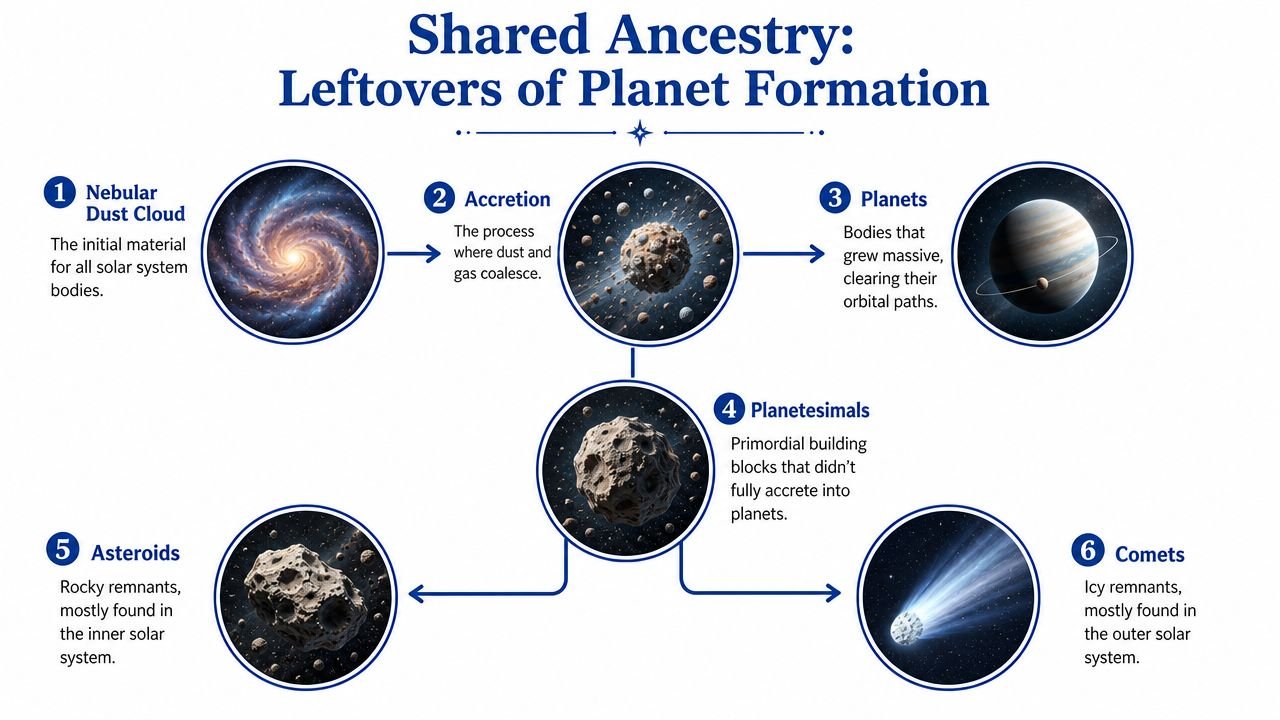
That's why researchers sometimes treat these objects like cosmic fossils. Planets have been melted, reshaped, weathered, and geologically reworked. Small bodies often preserve a much earlier chapter of the story.
Why scientists care so much about leftovers
This shared ancestry gives comets and asteroids several traits in common.
| Shared feature | Why it matters |
|---|---|
| Ancient origin | They preserve material from the Solar System's earliest era |
| Irregular shapes | Many never grew large enough to become rounded worlds |
| Cratered surfaces | They've spent billions of years colliding with debris |
| Primitive chemistry | They help scientists study water and organic molecules in early planetary history |
NASA also notes in that same overview that both groups preserve a chemically unaltered record of the early solar nebula and help scientists study the distribution of water and organic molecules delivered to terrestrial planets. That makes them more than drifting rubble. They're archives.
Practical way to think about it: planets are the finished books, while comets and asteroids are draft pages still carrying the editor's marks.
A reader might ask: if they came from the same starting material, why don't they all look alike now? Location matters. Temperature matters. Repeated passes near the Sun matter. A body that retained more volatile material can behave very differently from one that lost it early. But the family resemblance remains. Both are small worlds orbiting the Sun, both carry scars from collisions, and both trace the ancient rearrangement of material through the Solar System.
That's the first deep commonality. They aren't strangers. They're siblings from the same nursery.
Traveling Companions Through the Solar System
Origin is only half the story. Motion is the other half. However different comets and asteroids may look, gravity doesn't care what label humans give them. Rock, ice, metal, dust. Every one of these bodies follows the same underlying rules as it moves around the Sun.
Gravity treats them the same
A useful misconception to get rid of is the idea that composition determines orbit. It doesn't. Ice doesn't automatically mean one kind of path, and rock doesn't automatically mean another. A body's orbit depends on its speed, its position, and the gravitational tugs it receives from larger objects, especially the giant planets.
That's why both comets and asteroids can end up crossing into the inner Solar System. They orbit the Sun, they undergo gravitational perturbations, and some eventually pass through the same planetary neighborhoods. When those paths intersect Earth's, the consequences can range from harmless meteor activity to serious impact events.
Here's a clean way to frame it:
- The Sun sets the main path: every small body is bound to the Solar System's central mass.
- Planets reshuffle trajectories: close encounters and long-term tugs can alter orbits.
- Crossings happen: some objects move inward and pass through Earth's region of space.
If you enjoy photographing sky events, the same orbital patience applies to eclipse work. Careful timing matters in both cases, and a strong eclipse photography guide can sharpen the habit of thinking in paths, geometry, and changing light.
Different neighborhoods, similar journeys
People often associate asteroids with the inner Solar System and comets with the outer Solar System. That's broadly useful, but it can mislead if you treat it as a permanent boundary. The Solar System is more like a city with constant traffic than a museum with objects locked in display cases.
Some small bodies stay in relatively stable zones for long stretches. Others get nudged. Jupiter is especially important because its gravity can redirect material dramatically over time. A body that formed far from the Sun can be sent inward. A body on an eccentric orbit can begin to resemble another population in behavior or appearance.
A short comparison helps:
| Question | Asteroids | Comets |
|---|---|---|
| Do they orbit the Sun? | Yes | Yes |
| Can planets perturb their orbits? | Yes | Yes |
| Can they enter the inner Solar System? | Yes | Yes |
| Can they cross Earth's path? | Yes | Yes |
The Solar System isn't neatly shelved into “their region” and “our region.” It's full of orbital migration.
This matters for understanding overlap. Once you accept that both kinds of objects travel under the same gravitational rules, it becomes easier to accept that some may wind up on surprisingly similar paths. And when path and appearance start overlapping, the old tidy distinction begins to crack.
The Great Blur Where a Comet Looks Like an Asteroid
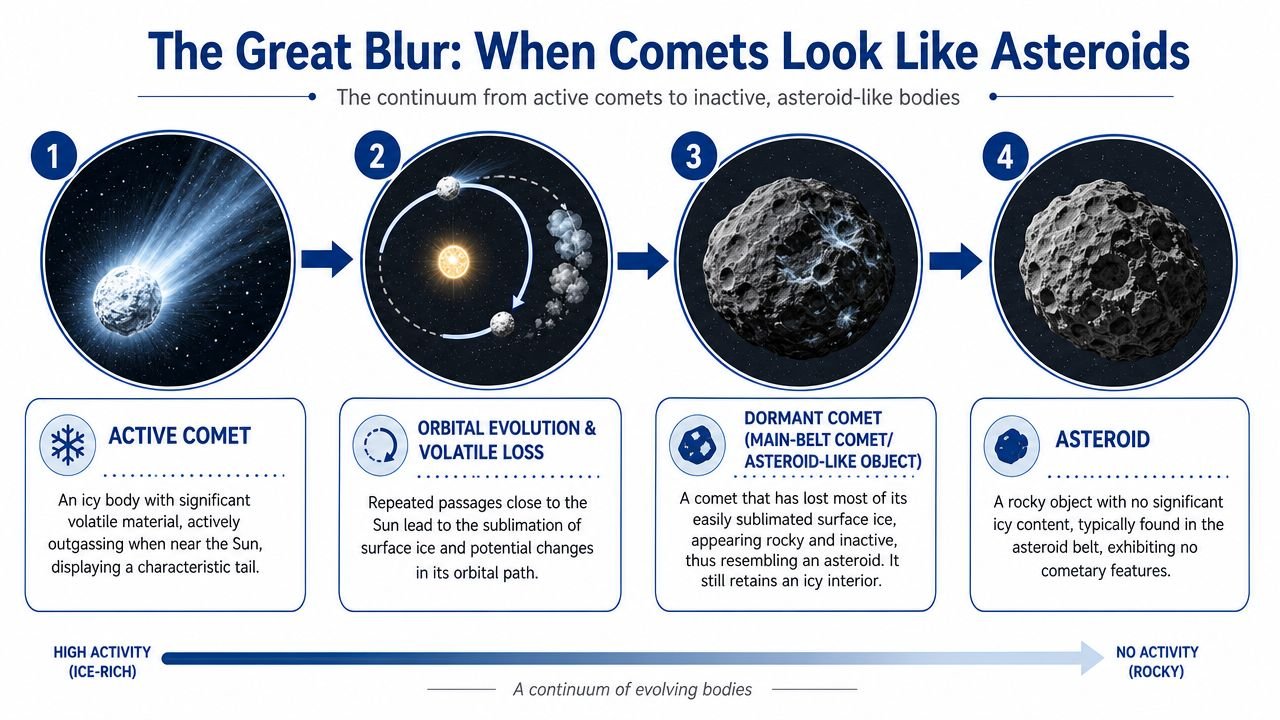
The most exciting answer to what do comets and asteroids have in common is this: sometimes they can look so similar that the distinction becomes an evolutionary question instead of a visual one.
That's where the modern continuum idea becomes powerful. Instead of asking, “Is this object permanently a comet or permanently an asteroid?” astronomers often have to ask, “What stage is this object in right now?”
The key evidence comes from two categories that disrupt the classic split. One is the dormant comet, a comet that has lost much of its easy-to-vaporize surface ice and no longer shows the spectacular activity people expect. The other is the active asteroid, an object on an asteroid-like orbit that produces dust or a tail and briefly behaves like a comet.
The asteroid overview on Wikipedia summarizes this key point: the discovery of 'active asteroids' (objects with asteroid-like orbits but cometary tails) and 'dormant comets' (comets that deplete ice and become asteroid-like) proves that the distinction is often a temporary phase, not a permanent identity, creating a continuum between the two.
Dormant comets
A comet's show depends on volatile material near its surface. As sunlight warms the nucleus, ice sublimates and drags dust outward, creating the coma and tail. But repeated close passages to the Sun can strip away that easy surface supply.
At some point, the object may stop advertising its comet identity. No bright coma. No dramatic tail. Just a dark body that, from a distance, can pass for an asteroid.
That's like a campfire after the flames die down. The glowing spectacle is gone, but the fuel history hasn't vanished. It's still the remains of the same fire.
Active asteroids
Now turn the puzzle around. Some bodies on asteroid-like orbits release dust and develop comet-like features. They don't fit the old script either. They show that visible activity isn't owned exclusively by classic comets.
For readers who like imaging subtle sky phenomena, that kind of ambiguity is part of why astrophotography guides for changing celestial targets are so useful. The sky often presents objects in transition, not in idealized textbook form.
Identity versus life stage
A better mental model is to think in terms of life stages.
- A body with abundant accessible ice can act like an active comet.
- Repeated heating can reduce visible outgassing.
- The object may enter a quieter phase and look asteroid-like.
- Some asteroid-like bodies can also show activity under the right conditions.
A label describes what we see now. It may not describe the object's whole history.
This doesn't mean comets and asteroids are identical. Composition still matters. Orbit still matters. But the boundary is porous. The old ice-versus-rock split is a first approximation, not a final map of reality.
That change in perspective affects how we interpret the Solar System's past. If bodies can shift appearance over time, then today's populations may hide yesterday's identities. Some “asteroids” may carry a cometary past. Some dusty “comet-like” behavior may appear in places once considered asteroid-only territory.
Once you see that blur, the small-body population stops looking like two bins and starts looking like a flow chart.
A Common Legacy of Craters and Meteor Showers
You don't need a spacecraft mission to feel the shared influence of comets and asteroids. You can see it in scars across planetary surfaces and in sudden streaks of light above your own head.
Scars on worlds
Both populations have spent billions of years colliding with other material. Their own surfaces are cratered because they've been hit, and they also create craters when they strike larger worlds. From the perspective of a moon or planet, the incoming object doesn't arrive with a neat label attached.
A fast impact is a geological event. It excavates material, reshapes terrain, and leaves a record that can last far longer than any human civilization. That's one reason cratered surfaces are such powerful reminders that the Solar System is active, not static.
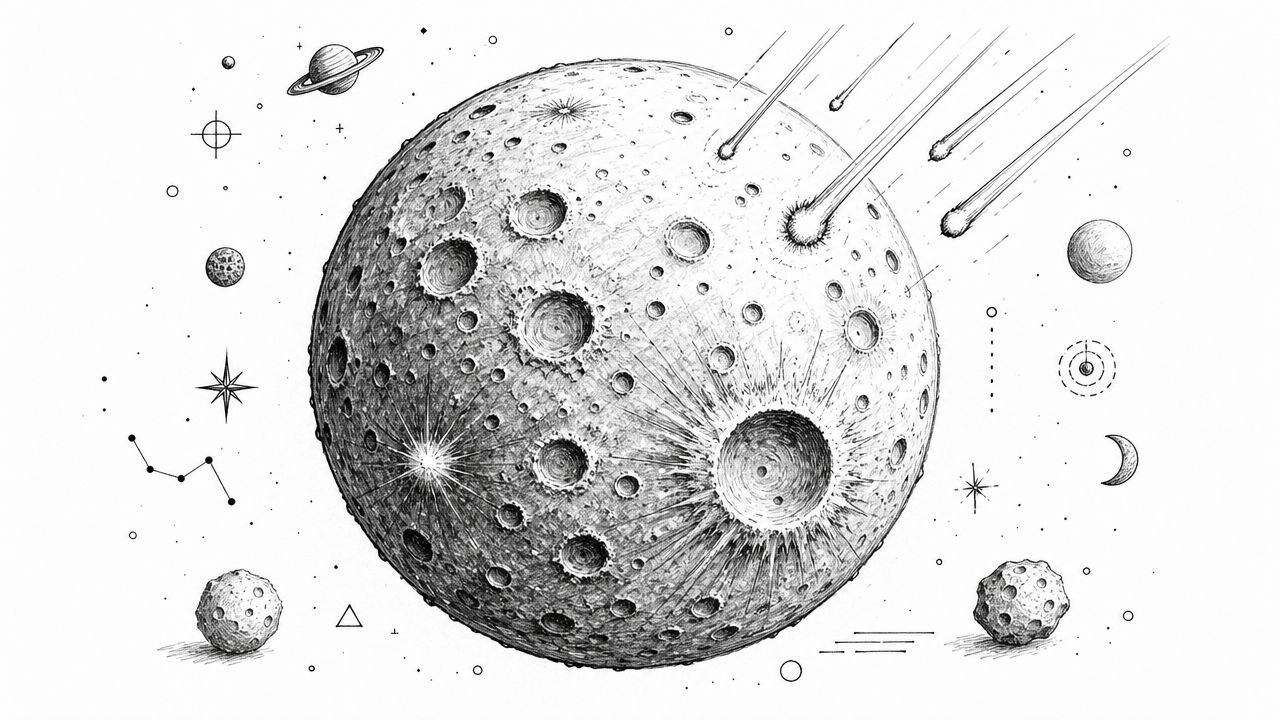
The battered look of many small bodies also ties back to their shared history. They've been jostled, chipped, and struck over immense spans of time, which helps explain their irregular shapes and rough surfaces.
Who made that shooting star
Meteor showers bring this topic much closer to daily life. According to NASA's related small-body classification overview in this video resource on asteroids, comets, and meteoroids, when Earth intersects the debris trails left by either comets or asteroids, the resulting particles create meteor showers, demonstrating that both populations contribute to the same meteoroid stream environment in the inner solar system.
That sentence clears up a common misunderstanding. People often associate meteor showers only with comets. Many do come from comet debris, but the broader point is that both populations contribute to the inner Solar System's dust and fragment environment.
A simple chain looks like this:
- Parent body sheds material
- Debris spreads along an orbit
- Earth passes through the stream
- Particles burn in our atmosphere
- We see meteors
Every meteor shower is a reminder that Earth moves through a busy orbital neighborhood.
This is one of the most beautiful shared legacies of comets and asteroids. The same kinds of objects that can scar a world can also produce one of the gentlest astronomical spectacles available to the naked eye. A crater is the violent end of an encounter. A meteor shower is the delicate version, tiny grains flaring and vanishing in the atmosphere.
That duality is part of what makes small bodies so fascinating. They're humble in size, but they shape both physical features and skywatching traditions.
Why This Blurry Line Matters for Science and Safety
The continuum between comets and asteroids isn't just a classification argument. It changes how scientists ask questions and how planners think about risk.
Science questions that depend on classification
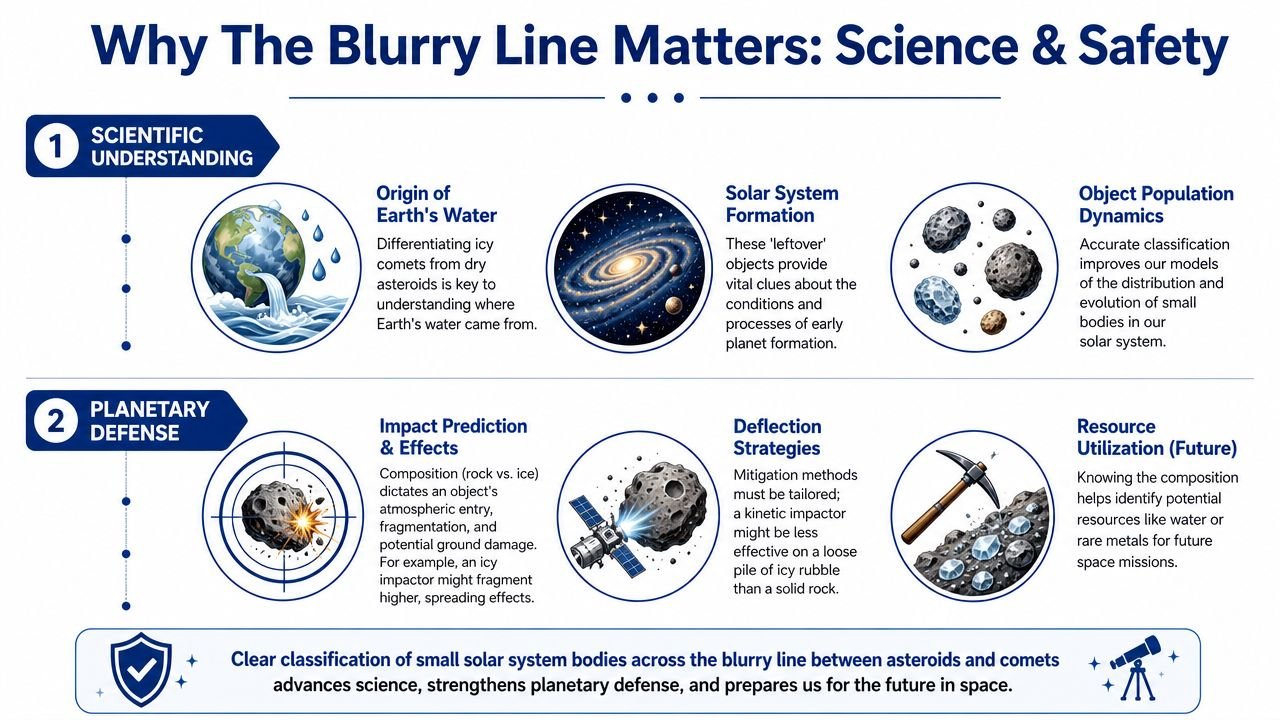
Small bodies preserve clues about the Solar System's earliest chemistry. NASA's overview of asteroids, comets, and meteors notes that these objects allow scientists to analyze the distribution of water and organic molecules essential to life that were delivered to terrestrial planets via impact events. If the comet-asteroid line is blurrier than once thought, then the story of how material moved through the early Solar System becomes richer and more complicated.
That matters for at least three scientific reasons:
- Tracing water and organics: volatile-rich objects may have helped supply key ingredients to early planets.
- Reconstructing migration: the present mix of objects preserves evidence of how giant planets reshaped the Solar System.
- Improving classification: if some objects change appearance with age or heating, scientists need models that allow for transition states.
The same habit of precise classification helps in other areas of sky planning too. Eclipse observers preparing for Europe in 2026 depend on exact geometry, timing, and safety rules, and a well-organized eclipse planning blog serves the same basic goal: don't settle for rough categories when details change outcomes.
Why planetary defense can't be simplistic
A second overlooked point is public perception of danger. People sometimes hear about dramatic comets and assume they dominate the threat picture. They don't dominate in number. NASA's asteroid facts page states that 99% of all Near-Earth Objects are asteroids, while also noting that comets travel at significantly higher velocities, making a single, though rarer, comet impact potentially far more energetic and dangerous than a typical asteroid impact.
That combination is important because it forces two thoughts to coexist:
| Risk question | What matters most |
|---|---|
| Which objects are most common near Earth? | Asteroids |
| Which rare events can be especially energetic? | Fast-moving comets |
So the right question isn't “Which class is the primary danger?” The right question is “What kind of danger does each class represent?” Asteroids dominate the near-Earth population. Comets can pose a different problem because speed changes impact energy dramatically.
Planetary defense works better when scientists think in profiles, not stereotypes.
That's the practical payoff of the continuum idea. If some objects hide their histories, and if appearance doesn't always reveal composition or behavior, then careful observation becomes essential. Classification isn't a naming game. It shapes how scientists interpret origin, forecast motion, and prepare for the rare cases that matter most.
And for everyone who watches the sky, there's a satisfying lesson in this. The heavens reward nuance. The most interesting objects are often the ones that refuse to fit the first category we give them.
If you're planning to view the total solar eclipse on August 12, 2026 from Iceland, Spain, or elsewhere in Europe, Total Solar Eclipse 2026 Live is a practical place to check eclipse timing, path geometry, eye-safety guidance, and location-specific planning details. The site is especially useful if you want city-level information, totality context, and preparation help for seeing the event safely and clearly.