July 14, 2026
Best Telescope You Can See Saturn with in 2026
To see Saturn's rings at all, you need a telescope with at least a 60mm aperture and around 50x magnification. That's the entry point, not the finish line, because the first time Saturn stops looking like a bright dot and turns into a tiny ringed world, many immediately want a better view.
A lot of readers searching for the best telescope you can see Saturn with are in the same spot right now. You've probably looked at a few beginner scopes, noticed huge magnification numbers on the box, and wondered whether any of them will show the rings or just a blurry blob. That confusion is normal.
Saturn is one of the best objects for a beginner because the reward comes early. You don't need an observatory, and you don't need expert-level gear to get your first real look. But 2026 also brings an important wrinkle that many older guides miss. After the 2025 ring-plane crossing, Saturn's appearance changed, and buying advice based on pre-2025 expectations can set you up for disappointment if your goal is fine ring detail rather than just seeing the rings.
This matters if you're shopping for a telescope you can see Saturn with and hoping for more than a quick novelty glance. In 2026, the rings are tilting back toward Earth, which improves visibility compared with the edge-on look around 2025, but the standards for seeing the Cassini Division cleanly are not quite what many old buying guides suggest. The richer journey starts with that first small “hat-shaped” view and keeps going toward sharper ring structure, better timing, steadier nights, and better technique.
Table of Contents
- Your First Look at the Ringed Planet
- What Saturn Realistically Looks Like Through a Telescope
- Understanding the Key Telescope Specifications
- Choosing the Right Type of Telescope for Saturn
- Essential Accessories for a Better Saturn View
- Pro Tips for Observing Saturn in 2026
- Your Path to the Planets and Beyond
Your First Look at the Ringed Planet
A beginner steps up to the eyepiece expecting a bright dot and suddenly sees a tiny planet with a shape that does not belong to any star. The reaction is usually immediate. Saturn looks small, but it looks real in a way that catches people off guard.
That first view depends less on chasing extreme specs and more on getting past the threshold where the planet stops looking like a blur and starts looking unmistakably ringed. For a newcomer, that means choosing a telescope with enough light-gathering power and enough usable magnification to separate the planet from the rings cleanly. The goal is simple. Your brain should recognize Saturn at a glance, without squinting and wondering if you are just being hopeful.
A good first Saturn telescope works like a decent pair of binoculars compared with toy opera glasses. Both can point at the same target, but only one gives your eyes enough information to make sense of what they are seeing. That is why shopping for the absolute minimum can backfire. A barely detectable view may count as success on paper, yet still leave a beginner underwhelmed.
Practical rule: Buy for the first satisfying view, not the absolute minimum detectable view.
That advice matters even more in 2026. Saturn's rings are opening back up after the 2025 ring-plane crossing, when they appeared nearly edge-on from Earth and were much harder for beginners to pick out. Many older Saturn guides were written for years when the rings were presented more generously, or they skip this cycle entirely. In 2026, the classic ringed shape is becoming easier to recognize again, which gives a new observer a better chance at the kind of first look people remember for years.
The best part of that first sight is what it changes. “Can I see Saturn?” turns into better questions. How sharp can I make it? Can I spot Titan nearby? What happens when the air steadies for a few seconds? That is the point where a telescope stops being a novelty purchase and starts becoming an instrument you learn to use.
What Saturn Realistically Looks Like Through a Telescope
You center Saturn, bring it into focus, and your first reaction is often surprise. It looks small.
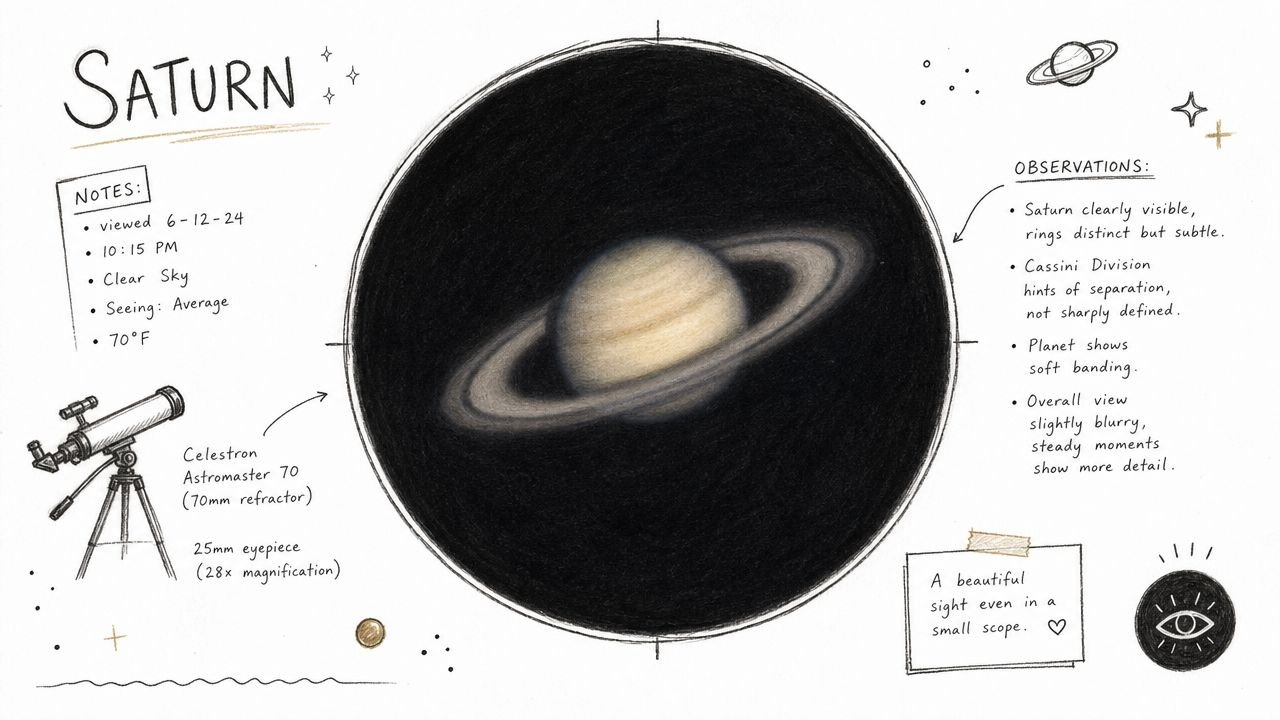
That catches many beginners off guard because photos have trained us to expect a giant striped world filling the eyepiece. At the telescope, Saturn is closer to seeing a distant coin held under a bright lamp. Tiny, yes, but clearly shaped. The thrill comes from recognizing that it is a real world with rings, hanging there in sharp focus.
The beginner view
With a small beginner telescope in the 60mm to 80mm class, Saturn usually stops looking like a star and starts looking like an object. That distinction matters. You are no longer asking, “Is that really Saturn?” You can usually tell, at a glance, that the planet has a ringed shape.
A good first view is often delicate rather than dramatic. Saturn may look like a tiny golden bead with handles, or a miniature ornament with a thin ring around it. The image stays small, but the shape is unmistakable on a decent night.
The atmosphere decides a lot. Unsteady air makes Saturn ripple and blur, like looking at a coin at the bottom of a swimming pool. Steady air lets the planet snap into focus for a few seconds at a time. Those brief sharp moments teach beginners an important lesson. The telescope matters, but the sky matters too.
A realistic beginner checklist looks like this:
- What you should expect: A small but clearly non-stellar object with visible rings
- What you might notice: The globe and ring system as separate shapes, with the planet looking slightly flattened by the rings
- What you should not expect: A large, colorful NASA-style view with obvious detail all the time
What changes as your telescope improves
In the mid-size range, around 100mm to 150mm, Saturn starts to feel less like a discovery and more like something you can study. The image is brighter, focus is easier to judge, and short periods of steady air reveal more structure.
This is also where 2026 matters. Many older guides were written for years when Saturn's rings were opened wider to our line of sight, so the planet looked more dramatic even in modest equipment. After the 2025 ring-plane crossing, the rings are opening back up again in 2026, but they still do not present exactly the same way they did in those older recommendations. Beginners have a better chance of seeing the classic ringed silhouette again, yet subtle ring detail still depends heavily on sky steadiness and optical quality.
Here is a realistic progression:
| Telescope class | What Saturn usually looks like |
|---|---|
| Small beginner scope | Rings are visible and distinct, but the image stays tiny |
| Mid-size scope | The globe looks cleaner, the rings look more definite, and faint detail becomes easier to catch in steady air |
| Larger amateur scope | Subtle banding, ring structure, and a few moons become more rewarding to hunt |
Higher magnification helps only when the image stays clean. If the air is shaky, extra power just makes the blur bigger. That is one reason some observers eventually prefer auto-tracking telescopes for planetary observing. Keeping Saturn centered lets you spend more attention on focus and those fleeting sharp moments instead of constant nudging.
Saturn rewards patience more than raw magnification.
In a larger amateur telescope, you may begin picking out Titan with ease, then watching for other moons nearby. On good nights, you can also start chasing gentle cloud banding on the planet or darker definition in the rings. These features do not jump out like bold lines in a textbook diagram. They appear gradually, with practice, careful focus, and time at the eyepiece.
That is the right expectation to carry into a purchase. A telescope that shows Saturn well does not need to make it look huge. It needs to make the planet look unmistakably real on your first night, then show a little more as your eye gets trained.
Understanding the Key Telescope Specifications
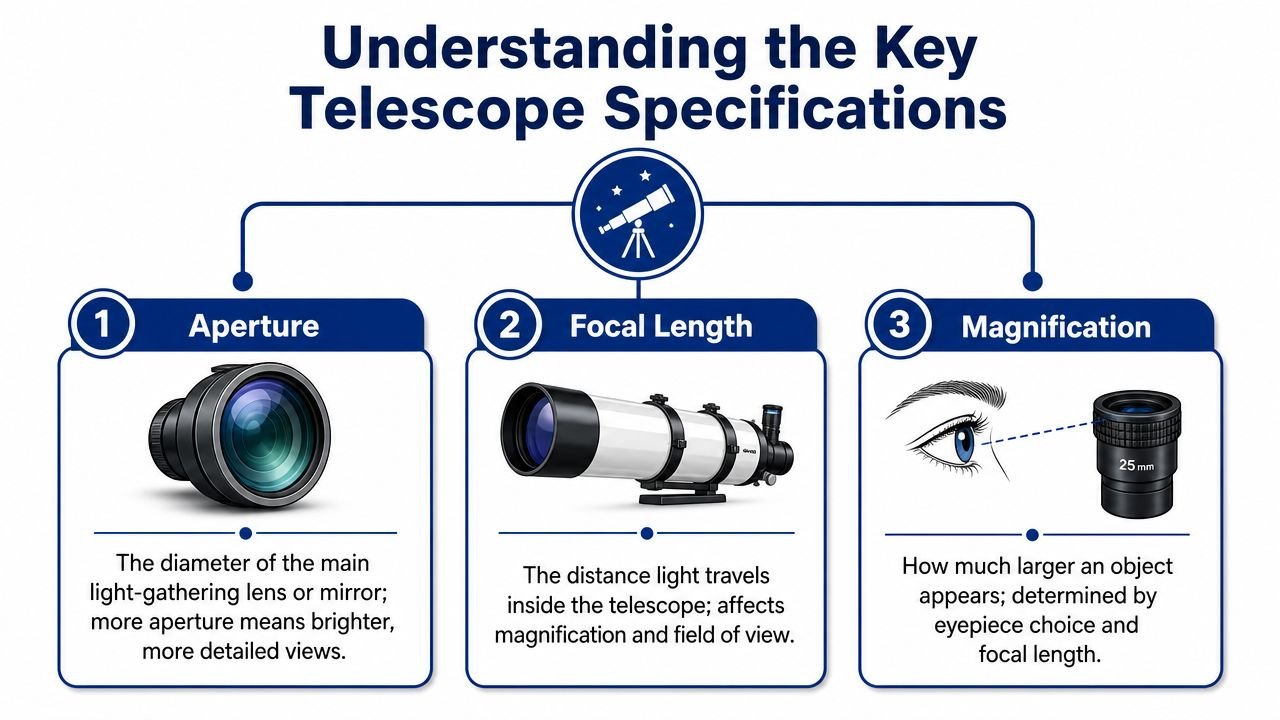
A telescope spec sheet can look more complicated than the night sky itself. For Saturn, you can simplify it fast. Three terms do most of the work: aperture, focal length, and magnification.
Aperture matters most
Aperture is the diameter of the telescope's main lens or mirror. It works like the width of a window. A wider window lets in more light and also allows finer detail to come through.
For Saturn, aperture sets the telescope's real potential. A small scope can show the planet and its rings as separate features. More aperture makes the edges cleaner, helps the planet hold up at useful magnification, and gives you a better chance of catching subtle ring structure during steady moments.
That point matters even more in 2026. After the 2025 ring-plane crossing, Saturn's rings are opening back up, but many older buying guides still reflect advice written for a different ring angle. In practice, that means beginners may find the rings easier to identify again than they were near edge-on, while fine details still depend heavily on aperture, seeing, and patience.
Aperture is the first number I check for that reason. The box may advertise huge power, but a small telescope cannot stay sharp just because the magnification number is high.
Why focal length and magnification confuse beginners
Focal length describes how far light travels inside the telescope before it reaches focus. In everyday use, it affects how naturally the telescope reaches higher power and how wide the view feels with a given eyepiece.
Magnification comes from the telescope and eyepiece together. It is a setting, not a quality rating.
A simple way to sort the three specs is this:
- Aperture decides how much detail the telescope can support
- Focal length affects how the telescope behaves with different eyepieces
- Magnification is the amount of enlargement you choose for that moment
The easiest comparison is a window and a pair of binoculars. If the window is small or hazy, stepping closer does not reveal more detail. It only makes the same imperfect view look bigger.
Shop for sharpness first, not the largest magnification number on the box.
For planetary viewing, balance matters. A Saturn telescope should have enough aperture to support useful power, a focal length that makes common eyepieces practical, and a mount that does not wobble every time you touch the focuser. If you are unsure what makes one setup steadier than another, this guide to telescope mount types for planetary observing will help.
One more point helps clear up a common buying mistake. For planets, the priority is usually aperture first, mount stability second, and advertised maximum magnification far down the list.
Choosing the Right Type of Telescope for Saturn
The best telescope design for Saturn depends less on brand and more on how you plan to use it. Some people want a quick, low-fuss setup on a patio. Others don't mind a bulkier instrument if it delivers more aperture for the money.
Refractors for simplicity
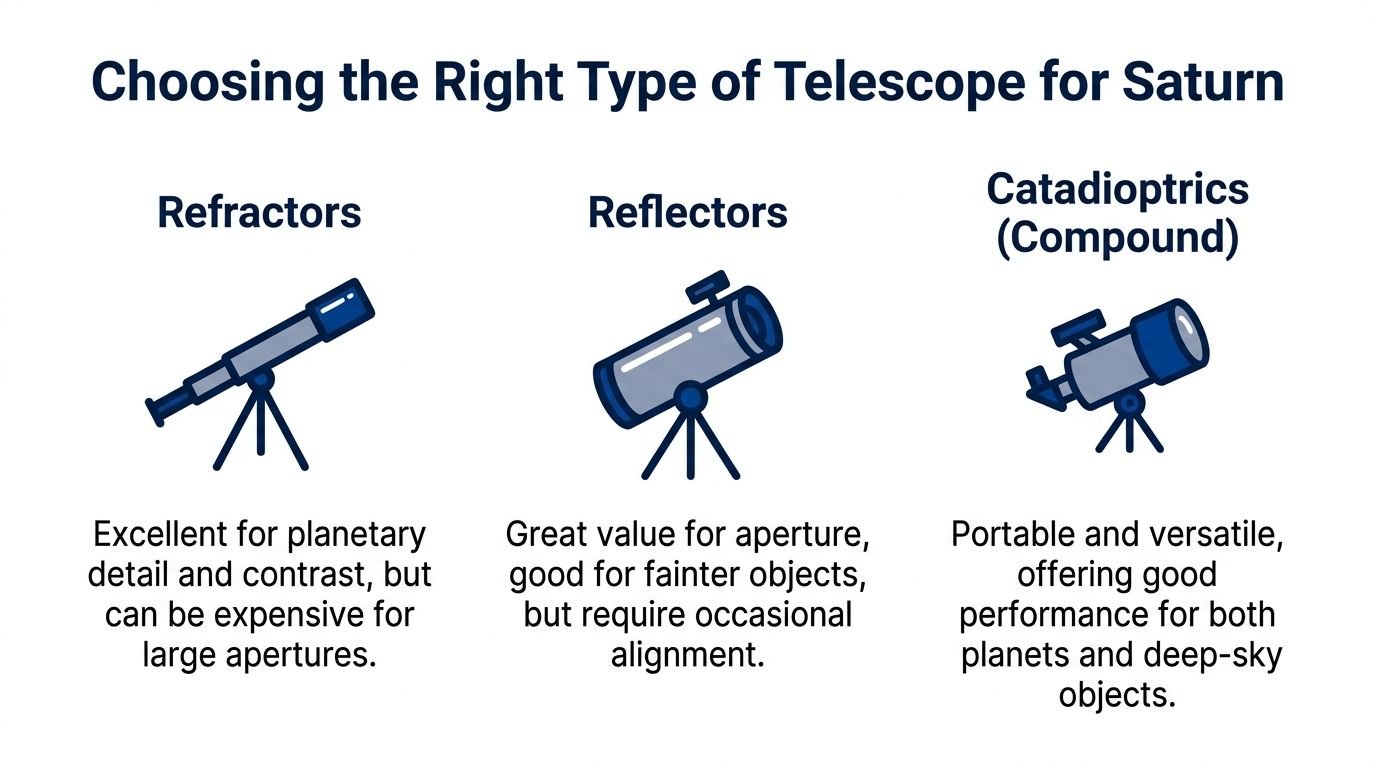
A refractor is the classic lens telescope. For Saturn, a good refractor has a lot going for it. The image often looks crisp and contrasty, setup is straightforward, and maintenance is light.
A 4-inch refractor is a lovely planetary instrument if your budget allows it. It's the kind of scope people keep for years because it's easy to use and quick to deploy. If your observing style is “grab it, carry it out, look at Saturn for half an hour,” a refractor fits that life well.
Best for:
- Ease of use: Little setup stress and no mirror alignment routine.
- Planetary contrast: Saturn often looks clean and sharp.
- Frequent short sessions: Great when you don't want a complicated night.
Reflectors for value
A reflector uses mirrors, and through this design, budget-conscious shoppers often get the best performance per dollar. A 6-inch reflector or 8-inch Dobsonian reflector can be a strong Saturn instrument because aperture goes up faster without the price climbing as steeply as with refractors.
The tradeoff is care and patience. Reflectors may need collimation, meaning mirror alignment, and they are more sensitive to temperature differences between the optics and the outdoor air. That matters a lot for planetary viewing.
The practical fork in the road looks like this:
| Telescope type | Why Saturn observers like it | Main compromise |
|---|---|---|
| Refractor | Sharp, simple, low-maintenance | Larger ones get expensive |
| Reflector | More aperture for the money | Cooling and alignment matter more |
| Compound | Compact and versatile | Usually higher cost |
If you're considering a motorized setup, this guide to auto-tracking telescopes for easier object following can help you think about convenience versus simplicity.
A lot of beginners buy a reflector because it gives them room to grow. That's a smart move, provided they're willing to learn the basics of setup and care.
Here's a useful visual explanation of telescope types in action:
Compound scopes for compact power
Catadioptric or compound telescopes, such as Schmidt-Cassegrain and Maksutov-Cassegrain designs, use both lenses and mirrors. Their big appeal is that they pack long focal lengths into short tubes.
That makes them popular with people who want a compact planetary setup that travels well. A small compound telescope can be much easier to store than a long refractor or a bulky Dobsonian. The image can be excellent, especially for lunar and planetary work.
A simple buyer guide:
- Choose a refractor if you want low fuss and you value optical neatness.
- Choose a reflector if your priority is maximum aperture for the money.
- Choose a compound scope if you want strong planetary performance in a compact package.
None of these designs is automatically “best.” The best telescope you can see Saturn with is the one you'll carry outside, set up properly, and use often.
Essential Accessories for a Better Saturn View
A telescope without the right accessories is like a good camera body with one awkward lens. It works, but it doesn't show what it can really do.
Eyepieces that make sense
For Saturn, you want a small set of eyepieces that gives you low, medium, and high power options. That matters because conditions change from night to night. One evening will support a crisp high-power view. The next will turn the same setup soft and shaky.
A practical kit usually includes:
- A lower-power eyepiece: Helps you find Saturn and center it easily.
- A medium-power eyepiece: Often the most comfortable starting point for observing.
- A higher-power eyepiece: Useful when the air steadies and Saturn can take more magnification.
You don't need a box full of glass on day one. You need a sensible spread.
A Barlow lens can stretch your eyepiece collection without forcing you to buy every focal length separately. It effectively multiplies the power of the eyepieces you already own. For a beginner, that's often one of the smartest accessory purchases after a decent extra eyepiece.
The accessories that help and the ones that distract
Some add-ons improve planetary observing. Others mainly create clutter.
The helpful ones are usually these:
- A stable mount or mount upgrade: Even a good optical tube feels frustrating on a shaky setup. If you're sorting through support options, this overview of telescope mount types and practical use cases is worth reading.
- A comfortable observing chair: Saturn rewards careful looking. Comfort helps you notice more.
- Simple planetary filters: Some observers like light blue or green filters for subtle contrast changes on planetary targets.
What beginners often overbuy are accessories that promise dramatic transformation. Saturn rarely works that way. Improvements tend to be incremental. A steadier view, better eye placement, a more suitable eyepiece, or less vibration often matters more than a drawer full of gadgets.
Good accessories don't change Saturn into something else. They remove the small obstacles that stop you from seeing what's already there.
That's the mindset that keeps your kit useful. Build a system, not a pile.
Pro Tips for Observing Saturn in 2026
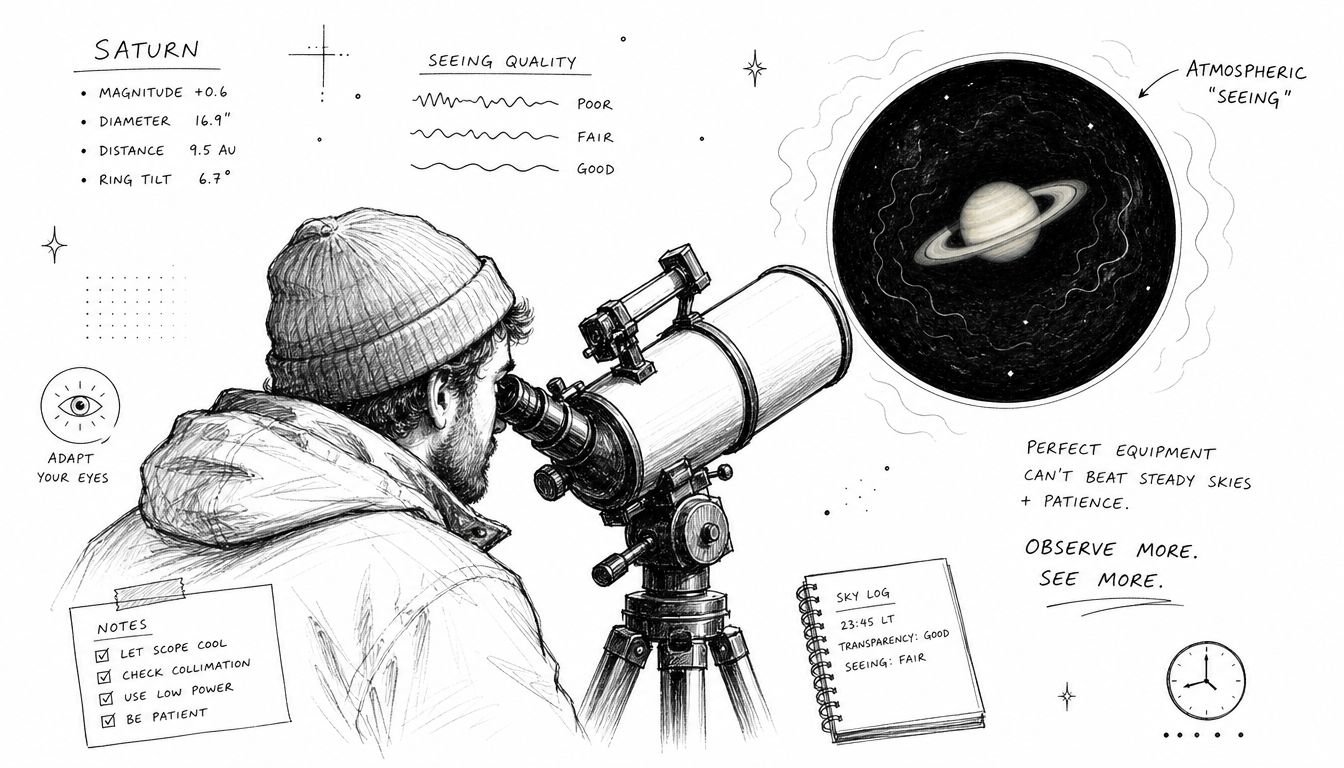
A common beginner experience goes like this. You finally get Saturn in the eyepiece, the planet looks soft, the rings seem thinner than you expected, and the first thought is that the telescope is the problem. Usually it is not. For Saturn, results depend heavily on timing, steady air, and whether the telescope has settled to the outdoor temperature.
Timing matters more than beginners expect
Saturn is strongest around opposition, when Earth sits between Saturn and the Sun. At that point, Saturn appears brighter and a bit larger, and it stays in the sky all night. Telescopic Watch's guide to observing Saturn explains why the weeks around opposition are usually the most rewarding time to look.
That matters because a modest telescope on a good night near opposition can give a cleaner, more satisfying view than a larger telescope used low in the sky or far from Saturn's best season. New observers often focus on magnification first. Experienced observers learn to watch the calendar and the planet's altitude just as closely.
For capturing images during those better windows, consider using astronomy photo stacking software for sharper planetary results.
Why 2026 advice needs updating
The big 2026 detail is the ring angle. After the 2025 ring-plane crossing, Saturn's rings are still presented at a much narrower tilt than they were in the years many older guides were written. That changes what detail is easy and what detail is demanding. AstroBackyard's discussion of Saturn's changing ring visibility notes that the Cassini Division becomes harder to pick out after the crossing, especially with smaller apertures.
This is the key expectation shift for 2026. Seeing Saturn as a ringed planet is one goal. Resolving fine structure in the rings is a harder goal.
A good analogy is reading a billboard versus reading the small print at the bottom. A small telescope can show you the billboard. The tiny lettering asks for steadier air, better optics, and often more aperture.
Get the telescope ready before you judge the view
Thermal equilibrium matters a lot, especially with reflectors. If the mirror is still warmer than the outside air, the image can ripple and blur even when the sky itself is decent. Sky at Night Magazine's advice on viewing Saturn with a telescope explains that refractors usually settle faster, while reflectors often need much longer.
That catches many beginners because the telescope may look ready long before it performs at its best.
Use a simple routine:
- Set the telescope outside early: Let the optics match the night air before serious observing.
- Check collimation on reflectors: Slight misalignment softens planetary detail quickly.
- Wait through the bad moments: Saturn often sharpens for a few seconds at a time when the air steadies.
- Observe when Saturn is higher: Looking through less atmosphere usually gives a cleaner image.
A cooled, well-collimated 6-inch reflector can show far more than the same telescope rushed into use. A smaller refractor that is ready immediately can also beat a larger scope that is still thermally unsettled.
In 2026, the best Saturn sessions come from matching your expectations to the post-2025 ring view, choosing your nights carefully, and giving the telescope time to behave like a precision instrument instead of a tube full of warm air.
Your Path to the Planets and Beyond
If you want a telescope you can see Saturn with, start simple and honest. Get enough aperture for a real first look, ignore exaggerated magnification claims, and give yourself equipment that you'll use on a steady night.
The satisfying route for most beginners is straightforward. Aim for a capable small or mid-size telescope, learn how eyepieces change the view, and pay attention to timing and cooling as much as hardware. That combination takes you from “I found Saturn” to “I can tell when the air is good enough for detail.”
Those habits carry far beyond Saturn. You learn how to judge conditions, track objects, use magnification sensibly, and read the sky with more confidence. The same skills also prepare you for other headline astronomy events, including major eclipses visible from Europe in 2026.
If you're also planning for the big sky event of the year, Total Solar Eclipse 2026 Live is a practical resource for timing, path details, city-by-city coverage, safe viewing guidance, and travel planning for the 12 August 2026 total solar eclipse in Europe.