July 11, 2026
Eclipse Solar 2018
I still remember standing with a group of sleepy observers before sunrise, all of us wearing eclipse glasses and waiting for a Sun that never fully disappeared. That was the lesson of Eclipse Solar 2018 in one scene: beautiful, memorable, and not total.
Table of Contents
- From a Year of Partial Views to a Generational Event
- A Look Back at the August 2018 Solar Eclipse
- Why 99 Percent Is Not the Same as Totality
- Three Essential Lessons from Past Eclipses
- Applying Your Knowledge to the 2026 European Eclipse
- Your Essential 2026 Eclipse Planning Toolkit
- Frequently Asked Questions From 2018 to 2026
From a Year of Partial Views to a Generational Event
A lot of people arrive at eclipse solar 2018 expecting a story about totality. That confusion is understandable. The phrase sounds like it should lead to one of those rare afternoons when the Sun vanishes, the horizon glows, and a crowd goes silent all at once. In 2018, that was not the event on offer. As EclipseWise's 2018 eclipse overview shows, the year featured partial solar eclipses and total lunar eclipses, not a total solar eclipse.
That detail matters because partial eclipses are often a person's first real lesson in how eclipse viewing works.
They teach discipline. You check the local time instead of the global headline. You learn that a low Sun can turn a good eclipse into a blocked one if a hill, building, or tree line sits in the wrong place. You test your viewing glasses before the day arrives. You also discover a harder truth that every eclipse chaser learns sooner or later. The sky does not adjust itself to match your hotel booking, your work schedule, or your cheapest flight.
A partial eclipse also teaches scale in a way books cannot. Covering much of the Sun can look dramatic on paper, yet the world around you may still feel bright and ordinary. That is the first hint of the big lesson behind this article. Partial and total eclipses belong to the same family, but they do not deliver the same experience. A rehearsal and opening night both happen on the same stage. They are still very different events.
That is why 2018 deserves attention now.
For people planning ahead for Europe in 2026, the 2018 partials work like training laps. They helped many first-time observers learn eclipse timing, viewing safety, and site selection without the pressure of chasing the Moon's shadow. The upcoming European total eclipse raises the stakes. It asks a different question. Not just, “Will the Moon cover part of the Sun where I live?” but, “Will I place myself inside the path where daylight drops away completely?”
That shift, from partial view to totality planning, is the key bridge between 2018 and 2026. Once you see 2018 clearly for what it was, the path to a smarter 2026 plan gets much easier to understand.
A Look Back at the August 2018 Solar Eclipse
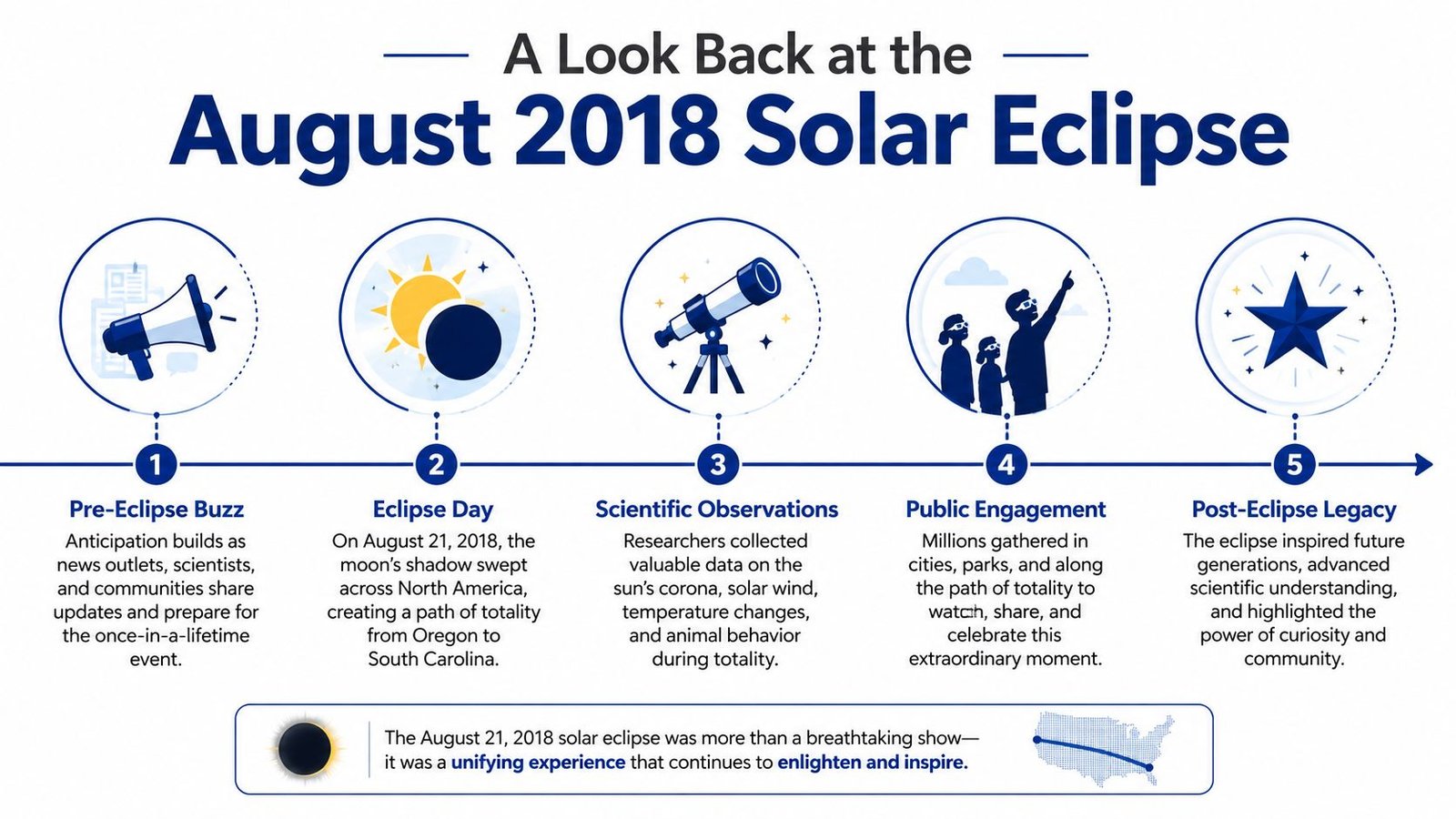
Dawn broke over parts of Europe and the North Atlantic with the Sun already missing a piece. For many first-time observers, that made August 11, 2018 feel dramatic before breakfast. It is also the event most readers mean by eclipse solar 2018, and it matters because it was a wide-reaching partial solar eclipse, as listed on Time and Date's August 11, 2018 eclipse page.
What happened on August 11
The Moon took a noticeable bite out of the Sun, reaching about 73% coverage at maximum. That sounds close to a grand finale. It was not a total eclipse anywhere on Earth.
The same source notes that the eclipse ran from 4:02:07 a.m. EDT to 7:30:42 a.m. EDT, with maximum eclipse at 5:46:24 a.m. EDT. It was visible across northern and eastern Europe, northern North America, and parts of Asia, including Canada, China, Estonia, Finland, Greenland, Iceland, Kazakhstan, Latvia, and the Faroe Islands.
One detail made this eclipse especially instructive. In some northern locations, the Sun was low in the sky near maximum. That turns eclipse watching into a practical field lesson. A perfect forecast means little if a hill, apartment block, or line of trees sits where the Sun needs to be.
A partial solar eclipse diagram helps here, because it shows why the Moon can cover a large part of the Sun while never producing the narrow path of totality people travel for.
What observers experienced
A deep partial eclipse changes the quality of daylight, but it does not replace the day. The Sun narrows into a bright crescent. Shadows can look sharper and stranger than usual. If thin cloud or haze is present, the view may seem softer, yet the Sun is still far too bright to view safely without protection.
That safety rule stayed in force for the entire August 2018 event. Since no location entered totality, eclipse glasses were required from start to finish.
Here is the simplest summary:
| Feature | August 11, 2018 partial eclipse |
|---|---|
| Eclipse type | Partial |
| Peak coverage | About 73% |
| Totality anywhere | No |
| Safe naked-eye viewing during event | No |
| Best-known viewing regions | Northern and eastern Europe, northern North America, parts of Asia |
Veteran eclipse chasers remember 2018 as a useful teacher. It showed how much can be learned from a partial eclipse. Timing matters. Horizon clearance matters. Safe viewing matters. And most of all, a dramatic partial view can still leave newcomers unprepared for what a total eclipse demands.
That is why this date still matters now. August 2018 gave many observers their first real eclipse practice, and that practice is valuable if you want to plan wisely for Europe in 2026.
Why 99 Percent Is Not the Same as Totality
Many smart, careful people make the same mistake. They see a map, notice a city just outside the path, and think near-total coverage will be close enough.
It won't.
The bright crescent problem
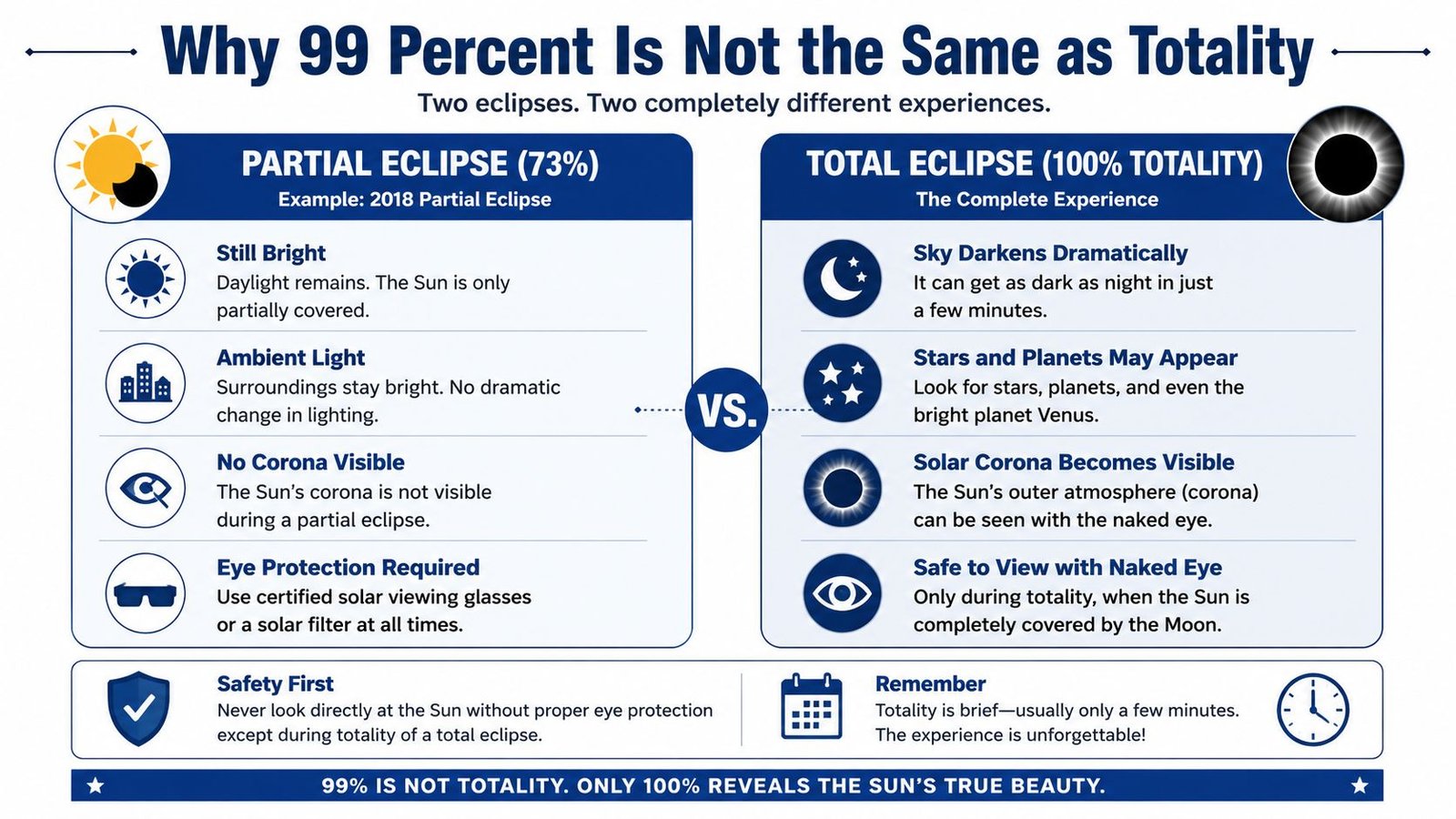
The gap between 99% and 100% isn't a small final step. It's a category change. As explained by Sky & Telescope's guide to 2018 eclipses, many viewers assume 99% coverage is nearly equivalent to totality, but the difference is profound. At 99%, the Sun is still a brilliant crescent and the corona isn't visible. Only inside the path of totality does daylight drop to moonlight levels and the Sun's outer atmosphere come into view.
If you've never seen this before, compare it to a concert hall. During a partial eclipse, the house lights are dimmed, but they're still on. During totality, someone cuts the power.
That's why maps matter so much. A city with very deep partial coverage may give you a dramatic-looking crescent Sun, but it won't give you the thing eclipse chasers travel for. If you want a visual explainer, this partial solar eclipse diagram is a useful way to see why the geometry changes everything.
A short visual can make the point more quickly than words:
What totality adds that partial phases never do
Totality changes the whole environment. The corona appears. The sky darkens dramatically. Bright planets and stars may show themselves. People who've only seen partial phases are often surprised by how sudden and complete the shift feels.
By contrast, even a very deep partial phase leaves you with a painfully bright sliver of Sun. That sliver dominates the scene. It hides the corona and keeps normal daylight from collapsing into that eerie eclipse twilight.
A quick comparison helps:
- Partial eclipse experience: You keep your eclipse glasses on the whole time. The Sun stays too bright to view directly. The main visual event is the changing shape of the solar disk.
- Total eclipse experience: During totality itself, the hidden Sun reveals the corona. The surroundings change character. The event becomes atmospheric, not just astronomical.
- Planning consequence: Don't settle for “close to the path.” Get into it.
The most expensive mistake in eclipse travel is stopping just outside totality.
This is the lesson people carry forward from years like 2018. Partial eclipses build interest. Total eclipses justify the journey.
Three Essential Lessons from Past Eclipses
The best eclipse plans are usually simple. Not easy, but simple. Choose the right place, stay flexible, and make safety routine instead of dramatic.
Lesson one, location beats convenience
If you learn only one thing from older eclipses, learn this: convenience is not the main variable. Geography is.
People often book a familiar city, a comfortable hotel, or the cheapest flight, then discover they placed themselves outside the experience they desired. That's especially common among first-time observers who've heard that near-total coverage is “basically the same.” It isn't.
Your first question shouldn't be “What's easiest?” It should be “Will I be where the eclipse I want is visible the way I want to see it?”
Lesson two, weather is part of the plan
Clouds decide more eclipse stories than telescopes do. Strong planners respect that early.
Research highlighted by Eos on eclipse-driven cloud changes shows that low-level cumulus clouds can decrease by more than a factor of 4 during an eclipse because of rapid land surface cooling. That's fascinating, and it can affect local conditions, but it's not a substitute for smart planning. You still need a weather strategy, a vehicle if possible, and enough time margin to move.
Some eclipse photographers also prepare for the possibility that the view will be marginal rather than perfect. If you're thinking ahead about image capture, this guide to astronomy photo stacking software can help you understand how people handle difficult light and changing conditions after the event.
Here's a weather-minded checklist I'd give any newcomer:
- Build mobility into the day: If your route allows it, avoid plans that lock you into one viewpoint.
- Favor options over certainty: A refundable room in a useful region often beats a beautiful room in the wrong one.
- Scout the sky, not just the map: Local haze, marine layers, and horizon clutter matter.
Lesson three, gear decisions should be boring
You don't want to solve safety on eclipse morning. You want safety to be settled long before that.
That means having your eclipse glasses ready, checking filters for cameras and binoculars, and practicing with any equipment you'll use. The best eclipse kit is the one you already know how to operate without fumbling.
Bring less gear than your ambition suggests, and test every piece before travel.
A calm observer with basic, reliable equipment usually has a better day than an overloaded observer wrestling with new accessories. Past eclipses keep teaching the same thing. The dramatic part should happen in the sky, not in your backpack.
Applying Your Knowledge to the 2026 European Eclipse
A lot of people first learn eclipse habits during partial events. Then a total eclipse arrives and exposes every weak assumption at once. The 2026 European eclipse will do that for anyone who treats it like a regular sunset outing instead of a carefully chosen observing window.
The big lesson from the 2018 partial eclipses is simple. Near enough is not good enough. In 2026, that applies to both your position on the map and your view of the horizon.
Spain demands a site check, not just a hotel booking
Northern Spain will draw huge interest, and for good reason. Several well-known cities lie in or near the path of totality, while other famous Spanish destinations sit outside it. That creates an easy beginner mistake. People book the city they know, then discover later that they are close to the eclipse, not inside the part that matters.
Spain adds a second layer of difficulty. The Sun will be low in the west late in the day, so your eclipse site needs the kind of horizon you would want for a clean sunset. A rooftop with charm, a historic square, or a hillside restaurant can still fail if buildings, ridges, or summer haze block the final approach to totality.
Treat Spain like a horizon problem first and a travel problem second.
- Choose a site with a clear western view: Open coastlines, broad plains, and uncluttered overlooks usually beat beautiful enclosed spaces.
- Check the Sun angle at the actual eclipse time: A spot that feels open at noon can be useless late in the afternoon.
- Test the location if you can: Stand there the day before at the same hour and look west. That one habit prevents a surprising number of bad choices.
If you want a feel for how quickly eclipse light changes near the end of the partial phase, this solar eclipse time-lapse example helps set expectations for pacing and setup.
Iceland favors observers who can adapt
Iceland offers almost the opposite experience. The scenery is unforgettable, but the planning mindset has to stay loose. Spain often rewards careful site selection ahead of time. Iceland often rewards travelers who can change course the same day.
That should sound familiar to anyone who watched a partial eclipse through moving cloud in 2018. You learn patience. You learn not to panic when one spot fails. You learn that a workable backup can matter more than a perfect first choice.
For Iceland, mobility is part of the observing plan.
How to decide which trip fits you
Ask a practical question, not a romantic one. Which mistake are you better at avoiding?
| Planning style | Better fit |
|---|---|
| You want stronger road access and more urban base options | Spain |
| You are comfortable adjusting to weather and changing locations | Iceland |
| You care most about protecting a low western view near sunset | Spain |
| You prefer a field-observer approach over a fixed itinerary | Iceland |
One more feature makes 2026 unusual. The eclipse path runs east to west, which is rare enough to catch experienced observers off guard the first time they study the map. That detail does not change what you need to do on the ground, but it does reinforce the broader lesson of this article. Partial eclipses teach useful habits. Total eclipses reward precise ones.
Your Essential 2026 Eclipse Planning Toolkit
Most eclipse mistakes happen before eclipse day. People choose the wrong city, misunderstand local timing, ignore the horizon, or leave safety questions unresolved until the last week. A dedicated planning toolkit solves those mistakes before they become expensive.
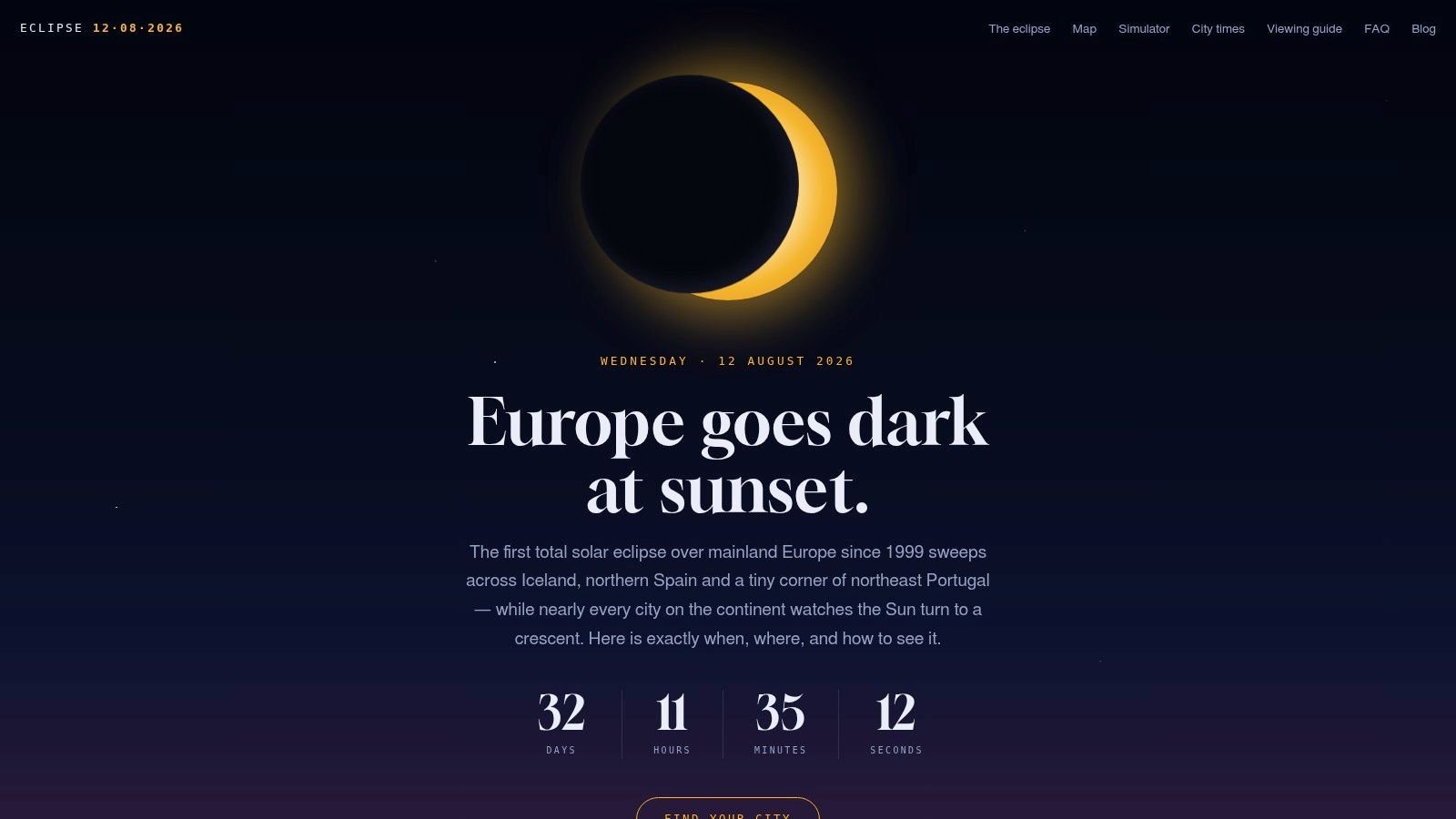
The most useful eclipse resources do three jobs well. They show where totality is, when each phase happens locally, and what conditions on the ground will affect your view. For Europe in 2026, that means city-level timing, path clarity, sunset geometry, and straightforward eye-safety guidance.
A good toolkit should help you answer questions like these without making you dig through multiple maps and forum threads:
- Am I inside totality or just near it?
- What local time does maximum eclipse happen in my city?
- Will buildings or hills block the low western Sun?
- What do I need for safe viewing during the partial phases?
If you're also thinking about how the event will look on screen rather than only in person, it helps to study examples of eclipse motion ahead of time. A well-made solar eclipse time-lapse is useful for understanding pacing, light changes, and how quickly phases can seem to move when you're in the field.
The practical value of a specialized planning resource is focus. General travel sites can book the trip. General astronomy pages can explain the science. But eclipse planning sits in the overlap. You need a place that treats timing, geography, and observing conditions as one problem.
That's especially true for a European event with both broad public interest and location-specific challenges. In Spain, horizon selection is central. In Iceland, flexibility is. In either case, a tool that translates eclipse geometry into local decisions is worth far more than one that just tells you an eclipse is happening.
Frequently Asked Questions From 2018 to 2026
A lot of eclipse confusion starts with a simple label. People remember hearing about an "eclipse" in 2018, then assume it must have been a total one. That is how many first-time observers get tripped up.
Was there a total solar eclipse in 2018
No. The solar eclipse on August 11, 2018 was a partial eclipse, not a total eclipse, as shown in NASA's SVS explanation of eclipse types.
That distinction matters more than it sounds. A partial eclipse is the Moon taking a bite out of the Sun. A total eclipse is the Sun's bright face disappearing completely, which changes the sky, the light, and the whole atmosphere around you.
Why do people keep talking about 2026 as a major European event
Because 2026 gives Europe something many observers have been waiting years for. The last total solar eclipse visible from mainland Europe was in 1999, and the same NASA reference helps explain why that makes 2026 feel so important.
For younger skywatchers, 2018 may have been an interesting event to notice. For 2026, many people will be planning trips, checking weather patterns, and choosing exact viewing spots because totality is a different class of experience.
If I'm near the path, is that good enough
It is good enough for a partial eclipse. It is not good enough if your goal is totality.
This is the lesson many people learn only once. Being close to the path of totality works like standing outside a concert hall and hearing muffled music through the wall. You are nearby, but you are not in the event itself. If you want the sky to darken and the solar corona to appear, you need to be inside the path.
What should I care about most in Spain
In many Spanish locations, the western horizon deserves serious attention.
The 2026 eclipse happens late in the day for much of Spain, so hills, apartment blocks, hotel roofs, and even a line of trees can spoil an otherwise excellent plan. A city can be inside totality on paper and still give you a poor real-world view if the low Sun drops behind an obstacle.
Sample 2026 European City Eclipse View
| City | In Path of Totality? | Maximum Coverage | Experience |
|---|---|---|---|
| A Coruña | Yes | Total | Strong choice if your site has a clear western horizon |
| Bilbao | Yes | Total | Good access, but site selection still matters |
| Zaragoza | Yes | Total | Promising option inside the path |
| Valencia | Yes | Total | Late-day Sun makes horizon checks important |
| Palma | Yes | Total | Attractive if your viewing direction stays open |
| Madrid | No | Partial | Good for public viewing, but not totality |
| Barcelona | No | Partial | Convenient, yet outside the total path |
The lesson from eclipse solar 2018 is not that partial eclipses are disappointing. They are beautiful and worth watching safely. The lesson is that partial and total eclipses should be planned for in completely different ways.
If you're preparing for August 12, 2026, Total Solar Eclipse 2026 Live is a practical place to start. It brings together city-by-city timing, path details across Spain and Iceland, safety guidance, and planning tools that help you choose a location that gives you the eclipse you want to see.