July 27, 2026
Cygnus Swan Constellation: Find the Northern Cross
On a warm late-summer night, you step outside expecting a few bright stars and instead find a giant, glowing cross laid over the Milky Way. That's Cygnus, the Swan Constellation, and the first time you spot it, it tends to feel less like “finding a constellation” and more like discovering a whole region of sky you didn't know was there. If you're out with binoculars, even a modest pair will start to show why this part of the sky keeps experienced observers coming back all season.
Table of Contents
- Meeting the Swan in the Summer Sky
- How to Find Cygnus Using the Summer Triangle
- The Major Stars That Form the Northern Cross
- Mythology and Cultural Stories Behind the Swan
- Deep-Sky Treasures Hidden in the Milky Way
- Astrophotography Tips for Capturing Cygnus
- Quick Reference for Planning Your Cygnus Session
Meeting the Swan in the Summer Sky

You're standing in a field after sunset, and the sky is dark enough that the Milky Way starts to look like a pale cloud band overhead. Then the pattern clicks into place, a long cross of stars, bright enough to notice at a glance, stretched right along that cloudy river of light. That's Cygnus, one of the easiest large constellations to recognize once you know where to look.
Cygnus is a major northern constellation, ranked 16th by area among the 88 modern constellations and covering 804 square degrees of sky (The Planets). Those numbers matter because they explain why it doesn't feel cramped or subtle. It's big, bold, and easy to trace with your eyes on a clear night, especially when the Milky Way is strong.
Why the Swan stands out
Cygnus lies along the plane of the Milky Way, which is exactly why it looks so rich in binoculars and small telescopes (The Planets). That background is packed with star fields, clusters, nebulae, and double stars, so the constellation feels like a gateway rather than a single shape.
Observers also know it by the Northern Cross, a five-star pattern that sits in the heart of the swan form (The Planets). It's one of those sky patterns that teaches you to see structure, not just individual points of light.
Practical rule: if the Milky Way is obvious overhead, Cygnus is usually worth checking next.
Cygnus is visible from about +90° to −40° latitude, which makes it a familiar sight for much of the Northern Hemisphere and a seasonal target farther south (The Planets, Go Astronomy). For northern observers, it first appears in the northeastern sky in late May, culminates in mid-August, and sinks below the northwestern horizon in December (Britannica). That timing is why it feels like a late-summer friend, one that shows up just as the evenings get comfortable.
How to Find Cygnus Using the Summer Triangle
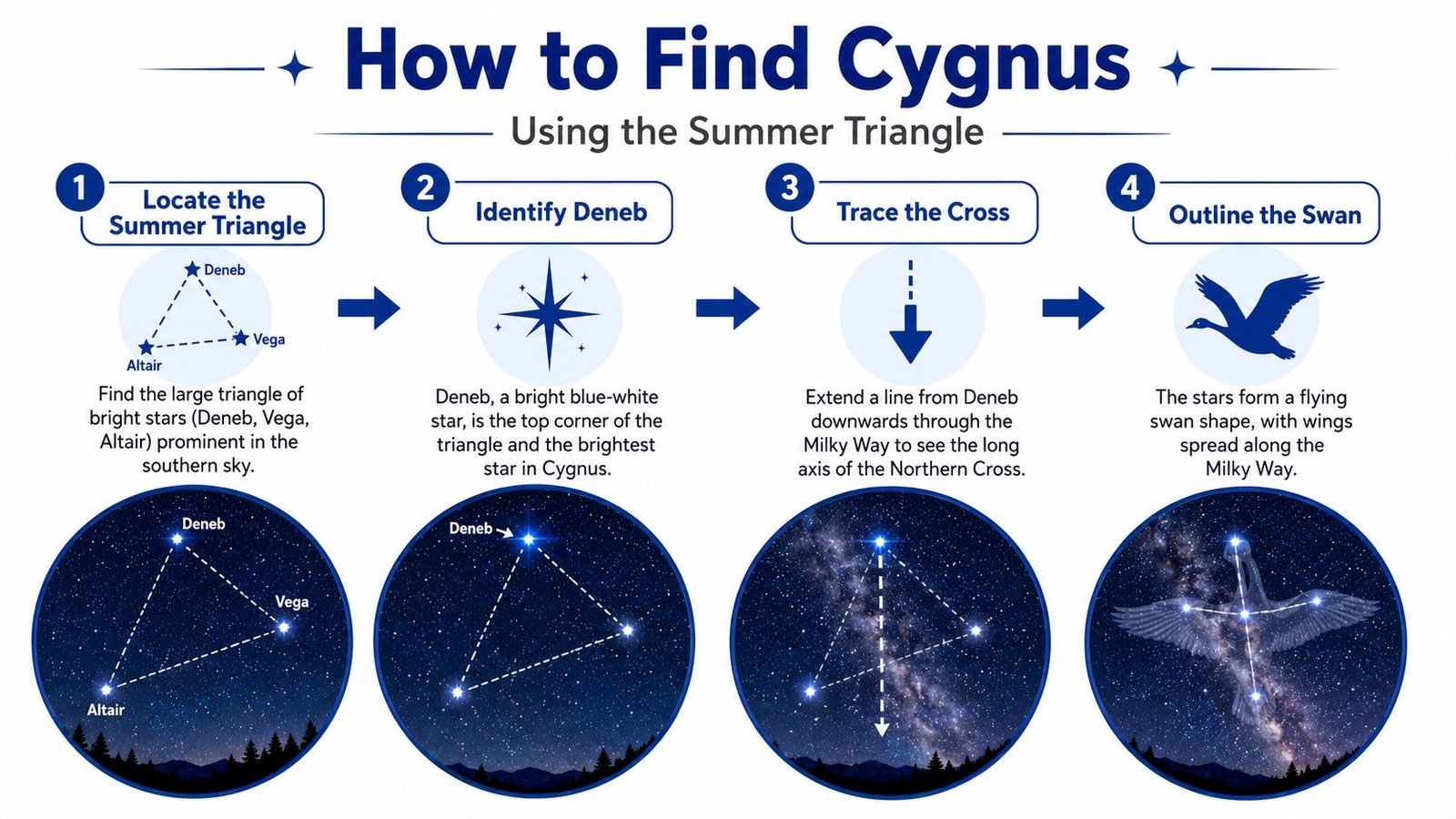
The easiest way to find Cygnus is to start with the Summer Triangle, because it gives you three bright anchors to work from. One of those anchors is Deneb, and Deneb is the star that marks the tail of the swan. If you know the triangle, you're already halfway to the Northern Cross.
Start with the brightest corner you can spot
Look for Vega first. It's the brightest of the triangle's three stars and a very easy evening landmark in summer skies. From Vega, move your eyes toward Deneb, then continue across the star field that stretches through the Milky Way toward the rest of Cygnus.
Deneb is one corner of the Summer Triangle alongside Vega in Lyra and Altair in Aquila (Wikipedia)). In practice, that means the triangle gives you a map, not just a shape. Once you identify Deneb, the long line of the Northern Cross becomes much easier to trace.
Trace the cross, then recognize the swan
A helpful mental picture is to start at Deneb and follow the bright stars downward through the Milky Way. That long axis points into the cross-shaped core of Cygnus, and once you see that shape, the swan outline starts to make sense. The geometry is especially useful because the constellation sits against a dense Milky Way background, which gives you contrast for star-hopping (Wikipedia).
For timing, northern observers usually get the earliest useful view in late May, the highest placement around mid-August, and a final descent in December (Britannica). Many skywatchers find the constellation especially satisfying in summer and early autumn, when it rides higher and looks cleaner against the dark sky (Space.com).
Follow Deneb from the Summer Triangle first. If you can place Deneb confidently, the rest of Cygnus is much easier than it looks.
If you want a quick visual check, compare the star field to the nearby Lyra region and the Summer Triangle neighborhood, where the Milky Way is prominent enough to guide your eye (Wikipedia). That's why this constellation becomes a favorite for beginner stargazers. It rewards a simple, repeatable method.
If you like following bright star patterns with a clear guide, you may also enjoy this collection of stars in Lyra, since Lyra sits right next to the route into Cygnus.
The Major Stars That Form the Northern Cross
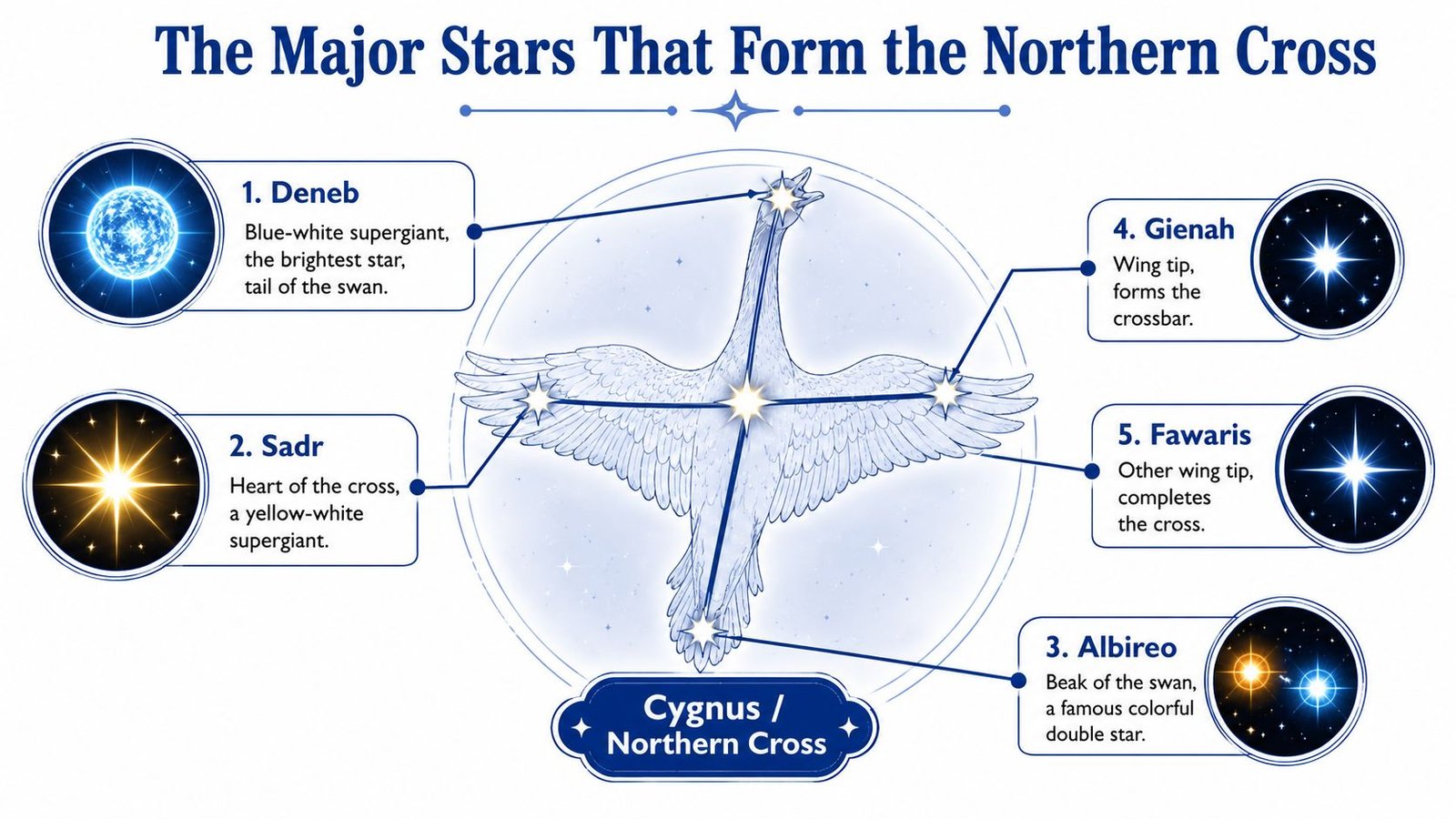
Cygnus becomes much easier to remember once you stop thinking of it as a single shape and start seeing its key stars as individual observing targets. The Northern Cross is made from five primary stars, and each one has a different personality at the eyepiece. That's what makes this part of the sky so satisfying, even if you're just scanning with binoculars.
The bright backbone of the cross
Deneb is the star that observers notice first. It's the brightest star in Cygnus and one of the corners of the Summer Triangle, so it does a lot of the work in both identification and orientation (Wikipedia). To the naked eye, Deneb is a steady, blue-white beacon. Through binoculars, it remains a clean bright point, which is part of its appeal, because it anchors the whole cross without being complicated.
Sadr, also called Gamma Cygni, sits near the center of the cross and lies in a rich star field (Wikipedia). Naked-eye viewing shows it as a bright knot in the middle of the pattern. Binoculars reveal more surrounding stars, and that crowded field is one reason the cross feels embedded in the Milky Way rather than floating separately from it.
The stars that make the shape memorable
Albireo is the one many observers remember best. It's the famous double star at the swan's head, and even small telescopes show its celebrated color contrast. Through the naked eye, it's just a modest star at the end of the figure. In a telescope, it becomes a true showpiece.
Gienah and Fawaris complete the crossbar and wing structure. Gienah is the wing star, with a name tied to the idea of a wing, and it gives the swan its stretched-out look (Crystal Vaults). Fawaris helps finish the other side of the cross, giving Cygnus that unmistakable flying shape.
| Star | Naked-eye view | Binocular or telescope view |
|---|---|---|
| Deneb | Bright blue-white anchor | Clean bright point, excellent reference star |
| Sadr | Central bright knot | Dense surrounding star field |
| Albireo | Moderate star at the head | Beautiful double star in a telescope |
| Gienah | Wing star in the crossbar | Strong shape marker in the Milky Way field |
| Fawaris | Opposite wing star | Completes the cross form |
For a quick observing rule, think of Deneb as the guide, Sadr as the center, and Albireo as the prize at the end. That simple three-star sequence gets most beginners to the heart of Cygnus fast, then the wing stars fill in the geometry around it.
Mythology and Cultural Stories Behind the Swan
The Greek story gives Cygnus a dramatic origin. Zeus, according to the myth, took the form of a swan to approach Leda, and the story became tied to the births of Helen of Troy and the twins Castor and Pollux. That tale gave the constellation a living character, which is why the swan image stuck so well in Western sky lore.
One sky, many stories
The name Cygnus comes from Latin for swan, and that became the standard label used in astronomy. But the stars themselves invited different readings depending on who was looking up. Some traditions saw a bird in flight, others saw a cross, and many cultures built their own stories around the same bright pattern.
That flexibility is part of the constellation's power. A cross is easy to sketch, a swan is easy to imagine, and both versions help people remember the same patch of sky. The shape changes with your cultural lens, but the stars stay where they are.
Why the nickname stuck
The Northern Cross nickname became especially useful because it describes the most obvious shape in practical observing terms. You don't need to know mythology to find it. You just need to notice the cross-like arrangement sitting in the Milky Way, then build from there.
Constellation names survive because they solve two problems at once, they help people remember the sky and give the sky a story.
That's why Cygnus feels so welcoming to beginners. It offers a myth, a shape, and a route into deeper observing all at once. If you're standing under a summer sky with no guide except your own eyes, that combination is hard to beat.
Deep-Sky Treasures Hidden in the Milky Way
Cygnus is where the fun really starts for observers who want more than bright stars. The constellation's position on the Milky Way makes it one of the best places to learn how skywatching changes as you move from naked-eye viewing to binoculars and then to a telescope. A good first pass is to treat it like a treasure map.
Start with the easiest targets first
The North America Nebula is one of the classic wide-field targets, and it can sometimes be glimpsed as a faint glow under dark skies. Its catalog name is NGC 7000, and it sits close enough to Cygnus's bright star fields to make it a rewarding binocular object when the sky is clean. The Pelican Nebula (IC 5070) pairs well with it in wide-field views, which makes the whole area feel bigger than a single object.
For a broader understanding of nebula scale and appearance, this overview of how big nebulae are helps frame why some objects respond better to wide-field optics than high magnification.
Move up to telescopic showpieces
The Veil Nebula is one of the most memorable Cygnus targets. Its components, NGC 6960 and NGC 6992, show delicate filamentary structure in a telescope, especially under dark skies. The best view usually comes from lower magnification rather than pushing the power too high, because the object is large and spread out.
The Dumbbell Nebula (M27) is different. It's a planetary nebula and one of the brighter nebulae in the sky, so it becomes a satisfying telescope target even when the background sky isn't perfect. Larger apertures begin to hint at color, which makes it feel very different from the more diffuse emission nebulae in the same constellation.
| Object Name | Type | Magnitude | Best Equipment |
|---|---|---|---|
| North America Nebula (NGC 7000) | Emission nebula | Not provided in verified data | Naked eye under dark skies, binoculars |
| Pelican Nebula (IC 5070) | Emission nebula | Not provided in verified data | Wide-field binoculars, small telescope |
| Veil Nebula (NGC 6960, NGC 6992) | Supernova remnant | Not provided in verified data | Telescope |
| Dumbbell Nebula (M27) | Planetary nebula | Not provided in verified data | Telescope, larger aperture for color |
For nebulae in Cygnus, the observing trick is simple. Use wide fields for the big glowing complexes, then reduce your expectations about brightness and let your eyes adapt. That approach is far more effective than chasing a “perfect” magnification.
Practical rule: if an object spans a large piece of sky, start wide and only increase power after the shape is obvious.
Cygnus works so well because it gives you both kinds of targets, sweeping emission nebulae and compact telescope objects. Once you've seen the star field, the deeper structures stop feeling random and start feeling connected.
Astrophotography Tips for Capturing Cygnus
Cygnus is a great constellation for photographers because it works at two levels. You can shoot the whole Milky Way region as a wide field, or you can isolate individual nebulae and build a more technical image around them. Either way, the constellation rewards patience and careful framing.
Wide-field shots that show the whole swan
For a first attempt, frame the Northern Cross against the star clouds of the Milky Way. A wide lens helps keep the whole pattern in view, and short exposures reduce star trailing while still collecting enough light to show the surrounding dust and star fields. The key is balance, enough exposure to reveal faint structure, not so much that the stars blur into streaks.
Cygnus is especially friendly to northern observers because it rides high enough to get above some of the worst low-altitude haze in many locations. That doesn't solve light pollution, but it does help. When the constellation is higher, the sky path is shorter and the contrast tends to improve.
Targeted imaging for nebulae
For emission nebulae like the North America Nebula or the Veil Nebula, tracked imaging makes a big difference. A tracking mount lets you use longer exposures and a longer focal length, which matters when you want to separate faint detail from the background sky. Narrowband filters are especially useful on emission targets, because they help isolate the hydrogen-rich structures that define these nebulae.
Post-processing matters too. Bring out the red hydrogen-alpha signal carefully, then protect the natural star colors so the image doesn't turn artificial. Many beginners push the nebula too hard and lose the surrounding context, which is exactly the part that makes Cygnus feel so rich.
If you're stacking multiple frames, this guide to astronomy photo stacking software is useful for building cleaner images from short sub-exposures.
A few simple habits make the difference:
- Use short test runs: Check star shapes early, then adjust before collecting a full session.
- Keep the field wide for the swan: The constellation's structure is easier to appreciate when the frame includes the surrounding Milky Way.
- Use filters selectively: Narrowband works well on emission nebulae, but it's not the right tool for every Cygnus subject.
- Protect color in processing: Don't crush the star fields while stretching faint nebulosity.
Quick Reference for Planning Your Cygnus Session
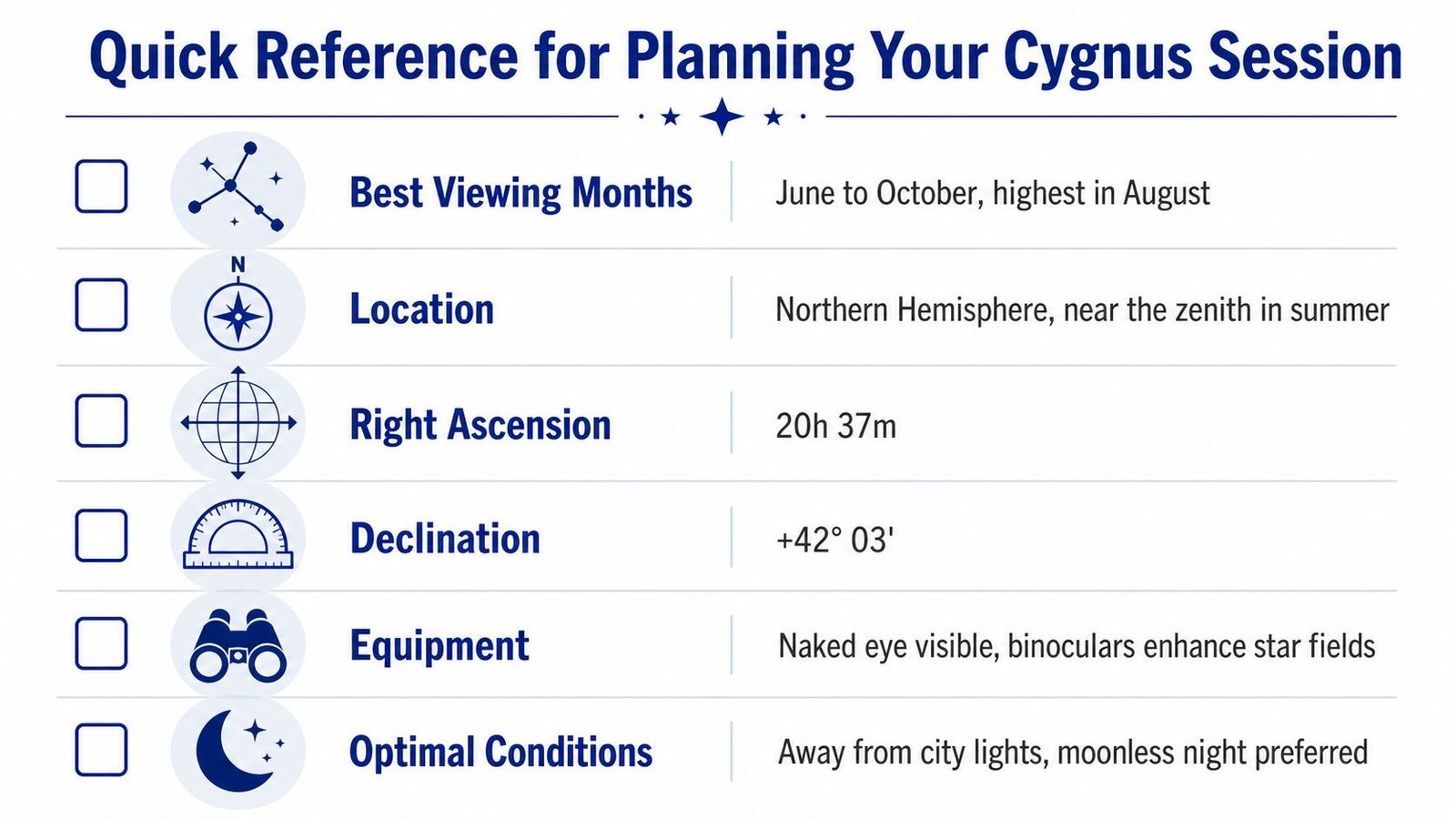
Cygnus is easiest to plan for in the months when it climbs high and stays clear of horizon haze. For northern observers, it's a summer constellation that first appears in late spring, gets best in late summer, and remains useful into early winter (Britannica, Space.com). The whole constellation is visible from about +90° to −40° latitude, and one guide places full visibility roughly from 28° S to 90° N (The Planets, Go Astronomy).
Quick session notes
- Best viewing months: late spring through early winter, with the strongest placement in summer.
- Location: best from the Northern Hemisphere.
- Right Ascension: 20h 37m.
- Declination: +42° 03'.
- Equipment: naked eye for the cross, binoculars for the star fields, telescope for Albireo and the nebulae.
- Best conditions: dark, moonless skies away from city lights.
Top targets
- Deneb, easy. Bright anchor for finding the constellation.
- Albireo, easy to moderate. A classic double star in a telescope.
- North America Nebula, moderate. Best in dark skies and wide fields.
- Veil Nebula, moderate to hard. Better with a telescope and patient scanning.
- Dumbbell Nebula, moderate. Bright enough to reward even modest apertures.
If you want to turn a late-summer evening into a real observing session, bring binoculars, a star map, and a little time to let your eyes adjust. For eclipse chasers, skywatchers, and travelers planning astronomy nights in Europe, Total Solar Eclipse 2026 Live also offers practical celestial planning tools that fit the same habit of looking up with purpose.